Space

GEOST sensors to detect interference will fly on SDA satellites

The company also is providing a ground system for the sensors that could provide data about interference threats to users across the Defense Department and Intelligence Community, said Josh Hartman of GEOST's parent firm.

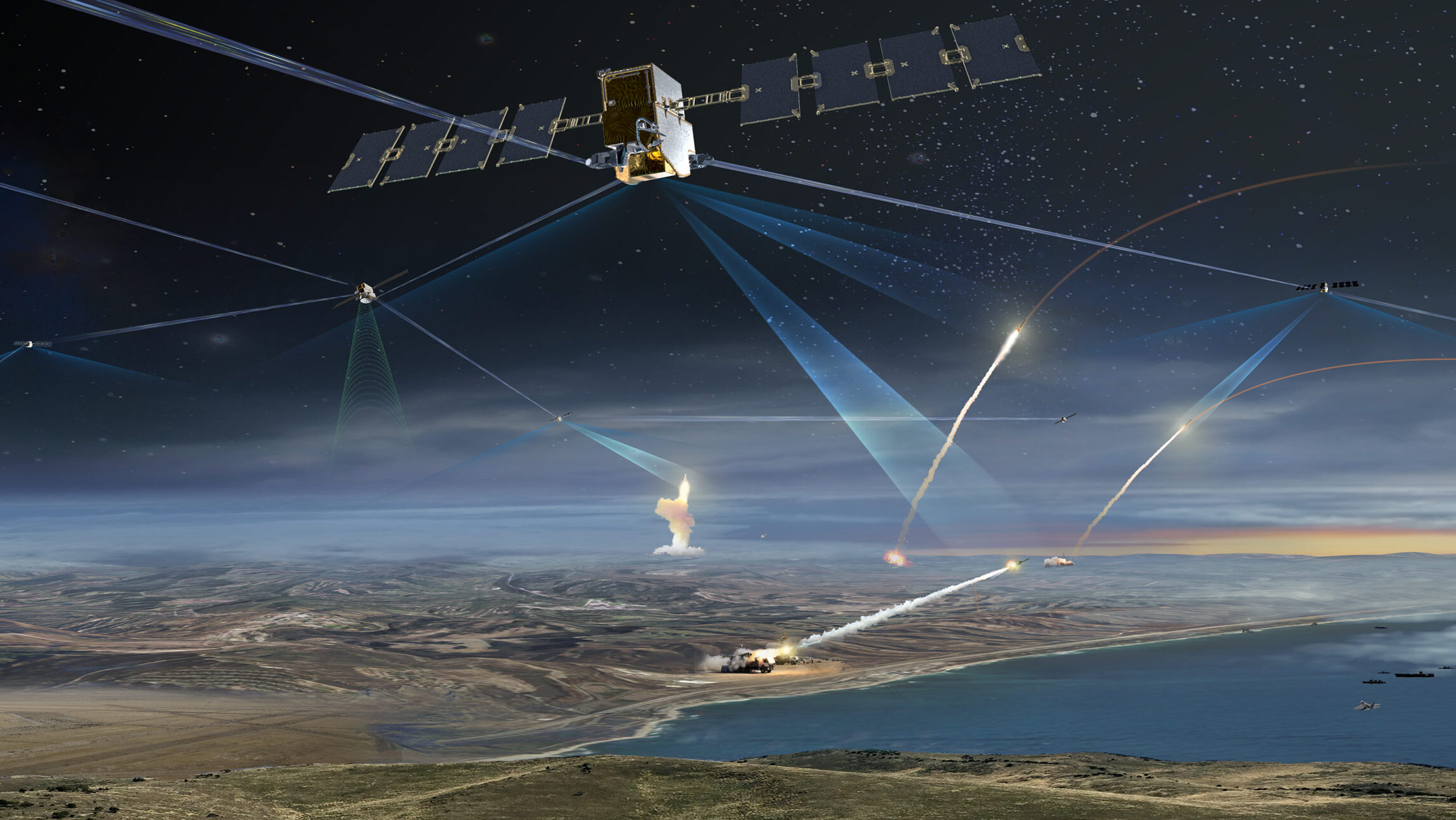
Northrop Grumman is developing satellites with infrared sensors for the Space Development Agency’s Tranche 1 Tracking Layer.
Northrop Grumman illustration of its missile tracking satellites for the Space Development Agency’s Tracking Layer.

AFA 2023 — Northrop Grumman has tapped Tuscon-based startup GEOST to provide sensor payloads to protect the missile tracking satellites the defense behemoth is building for the Space Development Agency (SDA), GEOST announced Monday.

GEOST, a LightRidge Solutions company, makes electro-optical and infrared sensors for space applications. Under the contract, the firm will supply eight tiny Starlite sensors, each about the size of a soda can, to identify ground-based sources of interference; it  will also supply an accompanying ground system. The payloads will equip some of Northrop Grumman’s satellites being built as part of SDA’s first operational Tracking Layer constellation in low Earth orbit, the release said.

In July 2022, the agency tapped L3 Harris and Northrop Grumman to each build 14 Tranche 1 Tracking Layer satellites, with L3 Harris’s award potentially worth some $700 million and Northrop Grumman’s potentially worth about $617 million. The Tranche 1 satellites are expected to launch in September 2024. The GEOST payloads will equip some of the

“GEOST’s approach to Space Protect and Defend (P&D) missions is characterized in our ‘See…Say…Act’ concept,” Josh Hartman, LightRidge Solutions chief growth and strategy officer, told Breaking Defense. “Collecting and reporting the data is not enough. Space systems must have the ability to see a threat, sound the alarm, and actuate a countermeasure with increasing autonomy and speed.”

SDA’s requirements for the Tranche 1 Tracking Layer did not originally include a sensor designed to help provide protect the satellites. However, its Sept. 6 solicitation for the follow-on Tranche 2 set of at least 54 satellites said some will be equipped a “directed energy sensor” that would be a “resiliency feature to protect against directed energy attack mechanisms” — suggesting that the data gathered could be used by Space Force operators to target the discovered sources of interference.

Hartman said he could not comment on the exact capabilities Starlite will bring, although he said the company is hopeful SDA will purchase more Starlites once they have proven themselves on Tranche 1.

As for the ground system, Hartman explained that it could be used to provide threat data gleaned by the Starlite sensors to users across the Defense Department and the Intelligence Community.

“The ground infrastructure for Starlite is planned to take in threat data from a network of heterogeneous sensors and is being designed in a modular capacity to feed the data to any Defense Department or Intelligence Community entity that has mission interest,” he said. “For example, we envision this data obviously benefiting the protection of the SDA missile warning and track architecture, but ultimately going to the NSDC [National Space Defense Center], the NSIC [National Space Intelligence Center], and others.”

PHOTOS: AFA 2023

PHOTOS: AFA 2023

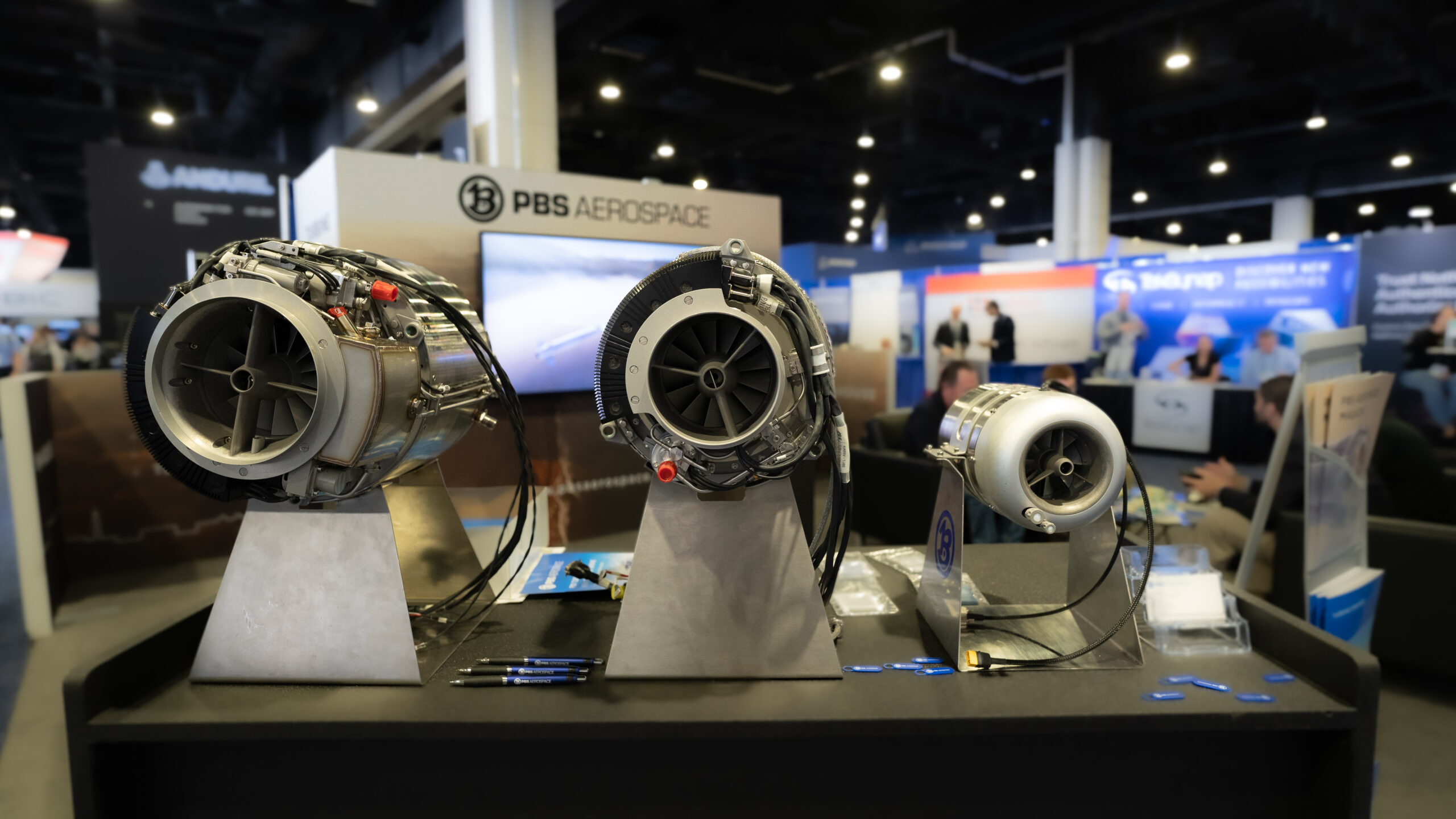
You don't see too many turbofans on unmanned aircraft systems but PBS Aerospace hopes to change that. Besides drones, they're also used for target drones, experimental aircraft, and ultralight helicopters.
Whether you fly fixed wing or rotary wing aircraft, Centex has a helment for you. Their suite of headborne protection systems manage hazardous conditions such as high-G, ejection, wind shear, noise and debris.

Elbit Systems of America wants to jam with you. That is, they. want to help you jam others with their systems that target threat radars, multiple emitters simultaneously, and surface-to-air and air-to-air missiles.

Augmented reality is going to be a boon to aircraft maintainers, in particular, and Amentum says it's perfect for reducing troubleshooting time and increasing situational awareness and collaboration. The dummy agrees.
CAE is here at AFA but their latest news came out of this week's Defence and Security Equipment International (DSEI) conference. CAE signed an MOU with Textron Aviation Defense that expands efforts to support defense force preparation, integrate next-generation aircraft. and develop advanced capabilities.
With decades of experience behind it, variants of the Aerojet Rocketdyne/L3Harris RL10 engine power the upper stages of United Launch Alliance’s Atlas V and Delta IV Heavy rockets. Two RL10 engines power the upper stage of ULA’s new Vulcan Centaur rocket, and RL10 engines also help propel NASA’s Space Launch System (SLS) rocket
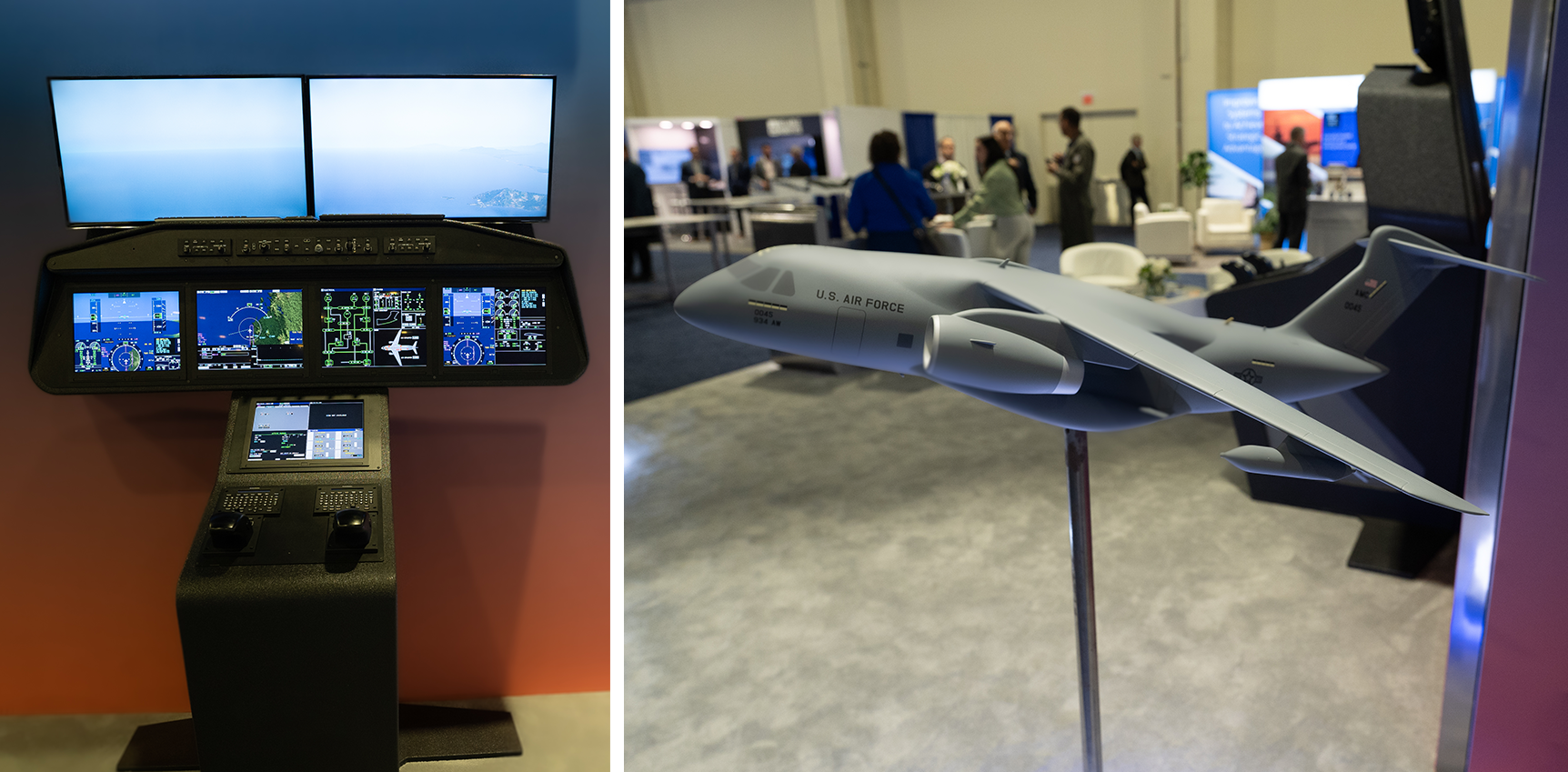
You can never have too many transport aircraft and Embraer is showing off its C-390 Millennium multi-mission transport to any US Air Force procurement execs walking the show flow. To the left are some of the C-390's cockpit controls. Embraer recently delivered the sixth C-390 multi-mission transport to the Brazilian Air Force.
Taking its visual cues from the Star Wars X-wing starfighter, the dart-like ROC-X VTOL precision strike missile from IAI is a version of the company's POINT BLANK electro-optically guided missile that is backpack carriable. Earlier this year, the DoD awarded IAI a multi-year, multi-million-dollar contract for the system. (Brendon Smith/Breaking Defense)
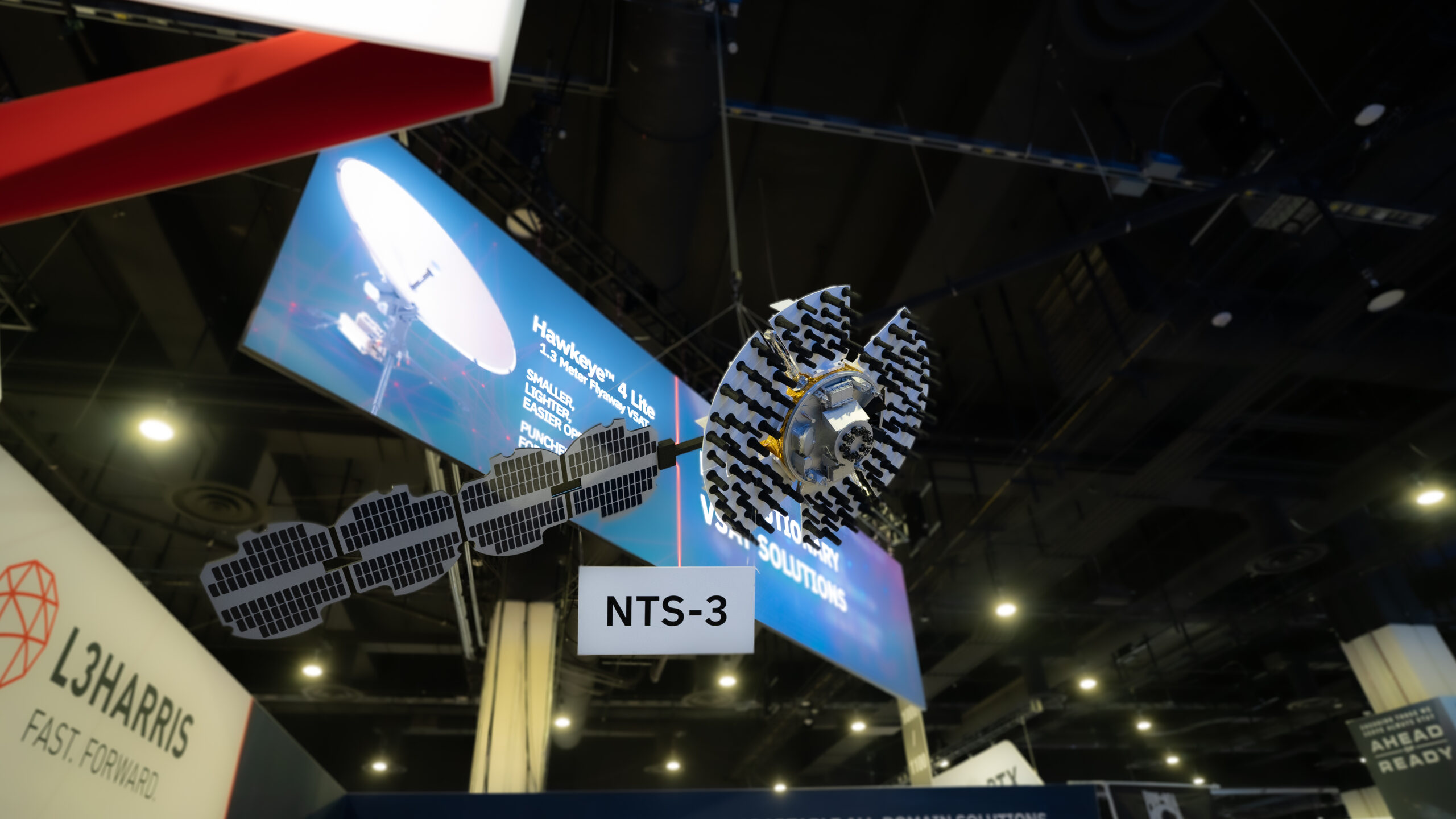
What do we want? We want uninterrupted position, navigation and timing. So says every military service. That's the purpose of the Navigation Technology Satellite – 3 Vanguard from L3 Harris. The NTS-3 is the first U.S. integrated satellite PNT experiment in almost 50 years, says the company. (Brendon Smith/Breaking Defense)
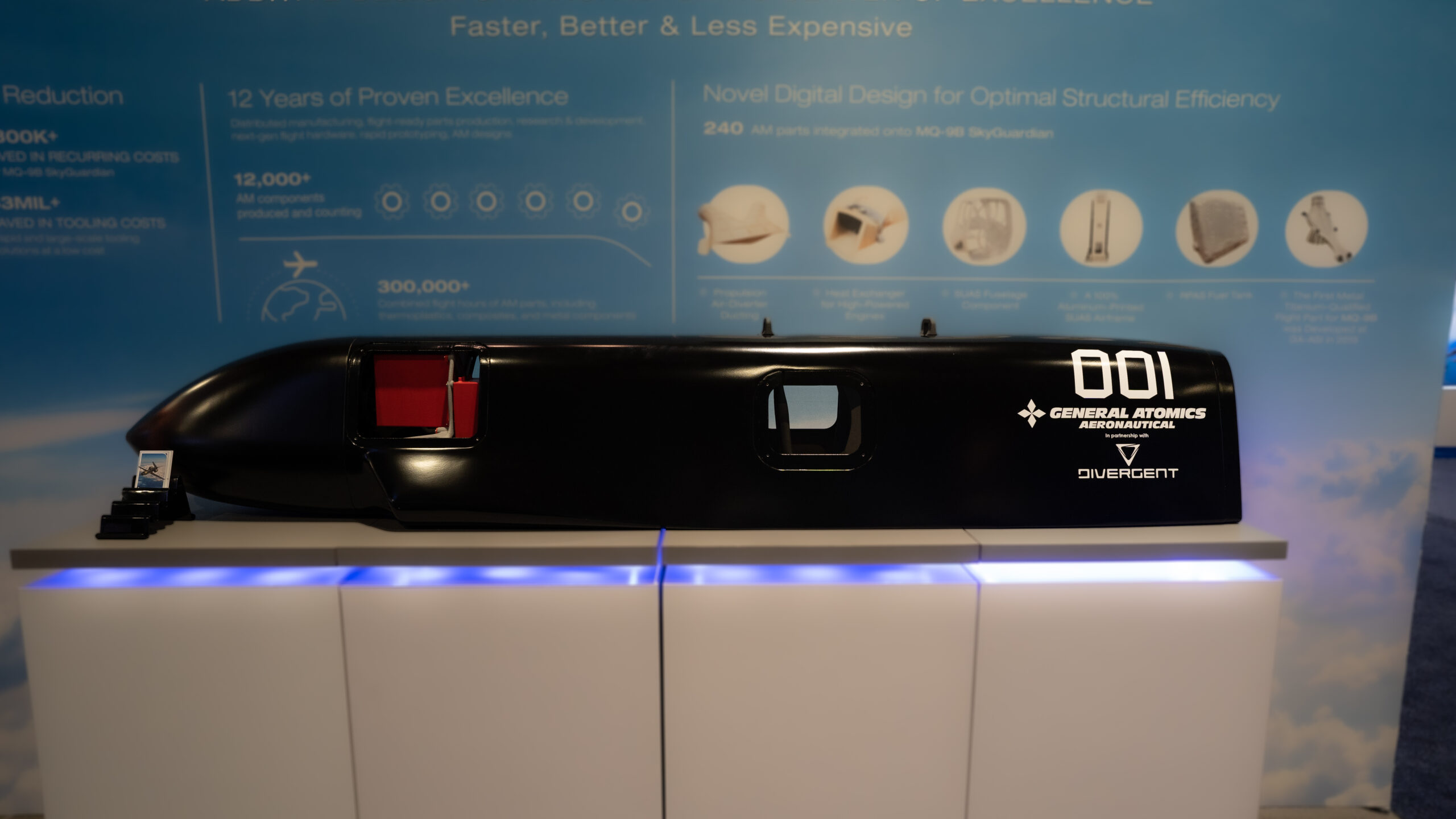
You know what would supercharge development and production of unmanned aircraft systems? That would be 3D printing. Earlier this year, General Atomics teamed with Divergent Technologies to support its additive manufacturing applications development efforts and implement a full digital manufacturing process for GA-ASI’s products. We all have the pleasure of seeing one of their early efforts here on the show floor. (Brendon Smith/Breaking Defense)
Red 6 envisions a future where warfighters across all domains are connected in a joint, augmented battlespace. The company is working to make that happen through its augmented-reality training helmet. (Brendon Smith/Breaking Defense)
The Kratos XQ-58A Valkyrie is not necessarily new but what it did recently was news. As part of a three-hour sortie in July, the Air Force Research Laboratory demonstrated for the first time a machine-learning trained, AI algorithms on an XQ-58A Valkyrie. (Brendon Smith/Breaking Defense)
It's both an advanced trainer and now also a light-combat aircraft. The M-346 trainer on the Leonardo booth, which also includes wares from its DRS company in the US, is also flying in a "Fighter Attack" version. (Brendon Smith/Breaking Defense)
Airmen all in a row. Given that they're at the FlightSafety booth, their virtual reality goggles are displaying training like emergency procedures, cockpit familiarization, and traffic pattern operations.
In his AFA 2023 keynote address, Air Force Secretary Frank Kendall talked about his plans to "optimize" how the service works. He recently released a memo mentioning broad plans to reorganize the Air Force. Details to come.
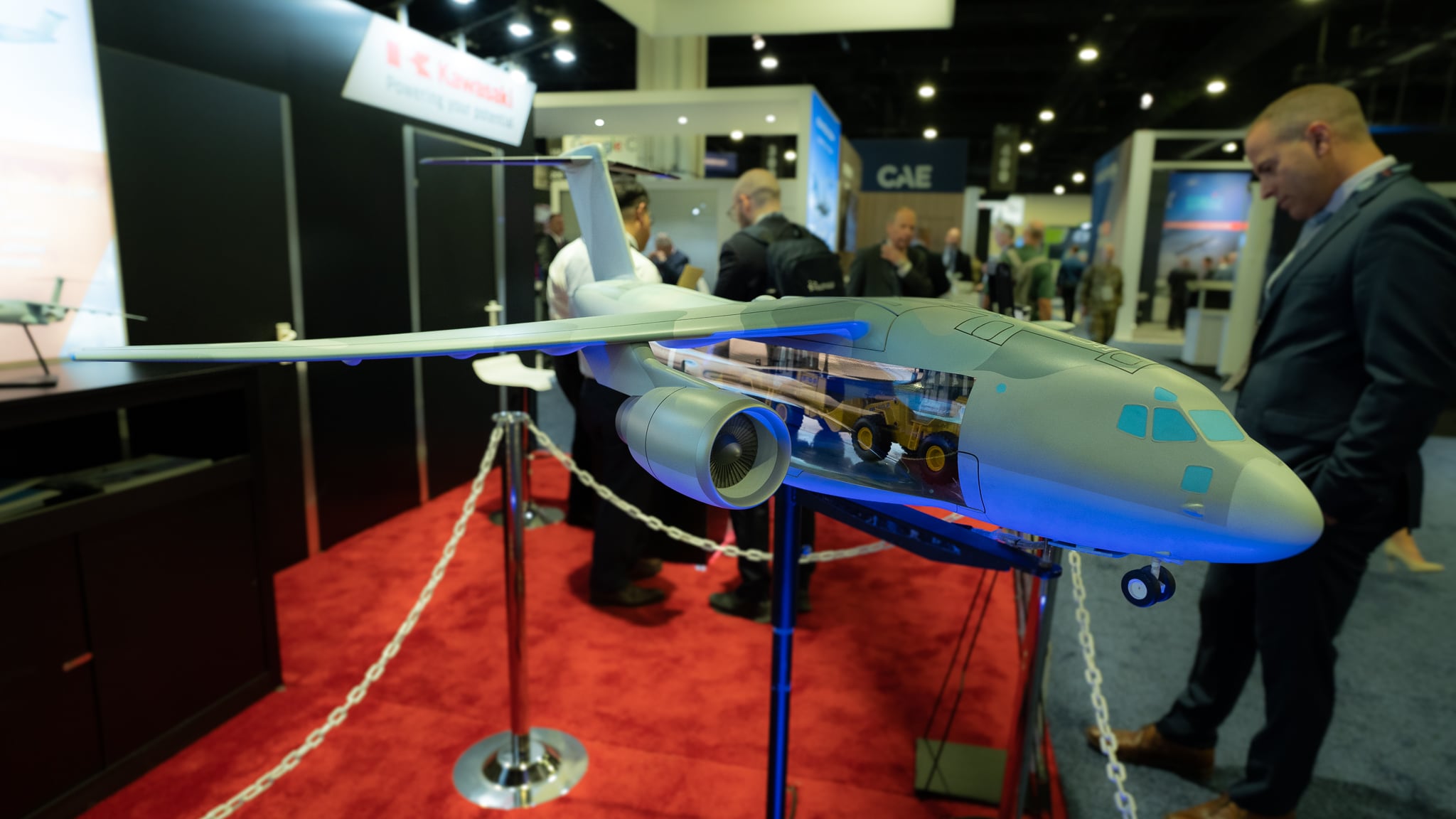
Kawasaki is here at AFA but not on two wheels. The C-2 transport model displayed a neat cut-out showing off its cargo capacity.
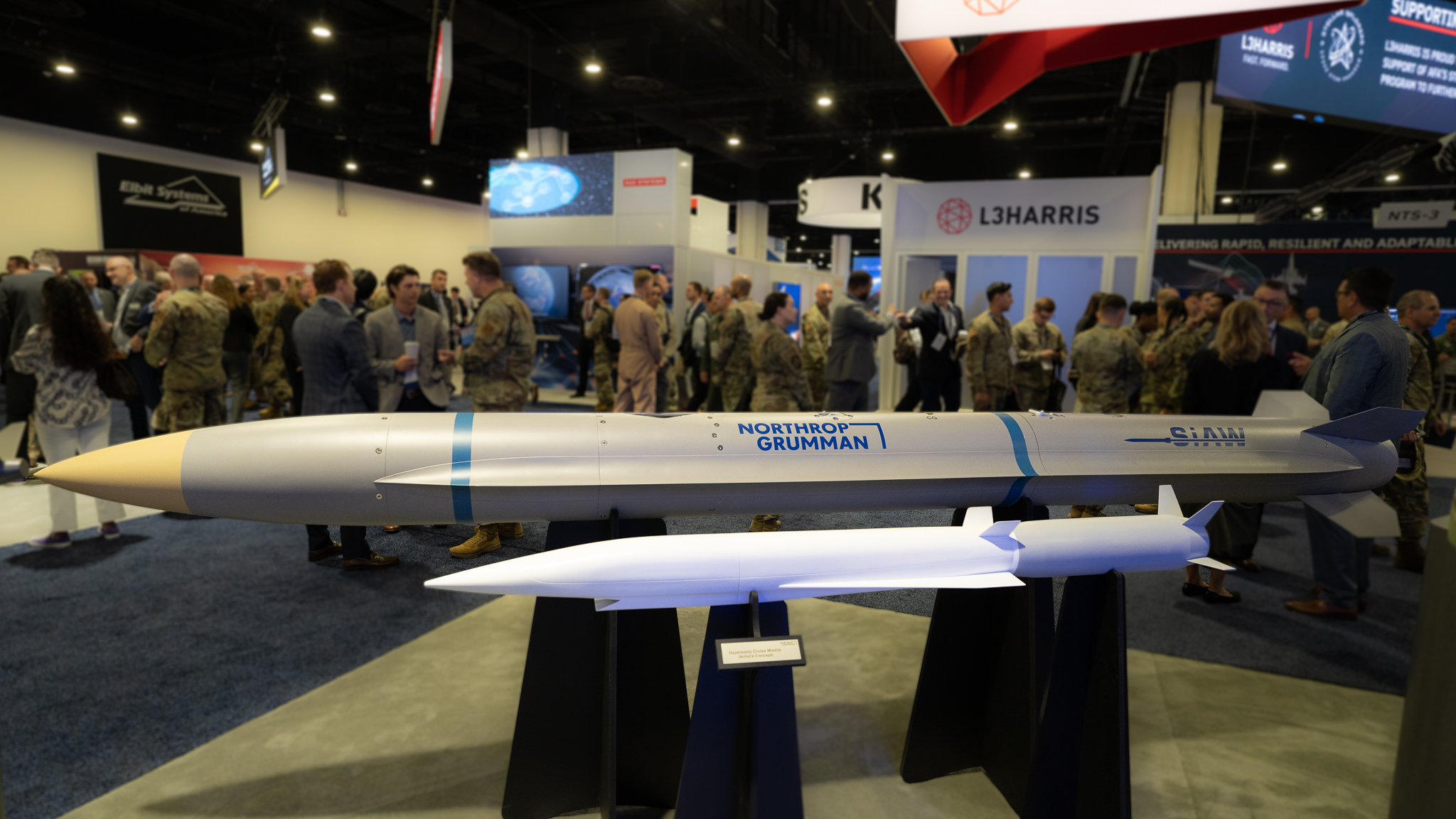
We spied a first-time visitor to be displayed at an industry show: a model of Northrop Grumman's scramjet engine that powered the Hypersonic Air-breathing Weapons Concept (HAWC) missile. Behind it is a Stand-in Attack Weapon for the Air Force.
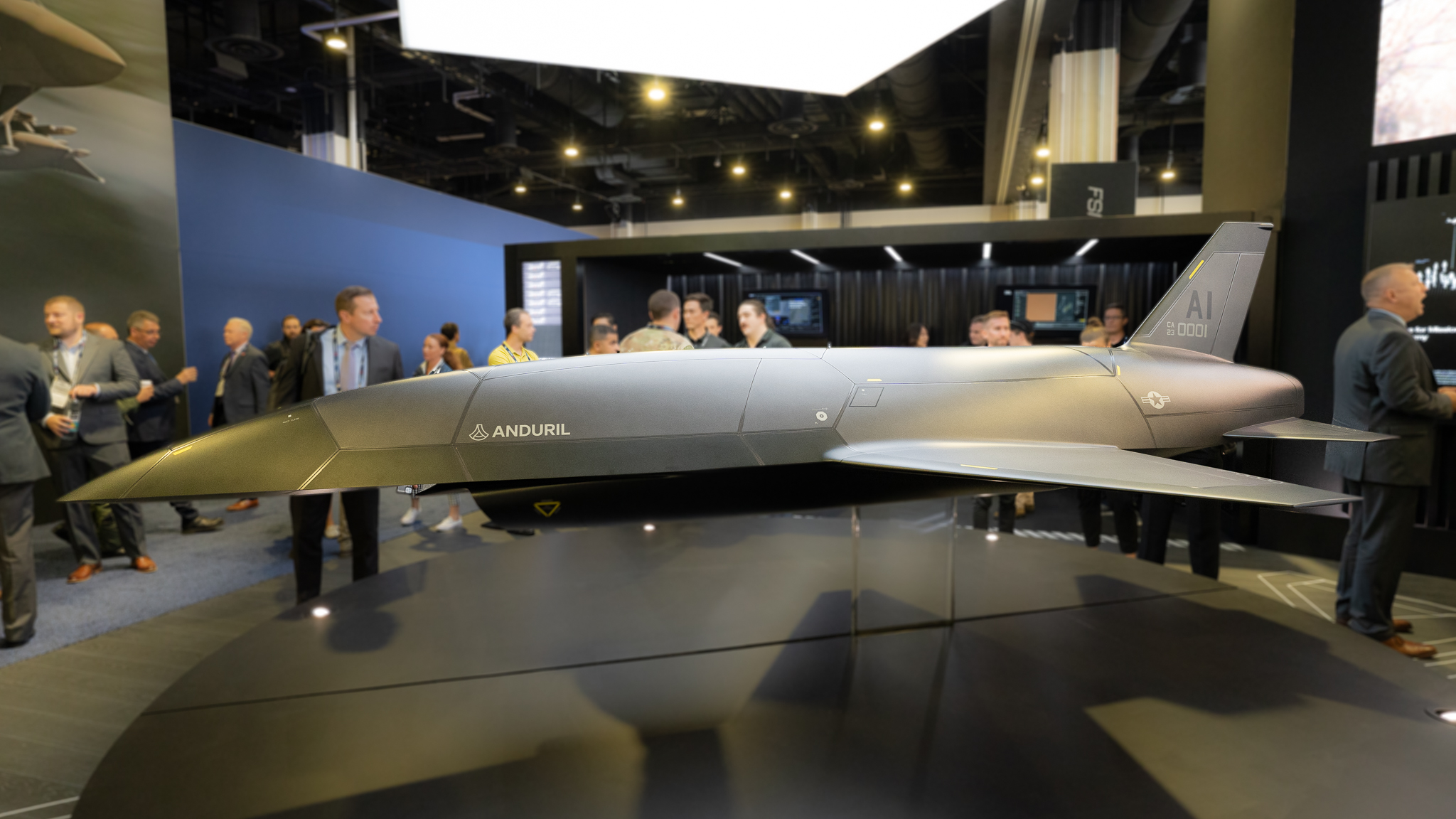
If looks could kill, Anduril's Fury multi-mission Group 5 autonomous air vehicle certainly fits the bill. Fury's mission is to accelerate the development, testing, and fielding of mission autonomy.
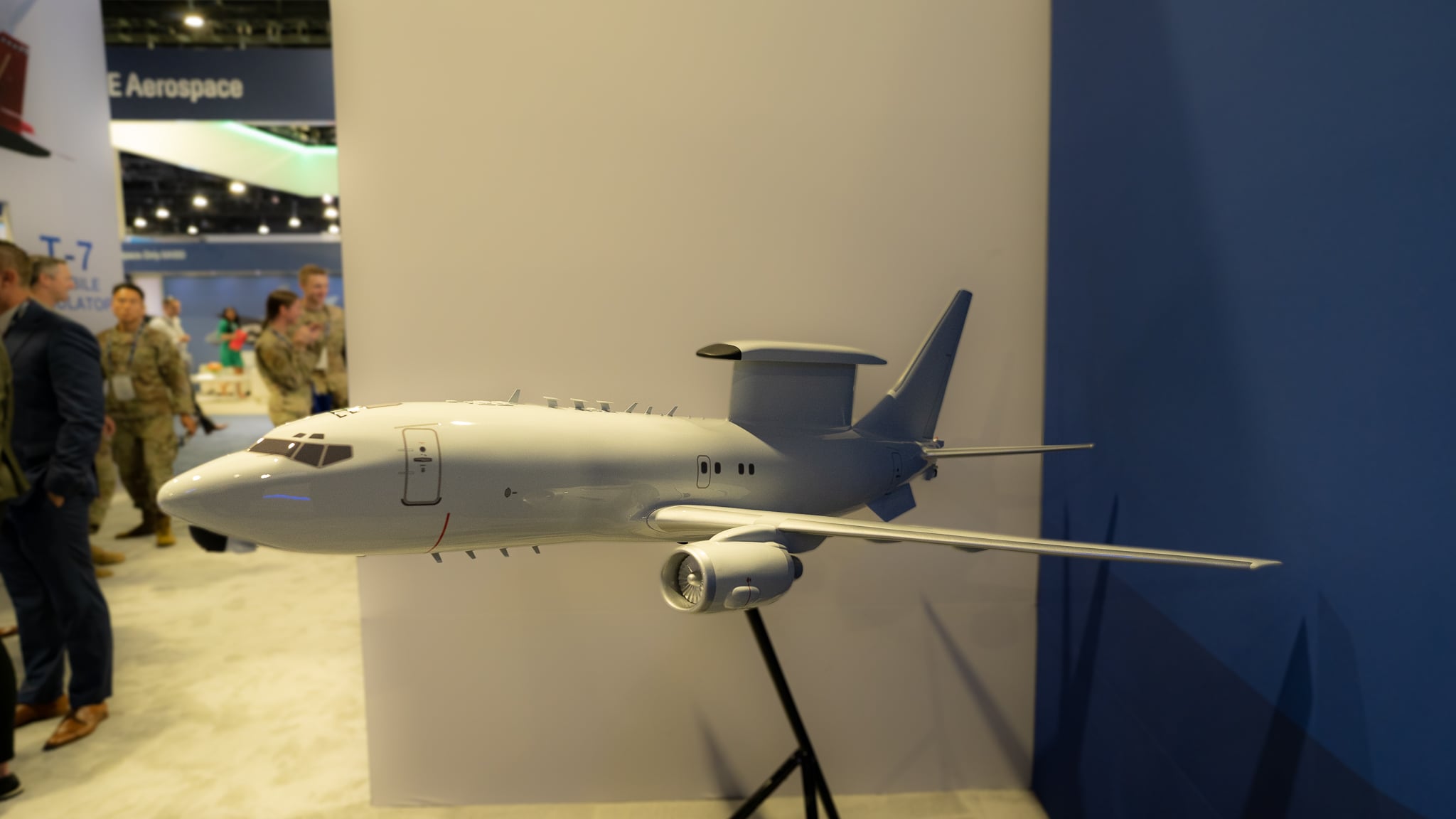
Tucked in a small seating area on the Boeing stand is a model of the E-7 airborne early warning and control aircraft. It's a command-and-control platform for multi-domain awareness.
Missiles a flyin' at AFA; at top left is a Joint Strike Missile from RTX. Also on their booth is an AIM-9X Sidewinder just below, an AIM-120 AMRAAM at top right, and a GBU-53/B StormBreaker glide bomb at bottom right.
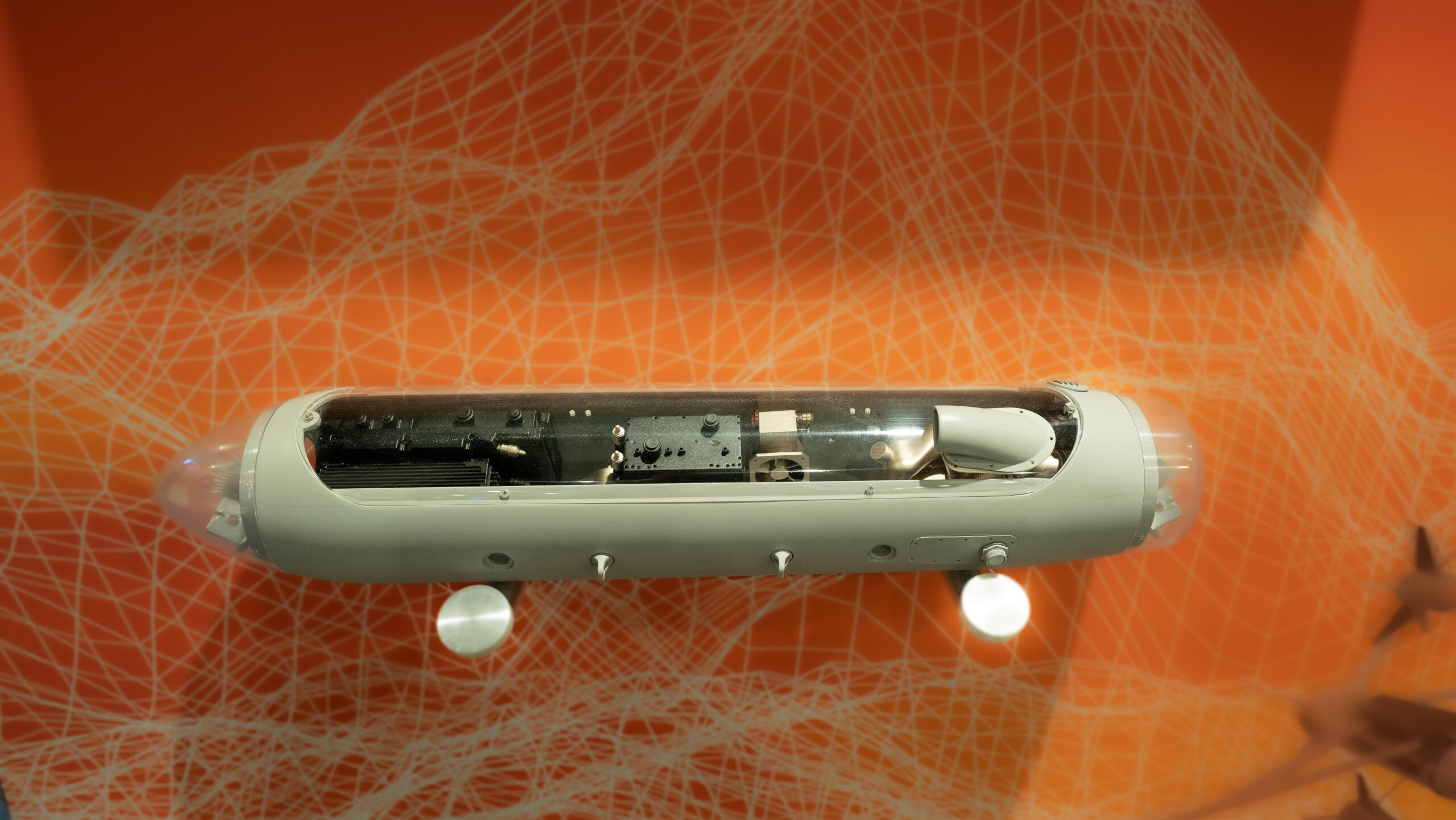
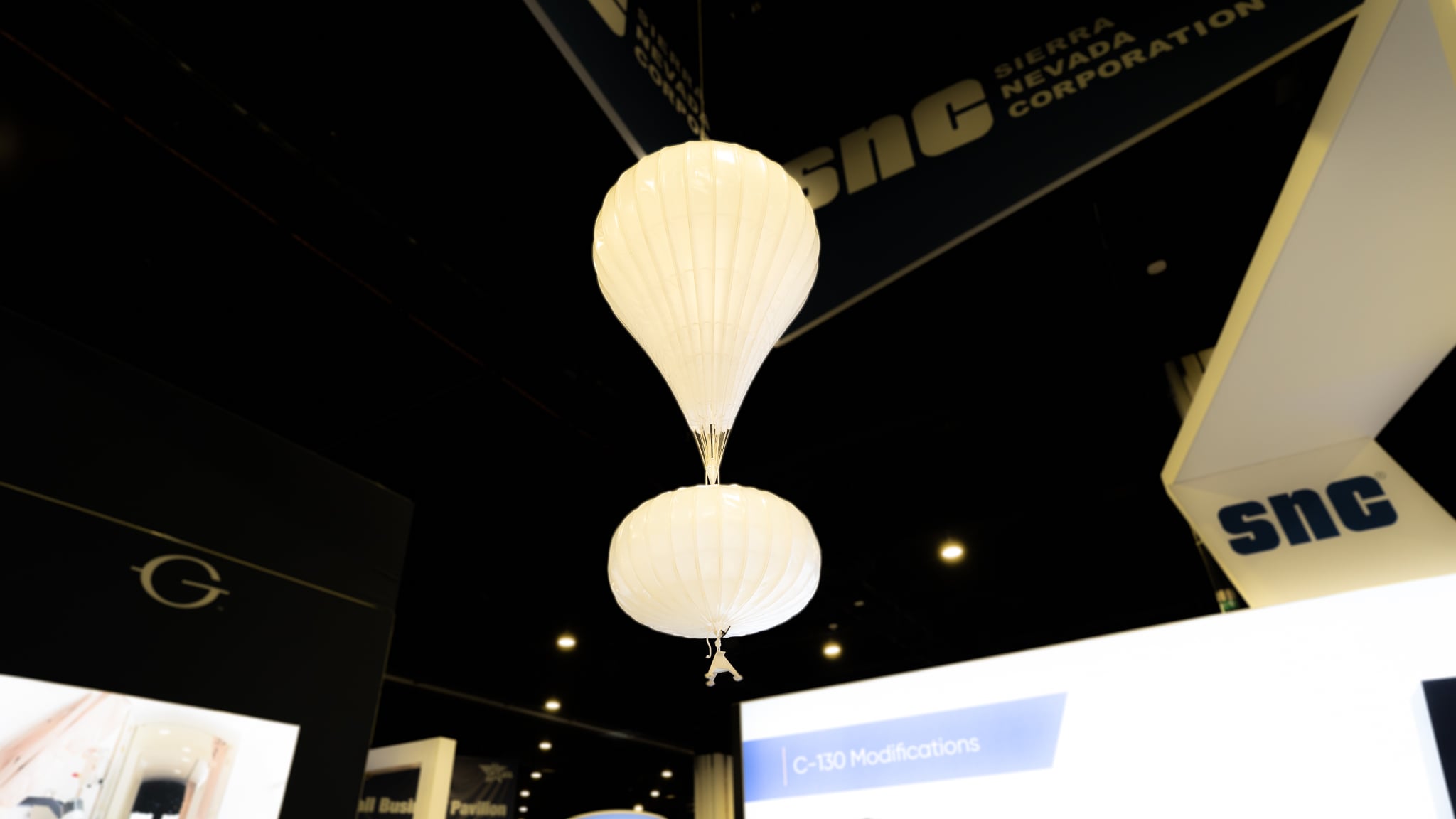
It's a surveillance and communications balloon named SHADE (Synchronized High Altitude Distributed Environment) that's designed to "leverage the stratosphere," says SNC. The black bit at the bottom of the model is a solar panel, and many more panels can be added depending on payload.