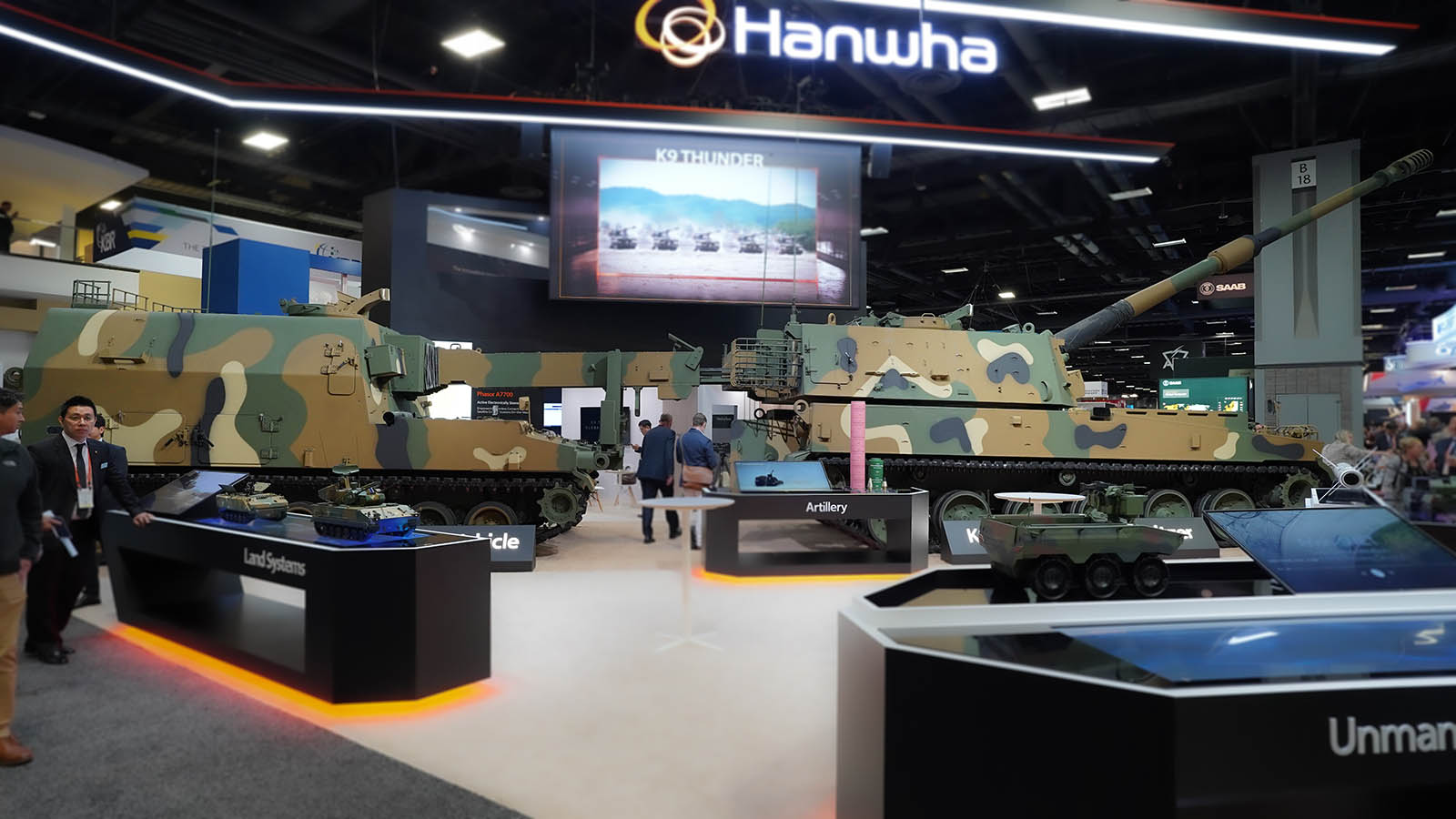
AUSA 2023 — The US-based subsidiary of South Korea’s largest defense contractor is laying the groundwork to become a prime supplier for land systems in the US by the end of the decade, and “all options are on the table” for the company to achieve its goal, Hanwha Defense USA Chief Executive Officer John Kelly told Breaking Defense.
The company’s planning predates the war in Ukraine, but the demand for weapons and ammunition is now outstripping supply throughout much of the West as the fight drags on, leading major military powers like the US searching for new sources, Kelly said.
The American supply chain, like those of other countries, “tends to be quite well protected. And it makes it difficult for a foreign-owned business to break in,” Kelly said Monday in an interview on the sidelines of the Association of the United States Army convention in Washington. “I think you’ve seen that paradigm stretch now, because there is just literally not enough supply going around.”
Hanwha has invested in some facilities to get the ball rolling on its US ambitions, opening a headquarters in McLean, Va. as well as an engineering design center in Detroit, Mich. But it’ll need a major new development to fully realize its plans, with Kelly raising the prospect of moves like partnerships or mergers and acquisitions.
The company’s strategy is “very much about being a prime contractor that can compete with the other peers that are here. And how do you get there? It’s about partnerships. It’s about organic growth. It’s about M&A type of capability,” Kelly said, adding that “all options are on the table at the moment” while preserving “a bit of agility to be able to move between them.”
Once “things progress” for the company, Kelly said Hanwha would then “look at transferring manufactur[ing]” into the US. The company has been working for two years to clear regulatory hurdles for foreign-owned businesses, according to Kelly, and is “almost there.”
Hanwha’s ultimately unsuccessful bid with Oshkosh on the Army’s Joint Light Tactical Vehicle program is a leading example of the company’s approach, Kelly said. Along those lines, he said Hanwha is interested in unmanned ground vehicle contests and is preparing to announce a new partnership to compete for a potential second iteration of the Army’s Small Multipurpose Equipment Transport (S-MET) program, though a competition has not been formally announced by the service.
Although current focus on Ukraine has led to high demand for artillery, attention turning toward the Indo-Pacific threatens to diminish some of that demand. Hanwha doesn’t make artillery shells that have been used extensively in the European conflict, though the company does supply energetics that propel them. (South Korean export controls prevent Hanwha-made weapons from being used in the war, which are instead only being purchased to replenish Western inventories.)
“We’ve done a lot of work on this, because that’s a concern of ours,” Kelly said. “Munitions, energetics tends to be the bill payer. When things are going down, that’s what you buy less of.”
But even if the war in Ukraine halted tomorrow, Western stocks would still need to be replenished and probably kept at a “much higher” level, Kelly reasoned. And, lessons learned about the lack of capacity could result in “a more sustainable base that can pivot up to meet a surge in the way that we struggled to meet so far.”
Walking around a full-sized K9 Thunder self-propelled howitzer on display at the show, Kelly said that the company’s South Korean pedigree can lend itself to some of the Army’s key initiatives. For example, he said the thinking behind K9’s automatic ammunition resupply vehicle was in part driven by manpower limitations in South Korea — which could be an advantage for a US Army trying to be lighter itself under contested logistics. As the Army weighs possible alternatives for its Extended Range Cannon Artillery (ERCA) initiative, Kelly also said the K9 would be a “good candidate.”
Alongside its inroads into the US, parent company Hanwha’s global reach is expanding through other countries, with nations like Poland signing big orders for weapon systems like the K9. The firm’s continued rise, which helped drive a record year for South Korean defense sales in 2022, is evidence of not just the strength of Hanwha, but the South Korean defense industry as a whole, according to Kelly.
“What you’re seeing in general with the South Korean defense business is its coming of age,” he said.
PHOTOS: AUSA 2023

 Gallery