AUSA 2023 — At 50 below, uninsulated batteries drain in minutes. The screens on tablets crack. Hydraulics freeze, crippling aircraft, trucks, and even howitzers. Satellite dishes must point lower and lower as troops move further and further north, until most satellites are blocked by the horizon. Even a soldier’s own perspiration turns against them, the moisture soaking their clothes and letting in the killing cold.
“If you sweat, you die,” said Maj. Gen. Brian Eifler, commander of the Army’s year-old “Arctic Angels” division. “That’s the environment we’re talking about… the harshest environment on the planet.”
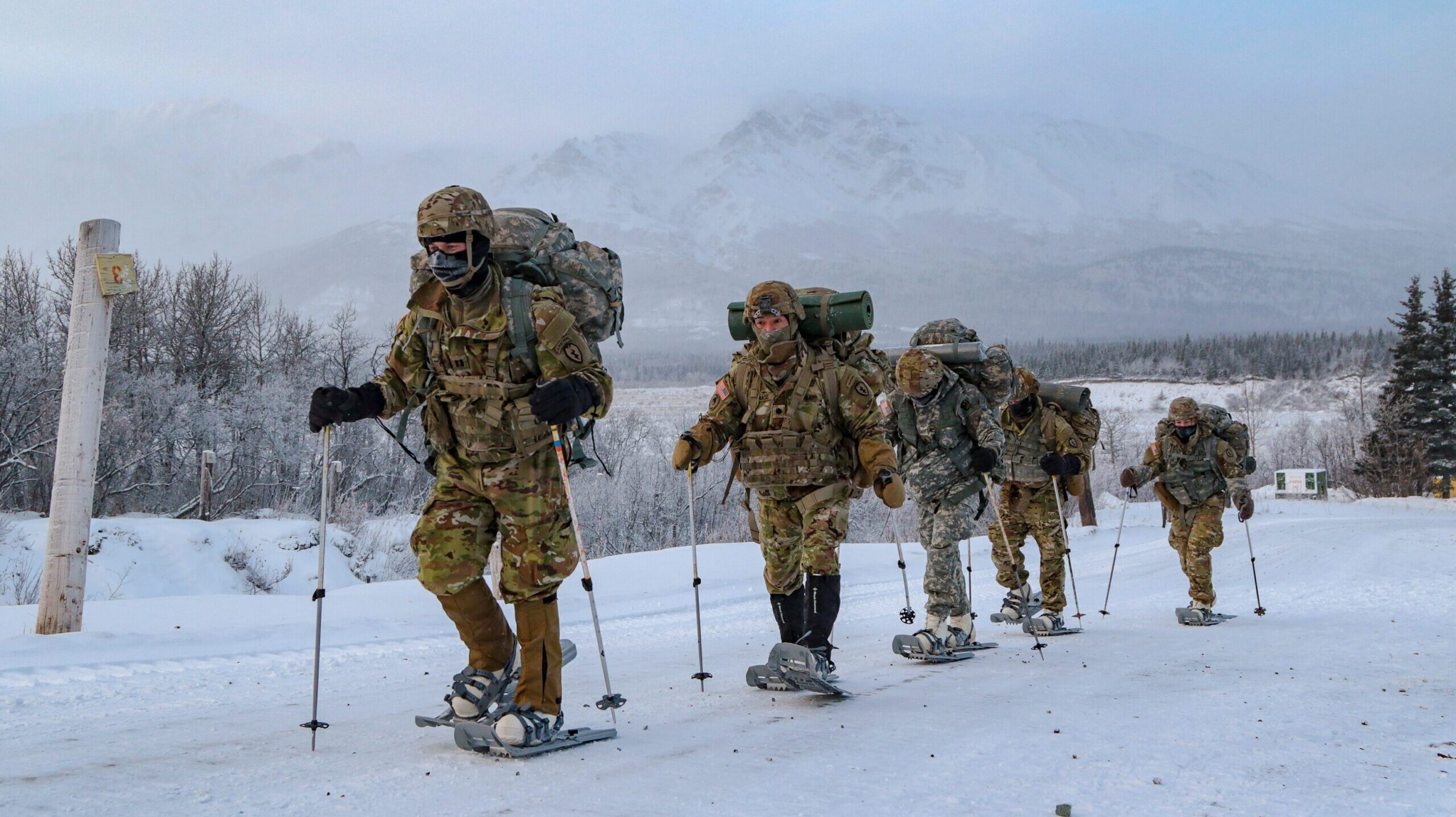
So as the Alaska-based 11th Airborne Division, reactivated last year but tracing its lineage to World War II, prepares for conflict in the utmost north, it’s exploring technologies and equipment that aren’t standard issue. That’s everything from insulated stretchers to keep the wounded from freezing to death to the service’s first new design for skis in 50 years.
“Just about everything in the Arctic is bespoke,” said the division’s senior NCO, Command Sergeant Major Vern Daley, showing off the new skis as he and Eifler addressed the Association of the US Army conference Wednesday.
The 11th was formed last year from units that have long been based in Alaska, but which had deployed all over the world, with a focus on the Pacific. Only last year, as part of the service’s 2021 Arctic Strategy, were they reformed into a single division specifically focused on operations in extremely high latitudes and low temperatures — like above the Arctic Circle, where the Pentagon and allies are seeing a creeping Russian threat.
“I don’t think, [when] it’s 65 below, you’re going to do anything other than try to stay warm — and whoever can stay the warmest, wins,” said Maj. Gen. Eifler. “[But at] maybe 30 below you can fight.”
RELATED: Admiral sounds alarm amid rising Russian, Chinese movements in high north
“If you have your cell phone with you and you take it out for two minutes, it’ll go from 100 percent [charged] to zero,” Eifler said. “If we want to use a tablet or something like that to do fires or planning or anything like that, and it’s exposed to that temperature, it’s gone. … Just the ambient air hitting it will crack everything.”
That’s a big problem for an Army increasingly invested in high-tech electronics, many of them bought “off the shelf” from commercial vendors and not hardened for extreme conditions. “The Army likes to give everybody the same communications gear,” Eifler said. “That doesn’t work in the Arctic.”
Often, he said, “the older the equipment is, the better it works,” with the troops learning to rely more on old-school FM radio.
The far north is also out of range for most communications and surveillance satellites, which orbit around the equator. Only a few satcom companies offer coverage in the Arctic, among them, Eifler said, Iridium and Starlink.
Starlink owner Elon Musk, who also owns electric auto-maker Tesla, has even visited the command to explore customized technologies, Eifler added. “We’ve had … Elon Musk and his team up there trying to figure out battery operated cars and insulated cars.”
The weather’s even a problem for military-hardened, purely mechanical systems like the hydraulics on the M777 howitzer, which is prized by infantry forces for its light weight and ease of transport. It’s also hard to dig out the deep snow so artillery units can emplace their weapons in stable firing positions. In the deepest cold, the very metal begins to fail.
That’s part of the reason the 11th is a light infantry unit, with a modest allowance of vehicles. One of its component combat brigades was actually a medium unit mounted in over 300 8×8 Stryker armored vehicles, but these have proved so problematic in the Arctic that the division has gotten rid of them and converted the brigade to foot troops, with the prospect of being trained for heliborne (air assault) operations. The other combat brigade was already an airborne light infantry unit. (Unlike standard Army divisions, the 11th only has two brigade combat teams instead of three). The unit is also checking out the Army’s new BAE-built Cold-weather All-Terrain Vehicle, the CATV.
Alaska is highly mountainous, the polar ice uneven and prone to melting, so in such difficult terrain many operations must be conducted on foot. That puts on a premium on individual kit, like the new skis or the recently fielded winter clothing, formally the Cold Temperature & Arctic Protection System, designed for temperatures down to -65 Fahrenheit after current cold-weather kit proved inadequate to Alaska. The Army’s Soldier Systems Center has even developed special medical supplies, such as an insulated sleeping bag/stretcher combination for evacuating casualties whose unstable body temperatures put them at even greater risk of hypothermia. The center also developed a quick set-up mini-tent to let medics work on the wounded without exposing them to the bitter wind.
The division is eagerly learning from allies with Arctic experience, like Canada, Finland, Norway and Sweden, as well as from units versed in high-altitude mountain warfare, like the Indian Army and America’s own 10th Mountain Division.
But a lot of the 11th’s lessons-learned are coming from its own soldiers on everyday exercises or field-testing kit in “soldier touchpoints” in the frozen north.
“Until you’ve experienced that and seen it first-hand,” said Eifler, “you really can’t explain.”
PHOTOS: AUSA 2023

 Gallery