
SYDNEY — As Australia Defense Minister Richard Marles has come under withering fire over the last week from opposition lawmakers and defense experts, the country’s national auditors have weighed in with a damning report documenting almost 38 years of program delays covering some of Australia’s most lucrative acquisitions from F-35 fighter jets to future Hunter-class frigates.
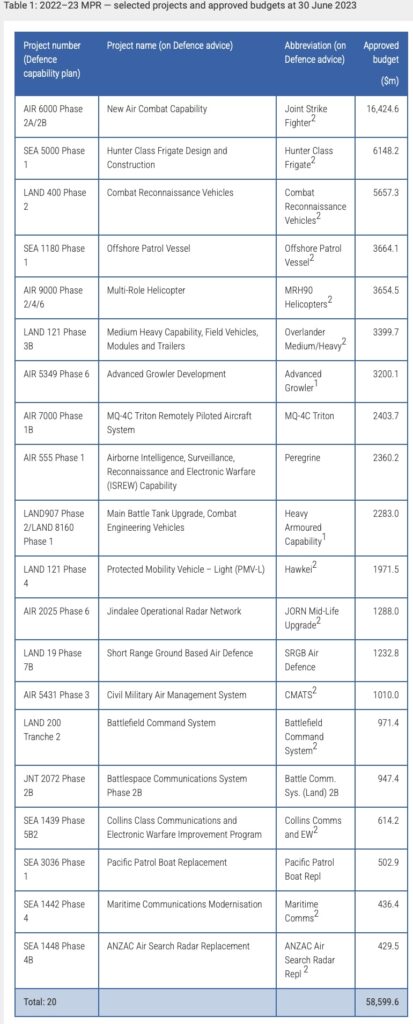
The annual Major Projects Report, published last week, found that delays rose substantially from 405 months in 2020-21 to 453 months in 2022-23 for the country’s 20 biggest projects under the government of Anthony Albanese. The Labor Party government has sharply criticized its predecessor’s poor management of defense acquisition and promised to do better.
The controversial $45 billion AUD Hunter anti-submarine warfare frigate program has some of its problems officially detailed in the report. It faces “strategic risks” due to the lack of maturity of the ship’s design and challenges to integrating the highly complex weapon and sensors systems, the combat capabilities that will be delivered. Other, lower level challenges are raised too, like the Navy finding enough personnel to man, maintain and operate the ships.
The Defense Department’s surface fleet review is expected to be made public on Feb. 19, which has led to a flurry of stories about whether the Hunter program will be severely cut from nine to six or even three ships, though the Australia Broadcasting Corporation reported today that the program is likely to get approval for at least six ships.
However, the audit report is thin on details for most large defense projects. That’s a conscious decision from Associate Defense Secretary Matt Yannopoulos, who wrote in the report that the government chose to conceal information about schedule and some capabilities for 12 programs, arguing their disclosure might “damage” Australia’s national security.
“Defence has assessed that some details, both in respect of individual projects and in aggregate, would or could reasonably be expected to cause damage to the security, defence or international relations of the Commonwealth without sanitisation of the data,” he is quoted in the audit report.
Defense Minister Richard Marles and Pat Conroy, minister for defense industry, declined to answer reporters questions about the audit.
Among the other major projects the department is effectively hiding both schedule and capability information about are the improvements to the Collins class submarines, tank improvements, upgrades to the highly advanced early warning Jindalee Operational Radar Network (JORN), schedule for the LAND 200 Tranche 2 Battlefield Command System, and the schedule for Gulfstream Peregrine jets designed for intelligence gathering and electronic warfare.
The number of programs so affected is 12, up from four in the last annual report. Among the programs is the F-35 Joint Strike Fighter, which is late for its Final Operational Capability, originally planned for the end of 2023.
The report drops at a tough time for Marles, who has been taking fire from the opposition and various defense experts in the wake of a Feb. 8 report from the Australian Financial Review, which documented sharp divisions between Marles and the Australian Defense Force.
Marles reportedly had a confrontation with the top two dozen people at defense “late last year,” where he told them to move more rapidly on decisions and to provide advice more quickly. Rumors of a major split between the ADF and Marles, and between the ADF and Greg Moriarty, the top civilian running the Defense Department, have been in the wind for more than three months.
That opened Marles up to a political broadside from his opposition, shadow defense minister Andrew Hastie, who on Feb. 9 told press “The Albanese Government is a weak government, and it’s particularly weak on national security. We’ve known this since April last year, when the Defence Strategic Review (DSR) was handed down, and in that we saw no new money for Defence.
“In fact, we saw cuts to capability, particularly the army, and we saw the delay and deferral of decisions. We’re yet to see the Surface Fleet Review be handed down by the government, and we’re yet to see a Defence strategy,” Hastie added.
Asked by reporters if Marles should resign or be pushed out, Hastie said, “He needs to step up and lead. He can’t be a part-time Defence Minister — he has to devote all his energies to this,” Hastie said. “He should focus on protecting this country and that means getting a Defence strategy rolled out, securing the money at ERC from Penny Wong, Katie Gallagher, and Jim Chalmers, and then making sure that our Defence Force, if called upon, can fight, and win a war.”