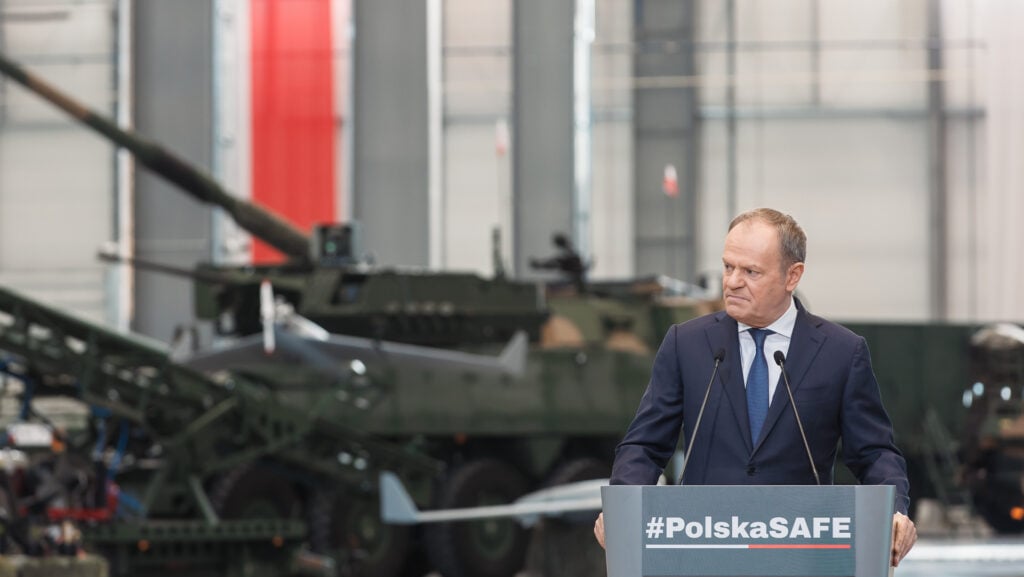
WARSAW — Poland will receive over €43.7 billion ($51.6 billion) from the EU’s Security Action for Europe (SAFE) instrument, government officials announced today — the most any member is receiving from the new loan system set up to help fund rapid weapon procurements for member states.
The announcement came as the Sejm adopted the Senate’s amendments to the bill implementing SAFE. It now heads to the desk of President Karol Nawrocki to sign, which is no sure thing as Nawrocki has expressed political opposition to the plan, claiming the SAFE deal “threatens Polish sovereignty.”
In addition to Poland, other EU states taking part in SAFE loans are Romania (€16.7 billion), France and Hungary (€16.2 billion each), Italy (nearly €15 billion), Belgium (over €8.3 billion), Lithuania (€6.37 billion), Portugal (€5.84 billion), Latvia (€3.49 billion), Bulgaria (€3.26 billion), Estonia (€2.34 billion), Slovakia (€2.31 billion), Croatia (€1.7 billion), Cyprus (€1.18 billion), Finland and Spain (€1 billion each), Greece (€787 million) and Denmark (€46.8 million).
Created May 29, 2025, SAFE is based on a pair of twined loans, where the European Union borrows capital on international markets and then re-lends it to member states. The higher credit ratings across the EU mean the costs of the loans suddenly become more affordable for smaller member states. The loans also come with a 45 year repayment horizon and a ten-year grace period on principal repayment — meaning that for the first decade, the state budget will only be required to pay interest.
The loan requires that at least 65 percent of the value of the components of the financed equipment come from the EU (including Poland), the European Economic Area or Ukraine. In 2026, Poland is to receive the first tranche in the form of a 15 percent advance payment (approximately €6.5 billion), and the interest rate for Poland was set at 3.17 percent.
According to Poland’s government, the money, which will be spent between 2026 and 2030, will go to a wide variety of systems (all figures in zloty):
- Artillery systems – 47.6 billion (28 percent)
- Anti-aircraft and anti-missile defense, unmanned and anti-drone systems 44.2 billion (26 percent),
- Ground combat and support systems – 32.3 billion (19 percent)
- Ammunition and missiles – 23.8 billion (14 percent)
- Strategic air transport and space resources – 13.6 billion (8 percent)
- Cybersecurity and AI solutions – 5.1 billion (3 percent)
- Safe Baltic project – 3.4 billion (2 percent)
- Poland’s Police, Border Guard, and State Protection Service will implement projects worth a total of approximately zł7.1 billion. Some funding will also go towards the military mobility targets laid out in Europe by helping build or improve roads and bridges.

Europe’s military advantage depends on sovereign command of the ground truth
As NATO and European governments accelerate investment in space-based intelligence, decision advantage will depend on how quickly sovereign and commercial capabilities can be fused into a trusted operational picture.
Poland Ministry of National Defense Armament Agency estimates that 89 percent of the funds will go to Polish industry, with an estimated 12,000 Polish companies benefitting from the program. The remaining funds will go to purchase non-local equipment, including from the United States and South Korea.
“Our country cannot wait any longer — it is necessary to quickly and decisively strengthen state security” said Poland’s Prime Minister Donald Tusk. “A well-armed Poland, as self-sufficient as possible, while simultaneously cooperating with its allies in a modern way — this is absolutely number one. There is no more important issue today. Every month, week, and hour will impact the level of security for us, the region, and the entire world,” he added.
“SAFE is not a political program, but a patriotic one. It is a zone of security and development that fulfills the dreams of past generations for a free Poland,” said Deputy Prime Minister and Minister of National Defense Władysław Kosiniak-Kamysz. “Without this program, we have no other option to build an even stronger army and better equip our soldiers in such a short time.”
The defense minister emphasized several times in his comments that the new loan will allow Poland to both keep its modernization efforts on track and expand its targets. “This is a very important part of the project — it frees up a significant amount of funds, allowing us to purchase more equipment for the same amount,” noted Kosiniak-Kamysz.
Minister of Interior and Administration Marcin Kierwiński highlighted the direct impact of the SAFE program on protecting Poland’s borders in the face of growing pressure from foreign regimes. Kierwiński emphasized that “modern technology is a key element in repelling hostile actions, and EU funds will enable a dramatic increase in the operational capabilities of our forces, and emphasized that national security begins with effective monitoring of every kilometer of the border, both on land and at sea.”
The Political Fight
Internally in Poland, SAFE has been a target of political attacks from opposition parties. For instance, the leader of the Law and Justice (PiS) party, Jarosław Kaczyński, called the program a project “under German leadership.”
But it is Nawrocki, the president, who poses the greatest threat to the funding. He has argued that since SAFE is a loan, not a non-repayable grant, it could burden the state budget for many years, and that the EU will now have greater influence on Polish politics. He has also said he wants more reassurances before signing it into law.
Kosiniak-Kamysz and Finance Minister Andrzej Domański have both publically called for Nawrocki to sign on, arguing that a veto would harm the country’s security. However, as Kosiniak-Kamysz announced, even in the event of a veto, Poland will be able to use SAFE, although it will be more difficult and may, for example, prevent the financing of non-military projects for internal infrastructure.
Tusk today attempted to push back on three key arguments put for by the opposition.
The first argument is the belief that the program was imposed from the outside and threatens Polish sovereignty. Tusk argued that, in fact, Poland was the driver in creating SAFE, calling it “our initiative, our idea, and our pressure.
“We convinced our partners — and it was no easy task — that the EU must radically increase its member states’ defenses and generate enormous resources to rearm EU armies. SAFE therefore serves Polish sovereignty. We told Brussels what this project should look like,” Tusk said.
The second concerns the so-called conditionality of when the spending program funds. The funding for SAFE falls under the EU’s general Rule of Law Conditionality, which means that any violation of the rule of law could lead to a halt in the funding. Opposition figures have said this means the EU could arbitrarily withhold the funds in the future if a more conversative government comes to power.
Tusk downplayed that concern, saying “This is a mechanism that protects projects from the threat of corruption or misuse of funds. Only where we have clear laws and anti-corruption safeguards can we be sure that funds will not be wasted. This mechanism should be defended by the opposition, as it is one of the real instruments allowing for oversight of the government’s spending.”
The third concern is the belief that the program will benefit not Poland, but Germany — always a political boogeyman for Poles. On that front, Tusk noted the discrepancy in where the funds are going.
“Well over 80 percent of the funds — these are the estimates of experts, generals, and state institutions — will benefit Poland and our companies. This is a huge injection of opportunities, money, and technology that will flow to the domestic arms industry and all its partners,” he said. “Do you know how much this vaunted German industry will benefit from the SAFE program we’re implementing in Poland? That’s 0.37 percent!”
Tusk also assured, that “SAFE will also not limit Polish spending in the US or cooperation with American allies. We will be an even better ally — thanks to the SAFE program. And the well over $100 billion we planned to spend on equipment and technological capabilities coming from the United States will be spent one way or another.”
Breaking Defense Video