BELFAST — Italy’s Leonardo hopes to test its new Michelangelo air defense dome in Ukraine potentially before the close of the year, before moving into planned NATO trials in 2027, the company announced today.
“The first component of the Michelangelo dome….is now under construction for our friends in Ukraine,” said company CEO Roberto Cingolani during the firm’s industrial plan update today. “The first test will be there [Ukraine] in a real environment,” with delivery “supposed” to go ahead by the close of 2026. “Don’t ask me more….but this is kind of proof that it’s a very effective approach,” he added.
Despite declining to share additional details about the Ukrainian move, Cingolani claimed that 20 countries have expressed interest in ordering Michelangelo. The air defense shield is forecast to draw €21 billion in new business opportunities by 2035, he added.
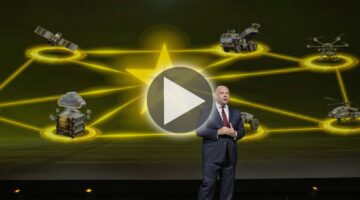
According to a company statement today, Michelangelo offers potential customers “full capability to intercept, track and neutralize emerging threats across the entire operational spectrum: from ballistic and hypersonic threats to saturating attacks, as well as low-altitude and hard-to-detect threats such as large swarms of drones.” Central to the dome is the firm’s MC5 product, a plug-in module that enables multi-domain connectivity.
Cingolani outlined that the open architecture based system can support defenses within a 10-15 kilometre long “dead zone” under attack from drones and other weapon systems. In that scenario the dome could act to interconnect artillery batteries, radars, satellites and counter-unmanned aerial systems.
“This [dead zone array of equipment] can be expanded as much as you want, as long as you have all the platforms and you own the software and the electronics and the control of those machines,” he explained.
Without disclosing a figure, Cingolani told investors that a MC5 development budget is included in Leonardo’s electronics division commercial plan. He noted, however, that billions of euros invested by Leonardo in the company’s suite of defense products have made Michelangelo possible.
In addition to the “urgent” program with Ukraine, Leonardo plans on Michelangelo technology transfer to “companion countries,” alongside “adaptation” of MC5 with more weapon systems, said Cingolani. He did not disclose individual countries.
The NATO trials will involve Michelangelo tested against ballistic missiles, with the dome also planned to undergo a command and control (C2) integrated air and missile defense trial in 2027. Space capabilities will be advanced when two Guardian constellation launch windows open in 2028 and 2029, according to Cingolani. By the end of 2030, Michelangelo is set to meet a full NATO and European Union integration milestone. The timeframe also applies to integration of next generation sensors and effectors, per a company slide presented as part of the industrial update.
Leonardo is open to collaboration on other dome models, said Cingolani, including French manufacturer Thales, who on Wednesday announced the launch of its Skydefender system.
“The dream is that one day you have a total dome that covers entire Europe….But I think there is widespread opportunities,” to consider, dependent on different use cases, he said. “It matters a lot whether you have to protect 25 kilometers square, or whether you have to protect Rome, which is much bigger, or you want to protect” all of Italy.
Talking through how Leonardo will leverage Michelangelo from a sales perspective, Cingolani pointed to a number of options including a software contract with the MC5 module or an “entire package” that would additionally cover other weapon systems like those produced by European missile manufacturer MBDA. Leonardo holds a 25 precent stake in MBDA, which is also owned by Airbus and BAE Systems.
Breaking Defense Video