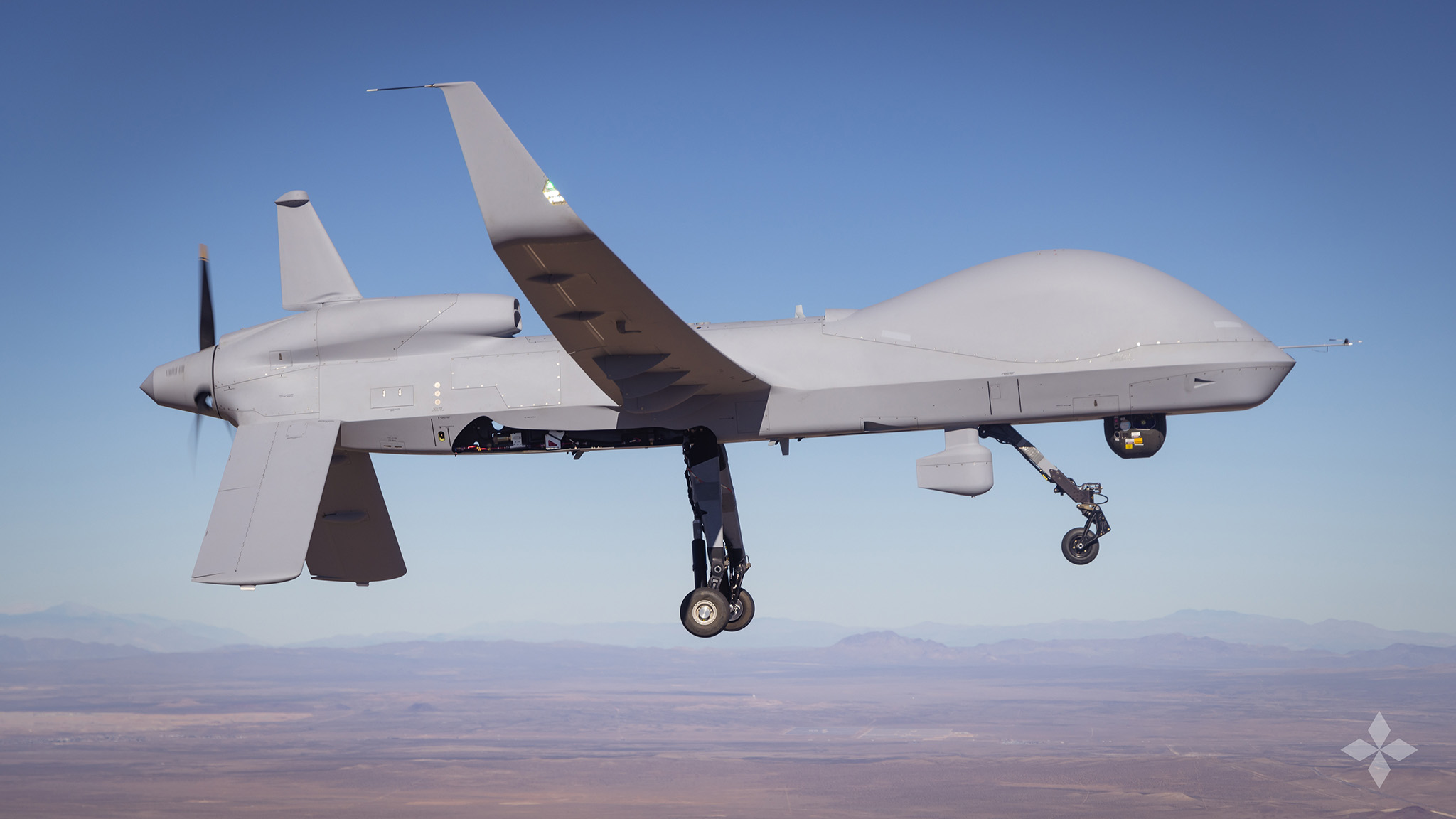
Much like the U.S. Army it supports, the Gray Eagle uncrewed aerial system is constantly evolving.
Today’s Gray Eagle 25M and Gray Eagle Short Takeoff and Landing variant, also known as Gray Eagle STOL, are the most capable aircraft in their class anywhere in the world. Their capabilities have been achieved through continuous enhancements and upgrades, building brick on top of brick to reach new heights by standing on the firm foundations of what came before.
Iterating based on proven increments lets the Army and other users gain a new level of performance with the lowest amount of risk. That’s been the Gray Eagle story since the beginning. Earning its reputation during counterinsurgency operations while adapting both the aircraft and its capabilities to large-scale combat operations demonstrates true transformation in contact—a top Army goal for now and the coming years. The Gray Eagle continues to be a relevant asset deployed in every area of conflict with U.S. or coalition soldiers.
The first aircraft grew out of the original Predator®. The Army sought a new unmanned aircraft to support commanders’ battlefield needs in the ongoing conflicts in the Middle East. But the new platform, initially nicknamed the “Warrior,” quickly took on its own identity.
The new look
One reason was that the Gray Eagle did not have a turboprop engine. Instead, it flew with a heavy fuel piston aircraft engine that responded to the Army’s single-fuel approach in the battlefield concept. This enabled the aircraft to burn either jet or diesel fuel, simplifying logistics for units as they operated in expeditionary environments.
Another reason was that the Gray Eagle was purpose-designed to be flown by an Army cadre of enlisted Soldiers. This didn’t require traditional aircraft-style stick-and-rudder flying. Instead, Soldiers would use highly automated controls to fly the Gray Eagle from a laptop or similar hardware.
Gray Eagle would take off and land automatically through secure line-of-sight links with no need for operator interaction and conduct its beyond-line-of-sight mission via satellite communications, providing the Army multiple command and control options in contested environments. Gray Eagles have recorded hundreds of thousands of these automatic takeoffs and landings, demonstrating advanced levels of automation and autonomy.
The success of the Gray Eagle quickly induced the Army to support additional upgrades. An extended range model doubled its range and endurance, thus providing the key discriminator for reconnaissance, surveillance, and target acquisition missions: persistence. The ability to observe, report, detect, and influence threats both kinetically and non-kinetically, from a single platform, with the unblinking eye of an array of long-range sensors, is one of the keys to creating overmatch for ground forces. One test aircraft flew for nearly two days nonstop in a demonstration above Southern California.
As the Gray Eagle was improving, the Army was adapting to it, too. The service began to pioneer the doctrine and systems for what is now known as manned-unmanned teaming, pairing Gray Eagle with the purpose-built AH-64E Apache Guardian attack helicopter. Crew members aboard these aircraft could seamlessly transmit and receive data from the Gray Eagle and even take control of the payloads or the aircraft if necessary.
Manned-unmanned teaming enables both aviation and ground forces to work together in ways that weren’t possible before. A flight of Apaches might use Gray Eagles to observe distant targets to coordinate their approach. An infantry unit might guide one sensor to confirm a target. At the same time, the onboard synthetic aperture radar might detect inbound threat drones and send tracking data to a shooter—or Gray Eagle might employ its own onboard systems against the threat.
The Gray Eagle of tomorrow, today
Building on these practices is what has brought manufacturer General Atomics Aeronautical Systems to the newest and most capable variant: the Gray Eagle 25M (GE 25M).
With an improved heavy-fuel engine, greater onboard power, significantly reduced maintenance, and other refinements, including an expeditionary laptop-based ground control station, GE 25M epitomizes the Army’s concept of transformation in contact and is the Gray Eagle the Army needs for the future fight.
Staying with manned-unmanned teaming, GE 25M’s modular open system architecture incorporates rapid, low-risk, low-cost integration of current and future applications, including a new breed of air-launched effects and long-range sensors. These additions increase the survivability of both the aircraft and the troops it supports while preserving all the multi-mission capabilities of the Gray Eagle.
Imagine the Army needs to close with a sophisticated adversary on a large battlefield. The enemy is defending its position with advanced air defense systems. Gray Eagle 25M approaches the forward line of troops, releasing one or more launched effects. These expendable, low-observable systems sniff out the enemy’s radars without the need to put a human in danger.
Once located—with Gray Eagle 25M acting as the quarterback for multiple launched effects relaying their findings—friendly aircraft, long-range fires, or other effects eliminate the air defense threat, permitting the maneuver elements to advance into their attack unharassed and potentially unobserved by threat-loitering sensors. When equipped with the EagleEye synthetic aperture radar, Gray Eagle can detect and track threat drones well beyond current ground-based options in addition to detecting ground targets out to 80 km and maritime targets out to 200 km.
Gray Eagle 25M’s other improvements include a high degree of electronic threat resilience, vision-based navigation in which onboard systems can recognize what it senses to counter GPS jamming, SATCOM anti-jam technologies, and a new engine designed to reduce long-term costs, sustainment, field service representatives, and spares along with an expeditionary laptop ground control element.
Gray Eagle 25M embraces the Army’s modular open systems approach in which any number of sensors, effectors, or other payloads can integrate rapidly with the aircraft. This versatility allows GE 25M to adapt at the speed of threats affordably. It has already proven its effectiveness by integrating multi-intelligence sensors in an operational theater against live threats and by utilizing the Army’s new class of launched effects at Yuma Proving Ground, Arizona.
Gray Eagle STOL
The next generation of Gray Eagle incorporates all the aircraft improvements in 25M with another innovative twist: the ability to take off and land in much shorter distances on unimproved surfaces or ships at sea. Commanders can choose virtually any bases of operation and take advantage of unconventional locations not normally affiliated with unmanned aircraft or aviation operations as an added level of survivability and surprise.
The aircraft emerged from a well-known record-breaking demonstrator known as Mojave, which caught the attention of the aerospace world as it logged first after first as part of a company-funded program.
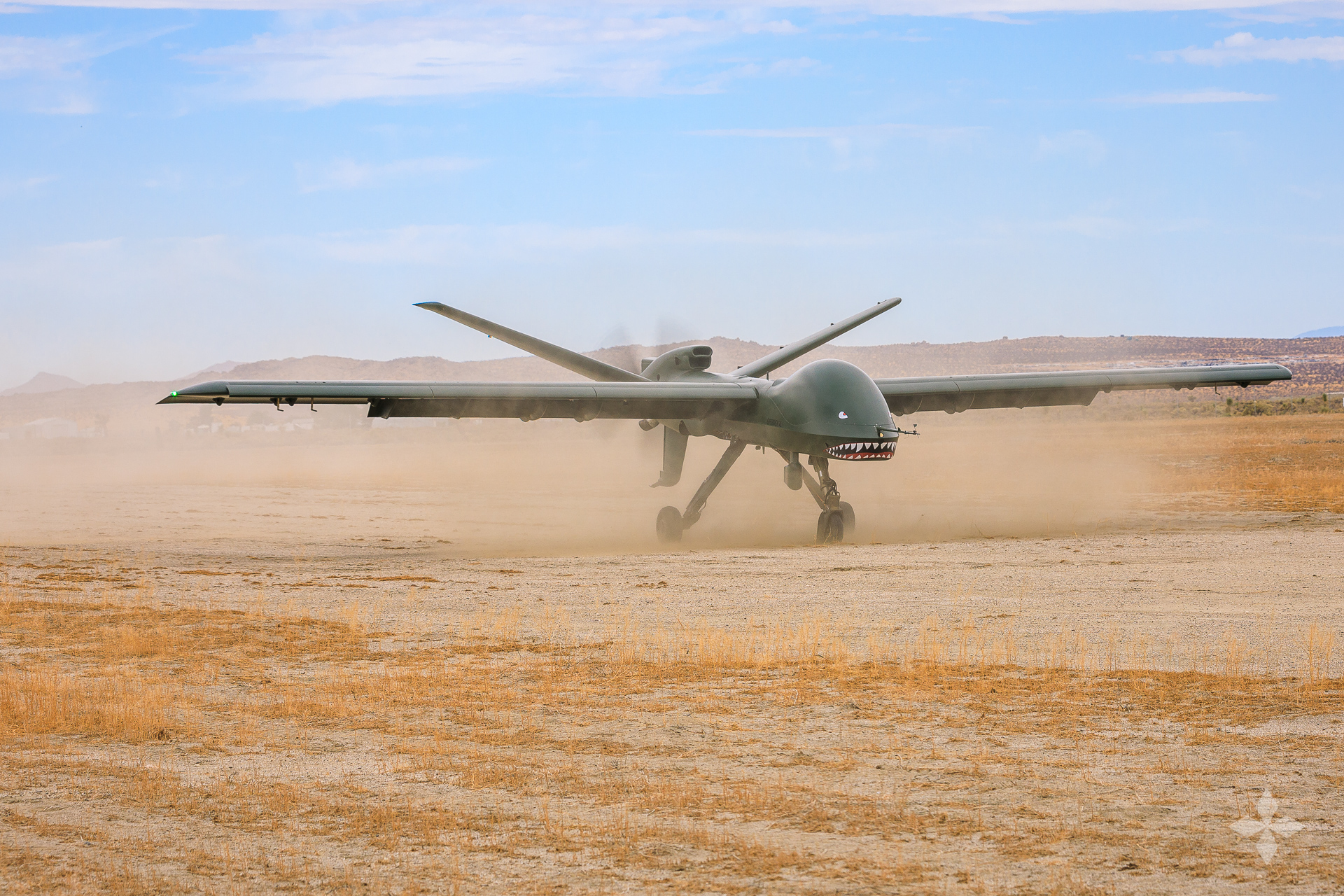
Mojave took off and landed with a fraction of the ground roll of a traditional aircraft at a dirt field and from the British aircraft carrier HMS Prince of Wales. The aircraft also conducted a field integration achieving a first pass hit on targets with the Dillon Aero DAP-6 minigun in a live-fire test at the Army’s Yuma Proving Ground.
Benefitting from these proven accomplishments and the commonality of the shared advanced data links and ground modernization with Gray Eagle 25M, Mojave was designated as Gray Eagle STOL.
With the ability to perform reconnaissance, surveillance, and target acquisition—or RSTA—as well as attack, contested logistics, and other missions, Gray Eagle STOL showcases new flexibility in where and how U.S. and allied forces can operate to support the full spectrum of missions in large-scale combat operations.
Gray Eagle STOL might go with American forces into an expeditionary base deep downrange, co-locating with them as necessary to support missions, including delivery of supplies with the range to reach from island chain to island chain for units separate from the main body. Operating from a semi-prepared landing zone, a dirt road, or any paved surface, it expands commanders’ options.
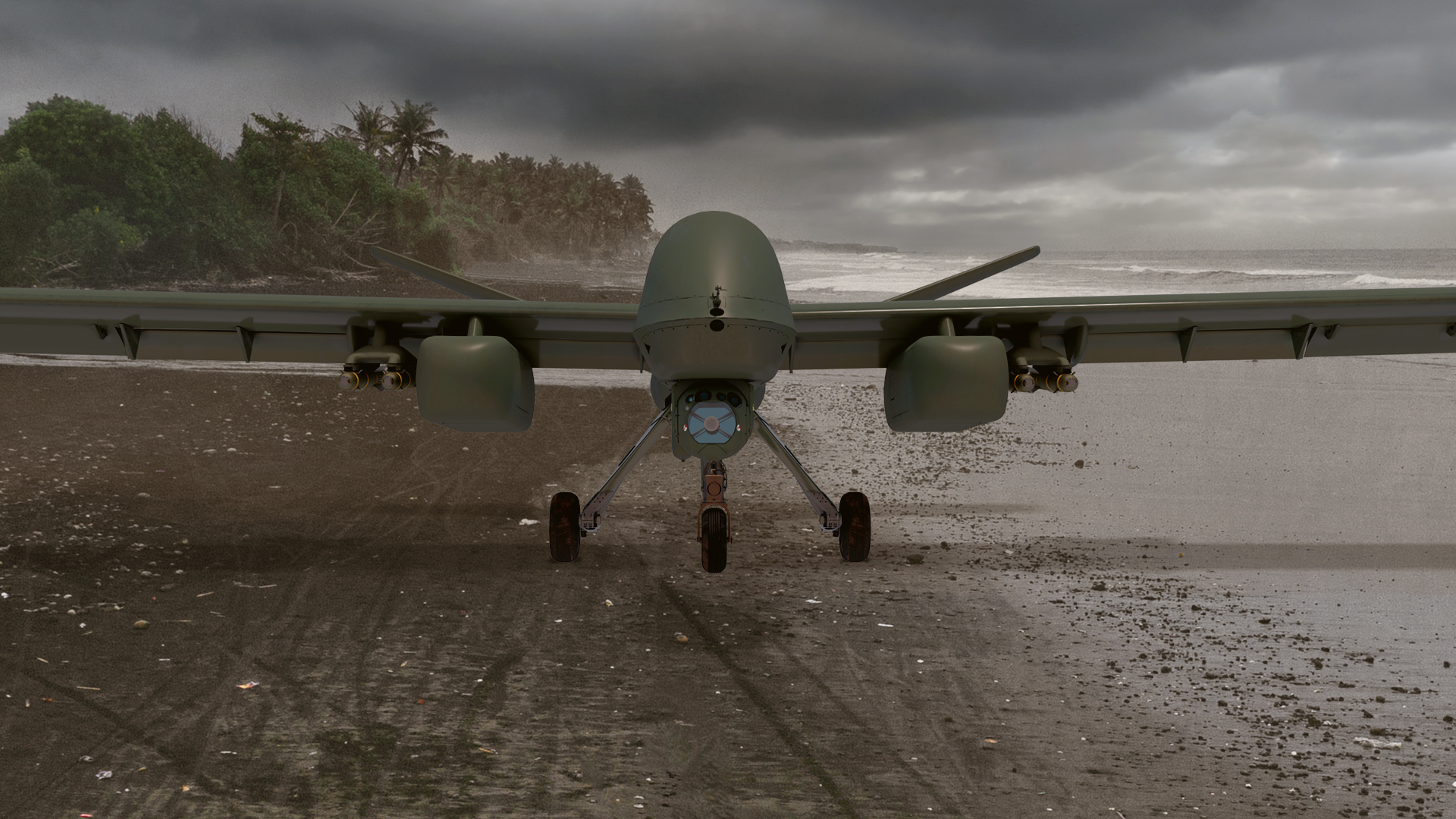
The aircraft also might provide armed overwatch combined with logistics support for small units deployed in a maritime environment. Picture a detachment of soldiers stationed on a small island where Gray Eagle STOL makes regular flights to resupply and rearm without risk to a human aircraft crew—while also providing reconnaissance and, if necessary, armed response against hostile incursions.
The possibilities are endless, making it easy to envision more missions and capabilities on the horizon. The Army can get there because of its success building the Gray Eagle 25M as the backbone for the data links, avionics, and expeditionary ground control stations over time to achieve a ruggedized, reliable, relevant, and survivable multi-mission capable platform.
PHOTOS: AUSA 2024

 Gallery