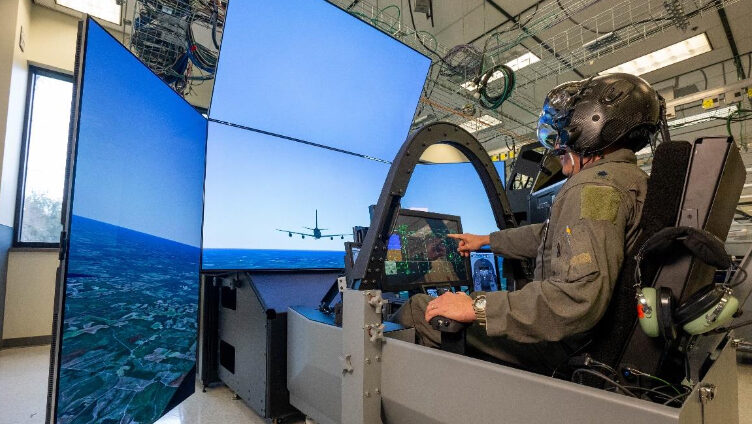
I/ITSEC 2024 — Lockheed Martin generally reserves plenty of floorspace at defense shows, but this year at I/ITSEC the aerospace behemoth is showing off a development in its simulation capabilities designed to save space as much as possible: a smaller, leaner F-35 simulator.
The point, according to Lockheed’s Erik “Rock” Etz, is to fit more of the simulators in secure facilities — the only places where F-35 simulators can be housed due to the plane’s still-sensitive nature — enabling more dynamic joint training.
“The MMRT [Modified Mission Rehearsal Trainer] reduces the overall hardware footprint of the platform and increases the options for high-fidelity pilot training,” said Etz, the company’s director of Strategy and Business Development. “You can get more of these devices inside of a SCIF [sensitive compartmented information facility], which affords the simulating of larger missions. In many cases this now means the ability to conduct a four ship versus eight ship training event,” which was not possible with the previous generation simulators.
Lockheed began an internal R&D project to develop the first of this newer, smaller simulator in 2021 that evolved into the current MMRT configuration.
“Growing the capacity for a greater number of sims creates the option to link more devices together. Recently at a final mission simulation at Luke AFB it was demonstrated that it is possible to datalink 12 devices together,” Etz said. “Other than offering more sims in the same space, the MMRT also presents additional capability. The result is a holistic training capability.”
Etz said Lockheed initially shrank the MMRT for the US Air Force but the “requirement will undoubtedly grow with the export customers of the aircraft.” (Nineteen countries currently fly the plane.)
RELATED: Romania signs LOA to secure entry to F-35 club
Simulated training for the F-35 can be far more complex than for other airframes, as much of the fifth-generation jet’s selling point is not dogfighting, but battle management. The aircraft is sometimes given the nickname of the “quarterback in the sky” as it can accept data from multiple sources — including satellites — and then hand targeting and other cues off to other aircraft, air defense batteries, ground forces and naval vessels. It’s a role that one Lockheed official said “markedly increases the training burden.”
At a Red Flag exercise more than two years ago, one of the F-35 pilots described the near sensory overload of being in the cockpit, saying “we have so much situational awareness in the F-35 and there is a lot of information coming at you. From the radar and the sensors and the radio chatter is going crazy.”
Simulators can also stand in for live training exercises, which may become more relevant with reportedly low mission-capability rates for the actual airframes.
“These stresses and complications with training are inevitably going to fall even harder on some of our export customers,” said one former US Air Force pilot now working at Lockheed, who spoke on the condition of anonymity.
“A bunch of these countries that have now signed up for the F-35 that are right on the border with Russia — or at least close to it: Poland, Finland, Norway, the Czech Republic, etc. Upping the game in the simulator business is probably the only way of keeping their pilots up to speed while the programmatic problems with the aircraft are sorted out,” he said.