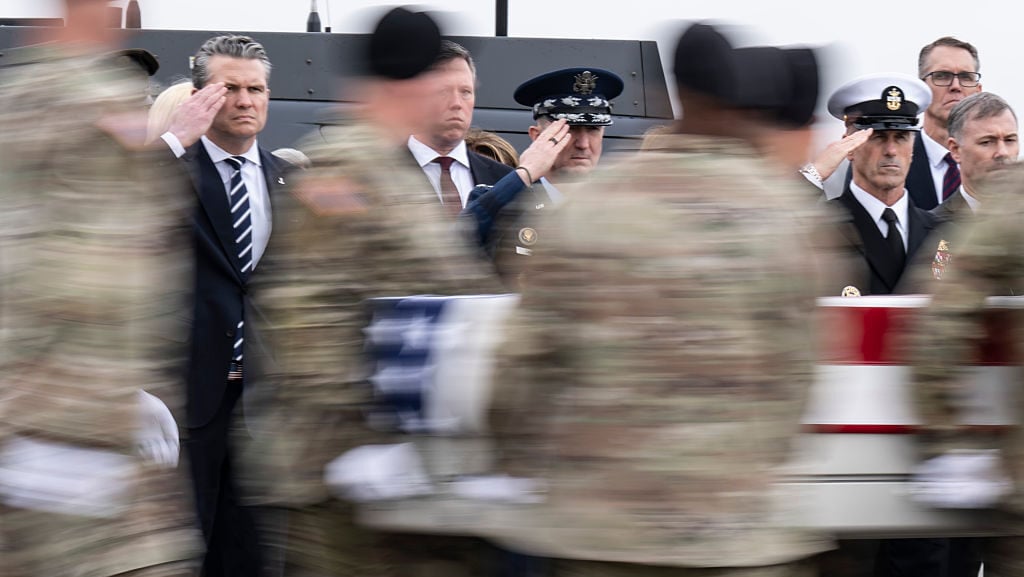
WASHINGTON — All six airmen are now confirmed dead after a US KC-135 refueling aircraft crashed in Western Iraq on Thursday, US Central Command said today.
“The circumstances of the incident are under investigation,” the command said in a social media post. “However, the loss of the aircraft was not due to hostile fire or friendly fire.”
Just two hours earlier, Chairman of the Joint Chiefs of Staff Gen. Dan Caine told reporters US military was still looking for the remaining two airmen in an “active rescue and recovery operation.”
“The incident occurred over friendly territory in Western Iraq while the crew was on a combat mission, and, again, was not the result … of hostile or friendly fire,” the four-star general said.
Circumstances surrounding the crash were still not immediately clear as Operation Epic Fury ticks towards the end of the two-week mark on Saturday. A second aircraft was apparently involved in events that precipitated the tanker’s crash, though the military has not said what went wrong. The other aircraft “landed safely” according to CENTCOM, which was reportedly another KC-135.
This latest aircraft crash follows the three US F-15s that were recently shot down over Kuwait in a friendly fire incident, but all pilots involved ejected safely. The Stratotanker, however, does not have ejection seats.
In all, the military has reported the deaths of 13 US servicemembers since the outset of combat operations, most of the others in a strike on a US installation in Kuwait.
Additional information about Thursday’s crash came as Caine and Defense Secretary Pete Hegseth said that today would see the heaviest day of kinetic US strikes on Iran.
“CENTCOM continues to attack ballistic missile and drone capabilities so that they are no longer a threat to US forces, our bases or our partners,” Caine said. “They’re continuing to destroy the Iranian Navy to ensure freedom of navigation, and this means going after Iran’s mine laying capability and destroying their ability to attack commercial vessels, and we’re targeting their defense industrial base.”
As of today, Hegseth added, the US is estimating that Iran is firing 90 percent fewer missiles and 95 percent fewer one-way attack drones compared to the early days of Operation Epic Fury. That reduction comes, as Hegseth and Caine said the US has now hit more than 6,000 Iranian targets and is now almost exclusively relying on stand-in weapons to strike missile launchers and production facilities — like Joint Direct Attack Munitions which include a GPS guidance kit for dumb bombs.
“Only 1 percent of the munitions we’re using today are standoff munitions. The rest are over the top, the types of which we have a plethora which was, which [was] our goal from the beginning,” Hegseth told reporters.
The two senior defense leaders also fielded questions about the halt of oil transit through the Strait of Hormuz, saying the Pentagon is still evaluating its options for escorting some of those vessels safely though.
“It’s a tactically complex environment,” Caine added. “Before I think we want to take anything through there at scale, we want to make sure that we do the work pursuant to our current military objectives, to do that safely and smartly.”
Breaking Defense Video