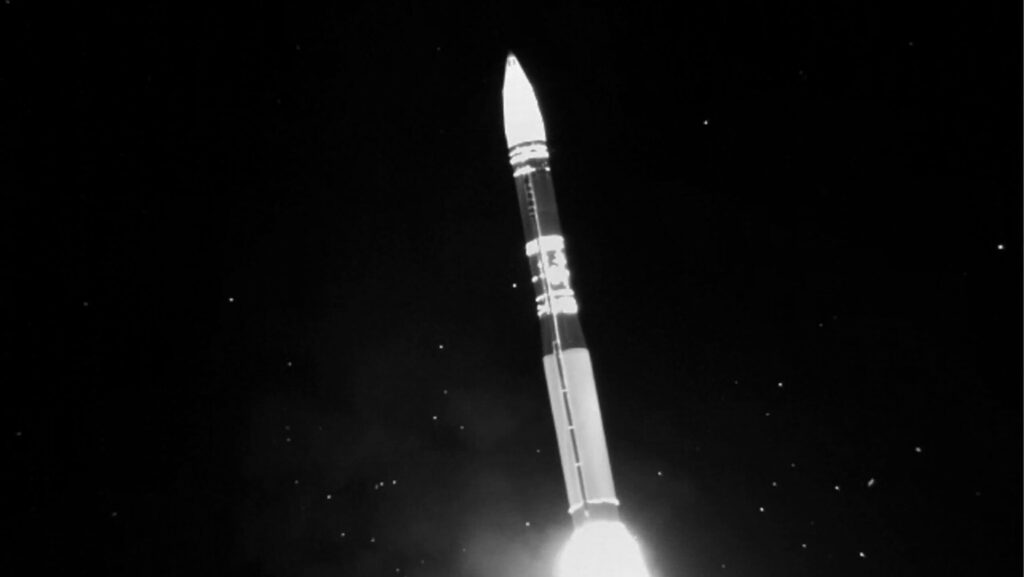
WASHINGTON — The Air Force is searching for an artificial intelligent agent that can centralize the various data streams underpinning its aging nuclear ballistic missile fleet, according to an active industry notice.
In a request for information published July 24, the Air Force says the Minuteman III (MMIII) program manages key data across “approximately 60 disparate and disconnected systems,” from “local hard drives” to “shared networks.” But it has no way to centrally govern all of them, requiring considerable manhours for tasks like assessing when parts may need to be replaced.
Sustaining the decades-old MMIII fleet is a national security imperative: The Air Force must continuously keep 400 missiles ready to launch at a moment’s notice, a responsibility often described as a “no-fail” mission since failure could lead to catastrophic consequences. And it’s a job that will continue longer than originally expected, as the replacement for MMIII, dubbed Sentinel, faces years of delays.
An AI tool could help ease airmen’s management of the missile fleet’s remaining lifespan. According to the notice, the Air Force is seeking an AI agent capable of constructing a “single, unified interface” that can pull data from various sources — including design drawings and maintenance data, among other areas — and visualize it for users. The notice says that previous attempts to create a centralized, digital ecosystem for the MMIII lifecycle have failed “due to a range of challenges.”
The Air Force expects that the AI tool can collate data in “near-real time” and cut down on manual compilation by a “measurable amount” that will be negotiated with a successful contractor. The notice adds that the project’s “initial phase” will cover data marked as controlled unclassified information, which could be expanded to information classified as secret.
The notice does not say AI will have any role in launching or operating the nuclear missile fleet, and officials maintain those decisions belong in the hands of humans. Responses to the request for information are due today.
Prior to the release of the July 24 notice, the Pentagon awarded Air, a firm formerly known as Govini, $31 million for supporting the Air Force’s ICBM fleet. The company said in a July 15 press release that work under the contract will “provide an integrated view of the ICBM industrial base and supply chains to identify current and future supply chain gaps and assess risks.” It’s not clear how Air’s platform might interact with the AI agent the Air Force is seeking.

Island surge: the Army’s Next Generation Command and Control in action
Lightning Surge exercises are turning soldier feedback on NGC2 into operational software changes in days, not years.
The Defense Department under Secretary Pete Hegseth has championed the use of budding AI tools, and is casting about for hundreds of software engineers to bolster its software prowess.
The military services are experimenting with AI for a range of tasks, and last week the Air Force marked milestones for AI integration with aircraft. Using a heavily modified, autonomous F-16 dubbed the X-62 VISTA, the Air Force said in an Aug. 4 press release that the aircraft’s AI agent analyzed live data from an infrared sensor and directed the jet to “intercept an airborne target in real time.” A separate demo integrated a “non-prime, third-party autonomous agent” from an undisclosed vendor to test safety rules, according to the release.