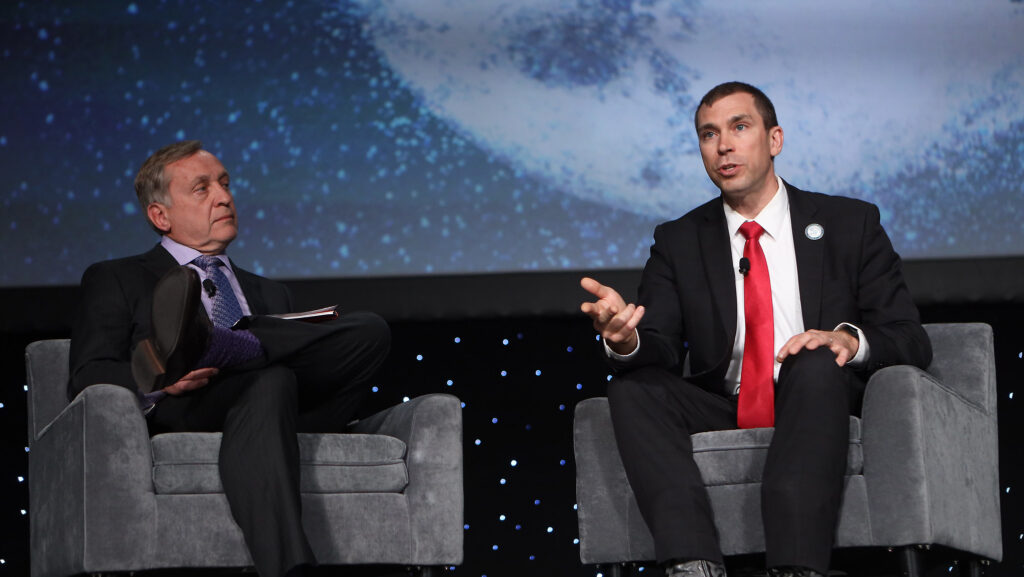
SPACEPOWER 2024 — The head of the US Space Development Agency isn’t really scared of a potential anti-satellite attack by an adversary, given the large number of low Earth orbit satellites being planned for the agency’s Proliferated Warfighter Space Architecture.
Instead, Derek Tournear said he’s worried about two potential problems that could undercut SDA’s primary goal to enable fast as possible sensor-to-shooter connections: weak cybersecurity across the constellation and shaky supply chains.
“There are two threats out there that I am really worried about. They’re common mode failure threats,” Tournear said during a panel discussion during the Reagan National Defense Forum in Simi Valley, Calif.
“Number one is cyber. If we have a cyber vulnerability. It doesn’t matter whether I have two satellites or 2,000 satellites, we could be vulnerable to that. So it is a big deal. We take a lot of protections against that,” he said. “The second one is, is supply chain — the ability to actually produce these satellites at scale — and then supply chain interdiction.”
He explained that becuse of SDA’s networked architecture, the agency needs to have “assurance for the providence” of all the “parts and pieces” that go into each one of the satellites being developed by different providers.
The question of the provenance isn’t only applicable to hardware, he stressed, but is also a critical question for software.
“[We] also need a robust industrial base that can create software, test software, get the software ready to go and build that capability up right now,” Tournear elaborated. “Our industrial base relies a lot on on foreign entities to write our software. It’s one of the things that we’ve kind of said we were worried about that at the Space Development Agency. We want our flight software and our satellites to be written in the US, because that’s one of the supply chain interdiction things that I’m worried about. So that’s been a bottleneck.”
Another key issue is the current fragility of the defense supply chain that Tournear said “is always going to be a problem” and “always going to cause delays.”
SDA experienced delays in launching its initial prototype satellites due to supply chain woes during the COVID-19 pandemic, with resistors being a key problem, he noted. Further, the planned launch of its first operational set of data relay and missile tracking satellites, called Tranche 1, has been set back by about seven months to the spring of 2025 due to another supply chain problem — this time involving optical communications terminals needed to create satellite-to-satellite links.
SDA As A ‘Canary In The Coal Mine’
Gen. Michael Guetlein, Space Force vice chief, told the Reagan Forum panel that while SDA is “the canary in the coal mine” with regard to supply chain woes, the problem is more widespread.
James Taiclet, Lockheed Martin’s CEO, chimed in that solid rocket motors are yet another commodity where there are only a couple of suppliers — to the point where the Defense Department weighed in with investment last year to bolster production.
Guetlein explained that the defense supply chain issue is systemic, due to general industry push in recent decades for “efficiency.”
“We have spent decades optimizing our industrial base for efficiency and consolidating, and we are single suppliers deep across multiple different fronts,” he said. “We’re going to have to start getting comfortable with lack of efficiency in the industrial base to start getting excess capacity so that we have something to go to in times of crisis or conflict.
“These challenges are significant, and we need to figure out how to get after them,” Guetlein said.
Breaking Defense Video