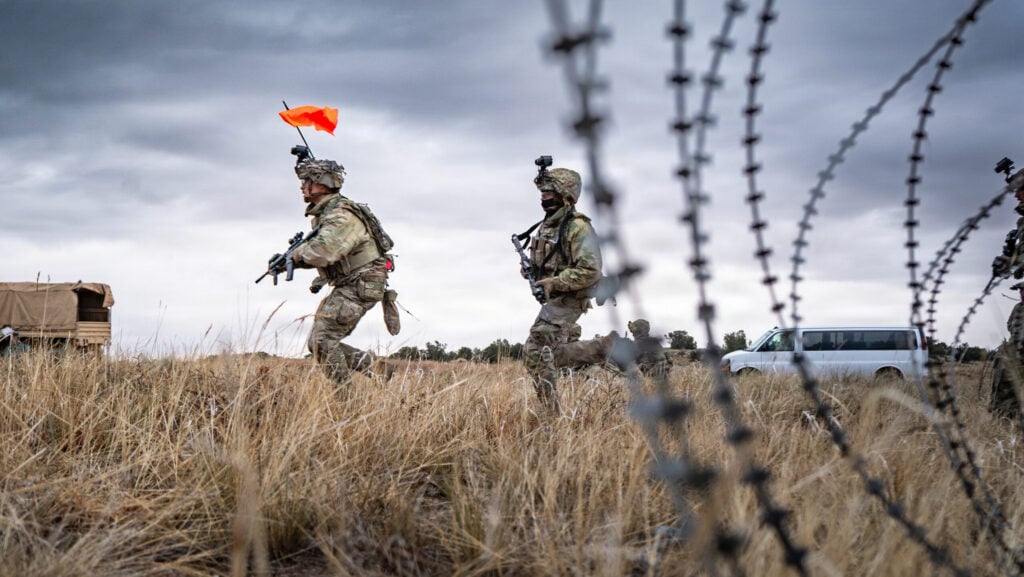
FORT CARSON, Colo. — It started by happenstance. Last summer, a senior Army special forces leader was on a routine visit to Fort Carson to see 10th Special Forces Group when he got to talking to the commander of the 4th Infantry Division, which also resides at the base.
The 4th ID commander, Maj. Gen. Patrick Ellis, mentioned the conventional unit’s work with a prototype of the Next Generation Command and Control (NGC2), the Army’s high-priority, high-profile network modernization effort. The talk made enough of an impression that word got back to 10th Group: “Figure out what it is.”
To do that, Maj. Jaysin Williams, 10th Group’s SOF NGC2 Integration Director, told Breaking Defense he found his way into a 4th ID briefing — and a lightbulb went off.
“I immediately saw like, oh man, this is going to change everything. This is really big,” he said. “I could see the digital kill chain already, just from the way [Ellis] was briefing it and I knew that we needed to do something to get involved and understand how we fit in this new architecture. I went back and I just kind of started working on it.”
Williams revealed to Breaking Defense that 10th Group since has been involved in several NGC2 prototyping experiments, known as the Ivy Sting series, culminating in last week’s Ivy Mass exercise, perhaps the largest test of NGC2 in a contested electronic warfare environment yet. The experiments have opened eyes for special operations forces.
“Because of what 4th ID and Next Gen C2 is doing over here, that’s forcing SOCOM [US Special Operations Command] to take a hard look at the way that they’ve done business,” Williams said. Now, 10th Group is “pioneering NGC2” for all of SOCOM, he said.
Following those initial planning meetings, Williams initially outlined three areas of focus for where he wanted to fit into the ongoing NGC2 efforts as he sought to participate in the Sting series. First was sharing position location information with the conventional forces —too often, he had seen fratricide between SOF and conventional forces.
Second, was helping to evolve and inform the targeting cycle, spurred on by changes in new technologies and processes.
“I knew that we had to find a way to inform that targeting process in a digital way. Otherwise, you have a guy coming over to the JAGIC [Joint Air Ground Integration Cell] with a sticky note, they’re like, yeah, cool dude, I don’t know what to do with that,” he said. “I knew that that was really important. I didn’t know exactly what that meant yet, but I knew that that was important.”
The third focus area was more broad, looking at applications being developed and trying to help inform them.
The Sting Series
In July 2025, the Army awarded Anduril and a team of vendors a contract to prototype scaling NGC2 to an entire division, in this case, 4th ID. The division undertook a series of sprints called Ivy Sting, each adding incremental capability. (Lockheed Martin is leading another, parallel NGC2 prototyping effort with the 25th ID.)
Those Sting sprints were building up to Ivy Mass, a force-on-force training event with the division playing out a large scale combat operations scenario maneuvering against a live opposing force at Piñon Canyon Maneuver Site, a massive training range, roughly 238,000 acres, about 100 miles south of Fort Carson.
For each Sting event, 10th Group has been a participant, first as a command post element informing the scenario, and then with ground maneuver forces. During Ivy Mass, the Special Forces group had an Operational Detachment Alpha at Piñon Canyon conducting special reconnaissance for 4th ID, serving as a liaison with the JAGIC.
A key part of the NGC2 tie in, in addition to helping develop better practices for SOF, is better SOF-conventional force integration. Due to its unique mission sets, SOF is often at the tip of the spear for any engagements, meaning they can be among the first to fight but also can serve as spotters and sources of battlefield intelligence for the Joint Force.
“I think the secret sauce is that SOF has always been a sensor for the conventional force. … What you’re seeing now is technically, probably been possible for a long time. The problem is that it’s been limited by the cognitive abilities of the humans that had to look at all the stuff,” Williams said.
At Ivy Sting 4 in February, he noted the demonstrated use of a kill chain in under two minutes, passing data from a commercial sensor, through multiple staff sections from both conventional and SOF, to an effector to shoot.
Those kinds of demonstrations have forced the SOF community to “take a hard look at that and say, ‘hey, how do we create the digital architecture of our own?’” Williams said.
“What I found was that on the SOF side, we had the makings and the pieces to create a digital kill chain, but they weren’t really coalesced into a coherent digital kill chain,” Williams said. “Ivy Mass is our opportunity to stretch that that kill chain out, use more green radios, tactical radios. We’re working through some friction with waveforms and this and that.”
Bringing NGC2 To SOF
Williams recently briefed at a SOF-focused technical exchange meeting at Fort Bragg, focused on what the next steps for taking advantage of next-gen C2. It featured industry engineers, Army team members and the newly established Army Data Operations Center.
After they’ve been able to integrate and demonstrate these capabilities, Williams said the next step is SOF owning a data layer.
While that already exists to some degree, Williams said they want to be able to pull the core baseline of NGC2 applications that the Army and 4th ID have developed into SOCOM’s information environment and leverage those tools for the broader SOF enterprise.
“What 4th ID is built is incredible, and I honestly don’t think we need to change much, if anything at all. I think we’re just going to use it slightly different than the way that … because we look at the fight slightly different than the conventional force does,” he said.