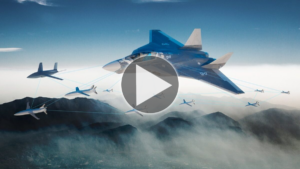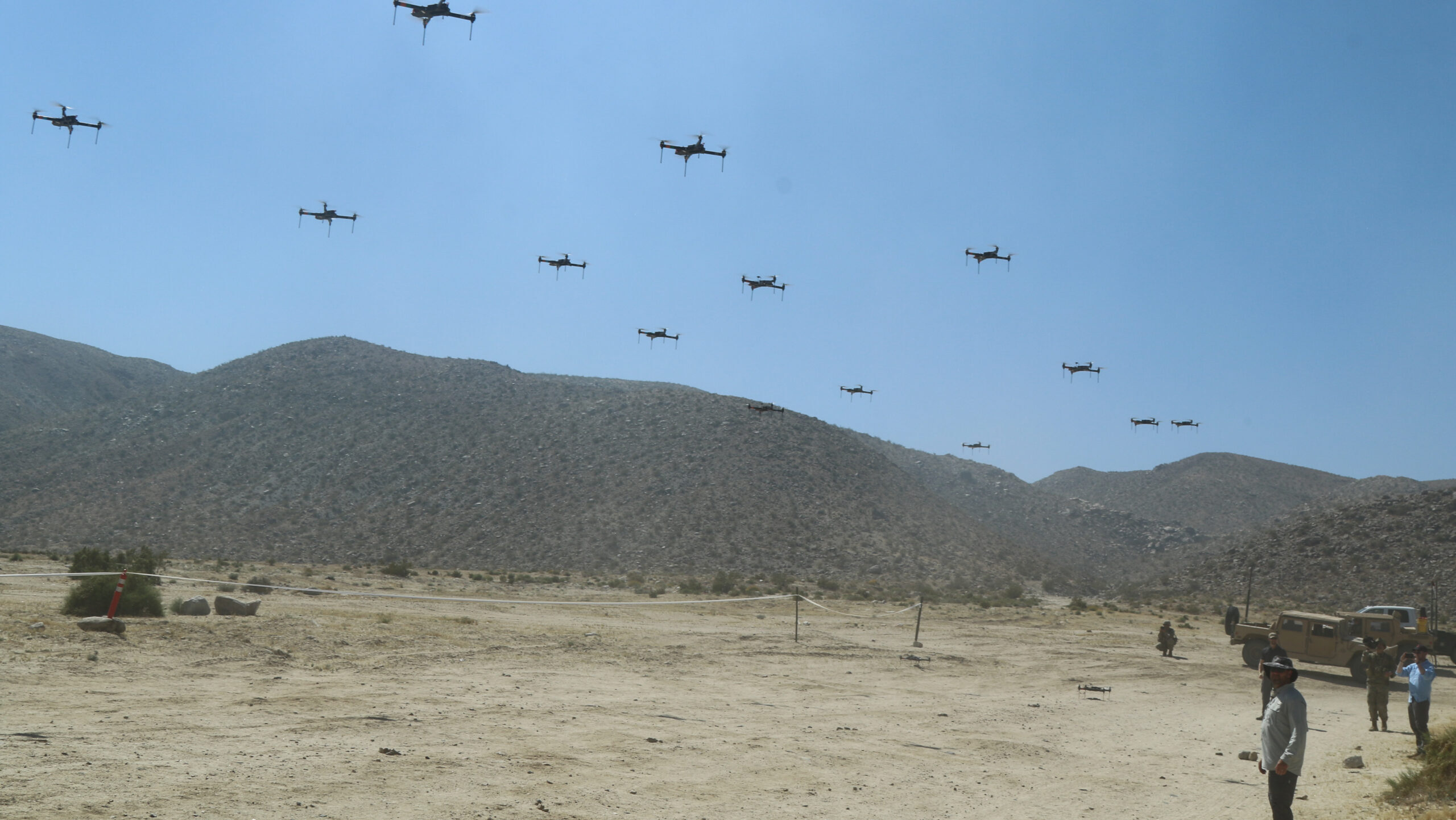
WASHINGTON — L3Harris today announced it is unveiling a new command and control software, dubbed “AMORPHOUS,” designed to control thousands of unmanned systems in a “swarm,” joining a number of other companies in recent years that have homed in on that technology as a gap in the Pentagon’s arsenal.
“There have been concepts that have said maybe you need one particular asset that is referred to as the mothership, or the brains of the operation,” Jon Rambeau, president of integrated missions systems, told reporters last week. “We believe that’s not the best approach, because if something happens — that asset is degraded, it’s attacked, it’s no longer able to communicate, then what happens?”
The answer, Rambeau said, is that AMORPHOUS is designed to pass control of the swarm from one asset to another on the fly. Toby Magsig, vice president of autonomy programs, added that the idea behind a “leaderless swarm” is that the user sends out instructions — for example, conduct a search of the area — to every asset in the swarm, but the drones intelligently delegate tasks among themselves.
AMORPHOUS — Autonomous Multi-domain Operations Resiliency Platform for Heterogeneous Unmanned Swarms — is currently being used on contracts for the Army and the Defense Innovation Unit. To date it has demonstrated the ability to control “multiple separate assets across multiple vehicle types operating in different domains during government-managed tests.”
Asked about how large of a swarm AMORPHOUS has controlled to date, Magsig said the top number has been in the “double digits,” and he believes it will soon exceed 100.
“It becomes an economy of scale in terms of testing this live, when you talk sort of four digits … and so that’s where we rely on a Live, Virtual, Constructive mix to get and test and validate this scalability to what DOD is really looking for,” he said.
Rambeau and Magsig acknowledged their product is joining a crowded field of competitors. Indeed, companies such as HII and Swedish defense giant Saab, among others, have all recently been making plays into software development focused on unmanned systems command and control.
L3Harris’s pitch may be among the more ambitious in scale but it’s unclear how the Pentagon — or more precisely, each of the individual services — will approach the question of controlling thousands of drones in concert on a joint battlefield.
Breaking Defense Video