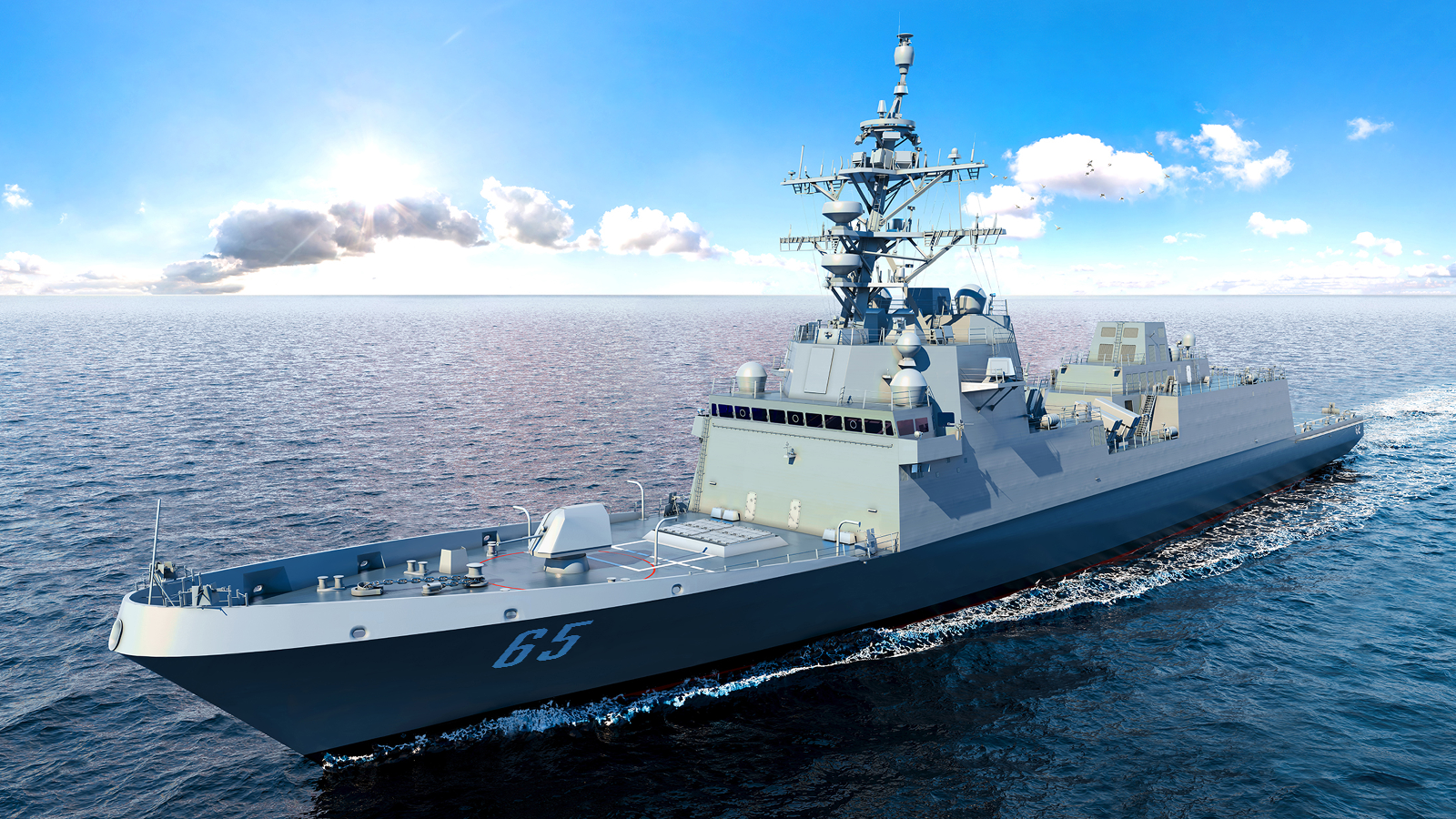
SEA AIR SPACE 2025 —The Navy is at a make-or-break moment with its over-schedule, over-budget Constellation-class frigate and needs to quickly nail down an achievable design, even if it doesn’t meet every single one of the service’s mission needs, two Republican lawmakers said today.
“We are at a tipping point with Constellation,” Rep. Rob Wittman, R-Va., a seapower advocate who chairs the House Armed Services Committee’s (HASC) tactical air and land forces subcommittee, told the audience at the Sea Air Space conference this morning.
“The question is, are we at a point where we either quickly recover and get back on track with this? … Or do you say maybe we’re too far along with this and we go in a different direction? The Navy is going to have to ask that question now,” he said. “It can’t push it off in the future.”
Early in the Constellation-class frigate’s life, the Navy assured lawmakers it would avoid the mistakes of the Littoral Combat Ship program by relying on a parent design, eventually settling on the FREMM multipurpose frigate designed by Italian shipbuilder Fincantieri. By using an existing design as its basis and adding in US-specific modifications such as the Aegis combat system, the Navy said it could lower development risk.
Five years after the service awarded a contract to Fincantieri Marinette Marine in Wisconsin, the program is now at least three years behind schedule as requirements have ballooned — a situation that has triggered ire on Capitol Hill, with Congress zeroing out about $1 billion of procurement funding for the program in fiscal 2025.
“We can’t do the Pentagon Wars thing,” said Rep. Trent Kelly, R-Miss., who chairs HASC’s seapower and projection forces subcommittee, referencing a famous scene in the 1998 film where the requirements for the Army’s Bradley Fighting Vehicle gradually morphs from a lightly armored wheeled troop carrier into a heavy tank-like vehicle.
“You’re better off violently executing to build 85 percent of the ship that you want, rather than having 0 percent because either the old ones are too old to work anymore, or the new ones are 10 years away in production. What we have to do is get a good idea, do it quickly, and then we have to invest in that and build it,” he said. “And then when we do something, you can’t keep making the changes which drive up cost, drive up time, and sometimes wind up having not even a product at the end of it.”
Wittman said he is “fully in favor” of funding a frigate class, but is frustrated by the Navy’s seeming inability to learn from its past mistakes. He pointed to the service’s Littoral Combat Ship program, which involved the design and construction of two variants of ships equipped with modular packages of mission equipment that could be swapped on and off as needed to contend with different types of threats.
As the service grew more concerned about near-peer threats like China, LCS — developed to fight Iran in the shallow littorals of the Strait of Hormuz — was no longer seen as priority, and the program failed to deliver on the promise of truly modular ships. After schedule delays, cost overruns, and readiness problems, the Navy ultimately cut the program short after 28 ships.
“What we have to look at is making sure that we are very mindful of the lessons of the past. Look at LCS and what that turned into be: two hull forms and, all of a sudden, retiring a lot of those early. The question is, why?” Wittman said.
The Constellation program started with a concept that was going to be 85 percent derivative of its parent ship, but the situation has now “reversed” and has led to a design that is “15 percent the original design, 85 percent add-ons,” he said. The question about the path forward for the Constellation-class is the “same question that should have been asked with LCS years and years ago.”
PHOTOS: Sea Air Space 2025

 Gallery