
WASHINGTON — President Donald Trump’s recent threat to decertify and impose steep levies Canadian-made commercial jets is designed to pressure Ottawa, but it’s unclear if the fallout could also extend to planes used by the US military.
“Based on the fact that Canada has wrongfully, illegally, and steadfastly refused to certify the Gulfstream 500, 600, 700, and 800 Jets, one of the greatest, most technologically advanced airplanes ever made, we are hereby decertifying their Bombardier Global Expresses, and all Aircraft made in Canada, until such time as Gulfstream, a Great American Company, is fully certified, as it should have been many years ago,” Trump said in a post on his social media platform Truth Social late Thursday.
“Further, Canada is effectively prohibiting the sale of Gulfstream products in Canada through this very same certification process. If, for any reason, this situation is not immediately corrected, I am going to charge Canada a 50% Tariff on any and all Aircraft sold into the United States of America,” Trump continued, adding, “Thank you for your attention to this matter!”
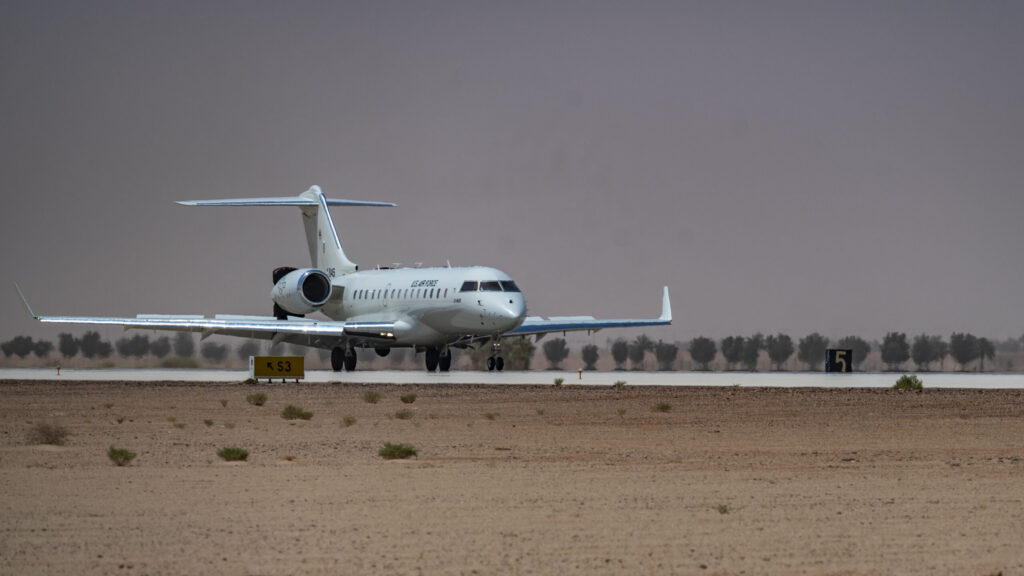
Trump appeared to be referring specifically to civilian aircraft, but his screed raised the question of whether converted military assets could also be in the crosshairs. The US military already flies multiple Canadian airframes used in missions from surveillance to airlift, and is in the midst of potentially acquiring many more.
When Breaking Defense asked the White House whether Trump’s statement would impact military planes in service or future acquisitions, an official did not differentiate between civilian and military platforms, only telling Breaking Defense that any new mandates would affect future aircraft rather than what’s already in use.
The US military and Federal Aviation Administration technically run parallel, separate aircraft certification processes so military aircraft “shouldn’t be impacted by this nonsense,” according to Richard Aboulafia, managing director at AeroDynamic Advisory, who added that interfering in military air assets would be “another big stupid kettle of fish.” He acknowledged to Breaking Defense, however, that as commander-in-chief, Trump could have more influence over the military certifications than those run by the FAA.
If the hammer does come down on military airframes, it could be felt most strongly in the Air Force and the Army.


Support for Patriot air-and-missile defense is a case study for the industrial base
Manufacturing scale, global sustainment, and next-gen tech are becoming inseparable.
Canadian manufacturer Bombardier, for example, has pitched a modified business jet to serve as a VIP airlifter and even a refueler amid a US Air Force quest for a next-gen tanker.
Bombardier’s Global 6000 is currently the basis for the Air Force’s E-11 BACN airborne communications node. The Air Force’s FY26 budget did not request procurement dollars for any new E-11s, but it’s not clear if a delivery in September is the final planned for the program. Northrop Grumman, which is in charge of militarizing the airframe for the E-11 mission, did not respond to a request for comment for this report. Also the Air Force P-9A Pale Ale used for maritime patrol, for example, is based on the Canadian-built De Havilland DHC-8.
Meanwhile, the Army’s High Altitude Detection and Exploitation System, or HADES, spy plane is based on Bombardier’s Global 6500. For that program, Sierra Nevada Corporation (SNC) is on contract to trick out the aircraft with tools that provide advanced, deep-sensing capabilities for multi-domain operations. The company, which declined to comment, has developed two prototypes and plans to start work on a third this year. It also has plans to develop one non-prototype for the program based on the Global 6500, though a recent request for information for more jets could potentially open the program to other vendors beyond Bombardier.
The Army also uses the 6500 for its ARES (Airborne Reconnaissance and Electronic Warfare System) jet, another deep-sensing ISR platform. The service’s ATHENA (Army Theater-Level, High-Altitude Expeditionary-Next Airborne) platform is additionally based on the 6500. ATHENA comes with two variants: the first being ATHENA-S, which is a signals intelligence jet that detects air-defense radars and other nodes in the sky, whereas ATHENA-R is a radar variant that tracks moving targets on the ground.
Rounding out the Greek-mythology-themed surveillance suite is the Army’s Airborne Reconnaissance and Target Exploitation Multi-mission System, or ARTEMIS, which uses Bombardier’s Challenger 650. The program was the Army’s first go at putting sensors on a high speed jet after typically relying on turboprops.
Though the ARES, ATHENA and ARTEMIS programs are still being flown by the Army, they were designed to be a testbed for the HADES program. Once HADES aircraft are fielded, according to the Army, the “bridging systems” will be retired. As Breaking Defense previously reported, the service plans to field the initial HADES aircraft by the end of this year or beginning of next year, with full production picking up in the 2030s.
The US Navy flies some Canadian-built aircraft, like the UV-18 Twin Otter based on the De Havilland DHC-6 and used for research, as well as the tail-dragger NU-1B Otter for short takeoff and landing training. The U-6A Beaver prop plane is additionally used for training and as a tow aircraft for the X-26 Frigate sailplane.
And that’s just the fixed-wing aircraft. It’s unclear from Trump’s comments if rotorcraft, some of which are also militarized by the Pentagon, would also be imperiled.
The Air Force referred queries to the White House, and the Army did not respond to a request for comment by press time. The Navy referred comments to OSD, though OSD did not respond to requests for comments by press time.
For its part, in a statement Thursday, Bombardier said it has “taken note of the post from the President of the United States to social media” and that the company is “in contact with the Canadian government.
“Bombardier is an international company that employs more than 3,000 people in the U.S. across 9 major facilities, and creates thousands of U.S. jobs through 2,800 suppliers,” the statement continued. “Thousands of private and civilian jets built in Canada fly in the U.S. every day. We hope this is quickly resolved to avoid a significant impact to air traffic and the flying public.”
Canadian officials reportedly are in contact with their American counterparts to resolve the issue.
Beyond Canadian jets alone, Trump’s comments may not bode well for another military platform: the F-35. Last year, the Canadian military revealed it was reevaluating plans to procure the American-made aircraft, though a final decision has not yet been announced.