Across Europe’s evolving battlespace, two parallel airpower revolutions are unfolding.
One is defined by high-end threats: fast-moving fighter aircraft, stealthy cruise missiles, and long-range aerial incursions by peer-state adversaries. The other is being waged with low-cost drones, loitering munitions, and coordinated swarms that saturate and overwhelm traditional defenses.
European security planners are now confronting the hard truth: defense systems optimized for one are often ill-suited to detect or defeat the other.
Enter GA-ASI. The company has announced a groundbreaking partnership with Saab to develop an AEW mission package for its MQ-9B-series unmanned aerial system (UAS), which will be an affordable solution designed specifically for both threats.
“Whether it’s a high-altitude threat aircraft or a low-flying cruise missile, MQ-9B with AEW gives decision-makers the ability to detect, track, and respond at a fraction of the cost of legacy AEW platforms,” said Jamie Walters, Vice President of International Strategic Development for GA-ASI. “Together with our partners at Saab, we’re poised to deliver cost-effective air dominance in an age of growing asymmetric threats.”
Redefining Early Warning for a New Era
For decades, early warning missions have depended on large airliner-derived, human-crewed aircraft. While highly capable, these assets also are expensive, few in number, difficult to maintain, and often over-committed across big theaters of operation.
At sea, airborne early warning either required its own dedicated human-crewed fixed-wing aircraft — also costly and vulnerable — or a compromise system carried aboard a human-crewed helicopter — slow and barely adequate for mission needs.
The MQ-9B-series aircraft with AEW fill these crucial gaps, providing persistent surveillance of both high-end and low-end aerial threats over NATO territory and contested regions. MQ-9B Short Takeoff and Landing, or STOL, provides a lower-cost, highly capable AEW capability to aircraft carriers at sea.
As a large medium-altitude, long-endurance (MALE) aircraft, the MQ-9B will detect targets flying close to the surface or below the ground radar’s line of sight, such as low-observable cruise missiles attempting to evade traditional air defenses or fast-attack aircraft attempting to hide amongst terrain for surprise strikes.
Crucially, the new AEW-equipped MQ-9B is being designed to complement existing manned theater AEW and maritime patrol platforms.
In a teaming role, MQ-9B can operate as an advanced sensor node to extend the range and coverage of manned platforms, feeding real-time target and surveillance data back to command centers or to the manned assets themselves.
And in a high-threat environment, MQ-9B can be deployed forward into contested airspace, reducing risk to pilots by performing missions that might be too dangerous for manned aircraft while remaining connected via secure, resilient communications.
“Nations are looking for smarter ways to extend their defense capabilities without overstretching their aircrews and budgets,” Walters said. “With the MQ-9B AEW configuration, we’re offering a force multiplier that strengthens existing manned-unmanned teams while introducing an entirely new level of mission flexibility.”
Drone Swarms and Beyond
The war in Ukraine has exposed the growing threat of saturation drone attacks in which dozens or hundreds of UAVs are deployed simultaneously to overwhelm layered defenses. Ground-based radars often struggle to detect such threats early enough to respond.
MQ-9B with AEW gives defenders critical time and space to identify threats from tactically relevant ranges, classify and prioritize them, and then enable defenders to put interceptors or electronic warfare systems into action.
With the significant flight times of the world’s leading medium-altitude, long-endurance aircraft, MQ-9B can provide persistent radar coverage of critical infrastructure, frontlines, and maritime chokepoints without the costs or logistical burdens of manned AEW platforms.
Working from ships at sea, MQ-9B STOL with AEW gives organic big-picture awareness to air and naval component commanders to defend an aircraft carrier strike group or support an air wing working missions against targets deep inland.
And unlike other ISR UAS, MQ-9B’s AEW role is active and responsive — not just collecting data but enabling decision-making at the speed of modern conflict.
Proven, Certified, and Operationally Flexible
MQ-9B is not just a concept, it’s a fieldable solution in production today that’s battle tested and, crucially, safe to operate in populous areas. In May, the MQ-9B became the first remotely piloted aircraft in its class to receive a Military Type Certificate, awarded by the U.K.’s Military Aviation Authority. It is NATO STANAG 4671-compliant, making it interoperable across allied airspace and command frameworks.
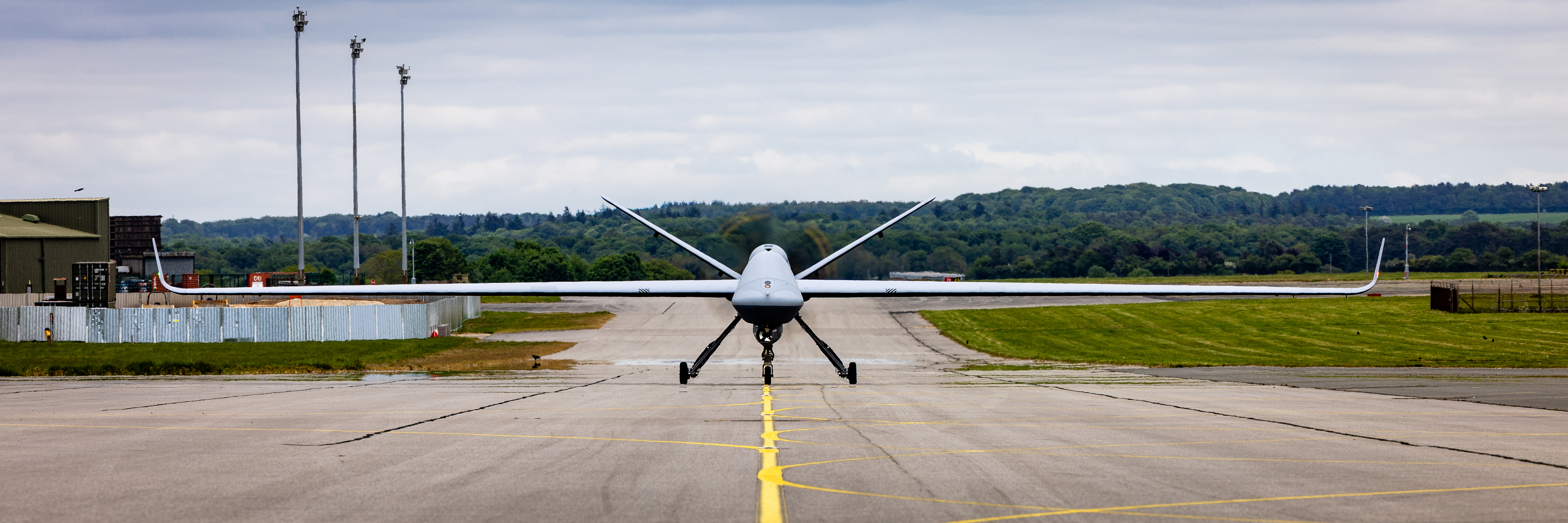
(Photo: Royal Air Force)
As peer adversaries expand their missile arsenals and drone production lines, nations are racing to enhance air domain awareness and defend against emerging aerial threats.
The MQ-9B-series aircraft with AEW answers this call, offering persistent wide-area air surveillance across the full spectrum of threats; cost-effective and scalable AEW coverage for high-risk zones; seamless integration into NATO’s evolving air and missile defense infrastructure; and rapid deployability for crisis response, border security, and strategic deterrence.
From defending critical infrastructure to monitoring maritime corridors, to patrolling Europe’s threatened Eastern front, the MQ-9B with AEW is positioned to become a core component of Europe’s next-generation air defense network.
“European allies are facing a new kind of air war,” Walters said. “The MQ-9B-series with AEW gives them one solution that sees everything and responds to everything.”
PHOTOS: Paris Air Show 2025
 Gallery