
UPDATE 6/23/2025 at 3:08pm ET: On Monday the Pentagon said Iran fired short- and medium-range missiles at al Udeid Air Base in Qatar, which hosts the regional headquarters for US Central Command and thousands of US troops. A defense official said there have been no reports of US casualties as a result of the strikes.
WASHINGTON — Hours after the US conducted a surprise, significant military operation against three Iranian nuclear sites, top defense officials unveiled the details of what the Pentagon called Operation Midnight Hammer, which involved seven B-2 bombers and the first known operational use of a 30,000-pound bunker buster bomb.
“The president authorized a precision operation to neutralize the threats to our national interests posed by the Iranian nuclear program and the collective self-defense of our troops and our ally, Israel,” Defense Secretary Pete Hegseth told reporters today.
While Chairman of the Joint Chiefs Gen. Dan Caine said a battlefield assessment is ongoing to evaluate the strikes, Hegseth called it “an incredible and overwhelming success.”
Caine, a newly minted four-star general, went on to some detail just how that US carried out the strike, saying it involved more than 125 US aircraft, “dozens” of aerial refueling tankers, a guided missile submarine and firing approximately 75 precision guided weapons.
Caine explained that around midnight on Friday a “strike package” with seven B-2 Spirit bombers departed Whiteman Air Force Base in Missouri, flying east for 18 hours with “minimal communications” towards the “target area.”
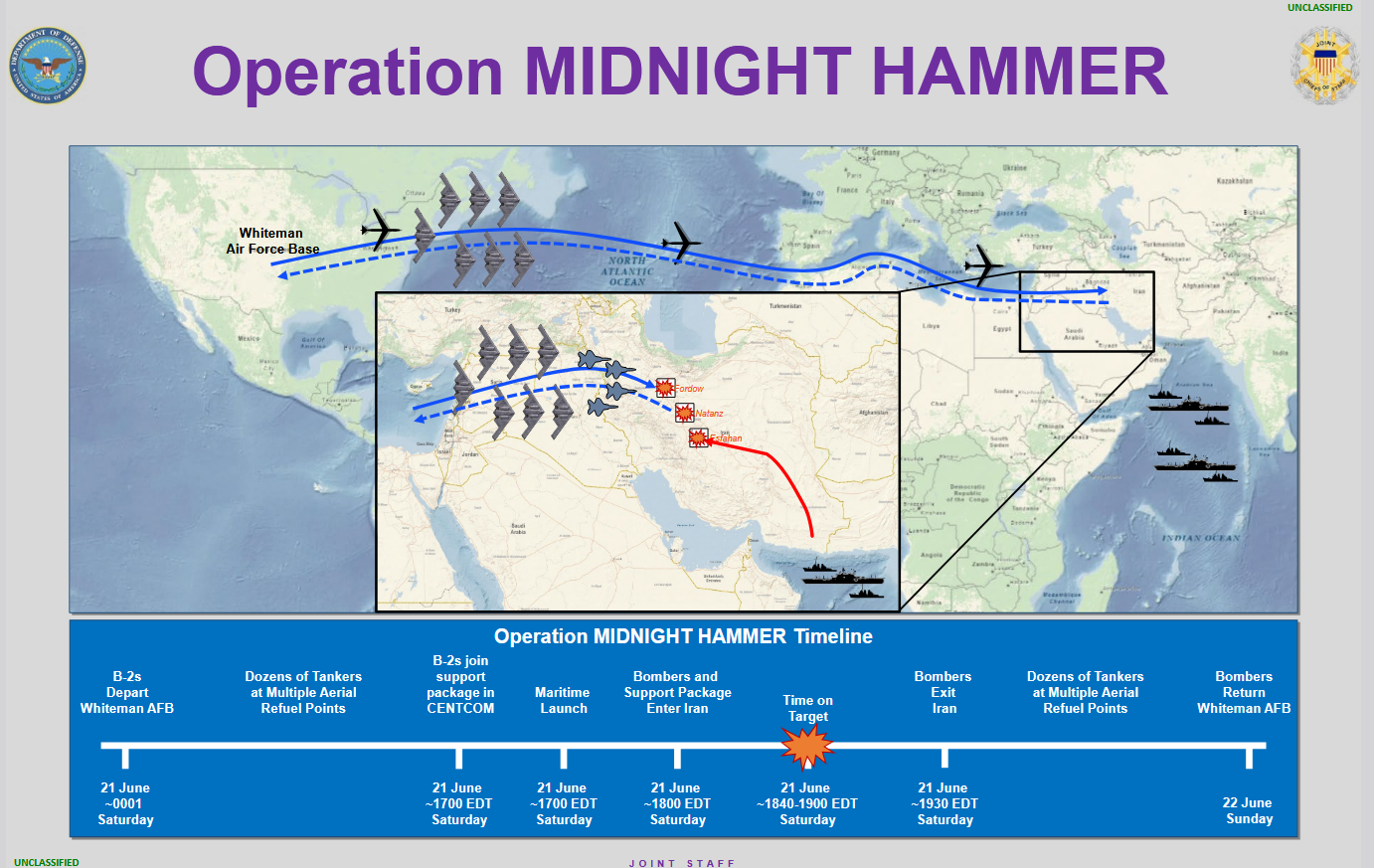
Once those aircraft were over land again, they “linked up” with escort and support aircraft “in a complex, tightly timed maneuver requiring exact synchronization across multiple platforms in a narrow piece of airspace,” Caine said.
By Saturday around 5 pm ET, just before the strike package was ready to enter Iran, a US submarine located inside the US Central Command area of responsibility launched more than two dozen Tomahawk land-attack cruise missiles against “key” surface infrastructure targets at the Isfahan site.
“As the Operation Midnight Hammer strike package entered Iranian airspace, the US employed several deception tactics, including decoys, as the fourth- and fifth-generation aircraft pushed out in front of the strike package at high altitude and high speed, sweeping in front of the package for enemy fighters and surface to air missile threats,” Caine explained.
FULL COVERAGE:
- Left of boom: Israeli strikes concentrate on Iranian missile threat
- Why Hezbollah might sit out the Israel-Iran conflict
- Will Israeli strikes impede Iran’s defense exports to Russia?
- ANALYSIS: What missiles does Iran have to launch against Israel, and how far can they go?
- Will Israel’s new war with Iran spill over into the region?
As the strike package approached Fordo and Natanz, the US deployed “high-speed suppression weapons” to allow for a safer approach around 6:40 pm ET.
The lead B-2 bomber then dropped two GBU 57 Massive Ordnance Penetrators on the “first of several aim points at Fordo,” Caine said, noting that in total, 14 MOPs were dropped in target areas at Fordo and Natanz.
Once the bombers had dropped the MOPs, those previously launched Tomahawk missiles struck Isfahan, he added.
“Following weapons release, the Midnight Hammer strike package exited Iranian airspace, and the package began its return home,” Caine said.
Caine said that it does not appear the US jets were fired upon during the operation. “Iran’s fighters did not fly, and it appears that Iran’s surface to air missile systems did not see us,” he said.
Hegseth said that congressional leadership was notified of the operation as soon as American planes were out of danger. (On X, White House Press Secretary Karoline Leavitt said the White House made “bipartisan courtesy calls” to congressional leadership, speaking to minority leader Sen. Chuck Schumer “before the strike,” though unable to reach House Democrat leader Rep. Hakeem Jeffries until after.)
As for the effectiveness of the strikes, Caine said a “final battle damage will take some time, but initial battle damage assessments indicate that all three sites sustained extremely severe damage and destruction.”
The US, a backer of Israel, is the only known country with the ability to penetrate Iran’s nuclear sites deep underground and to do so, required the bombers dropping the 30,000-pound MOP for the first time in an operations setting.
“This is a plan that took months and weeks of positioning and preparation so that we could be ready when the President of the United States called,” Hegseth said. “It took a great deal of precision. It involved misdirection and the highest of operational security.”
Now, all eyes will be on Tehran and how the Islamic Republic responds, as well as on whether the US conducts further action.
Hegseth said the Midnight Hammer mission “was not, has not, been about regime change, but later Sunday President Donald Trump posted on Truth Social that if the “current Iranian Regime is unable to MAKE IRAN GREAT AGAIN, why wouldn’t there be a Regime change??? MIGA!!!”
UPDATED 6/22/2025 at 5:40pm ET to include Trump’s comments about “regime change” in Iran and White House comments about notifications to congressional leadership.