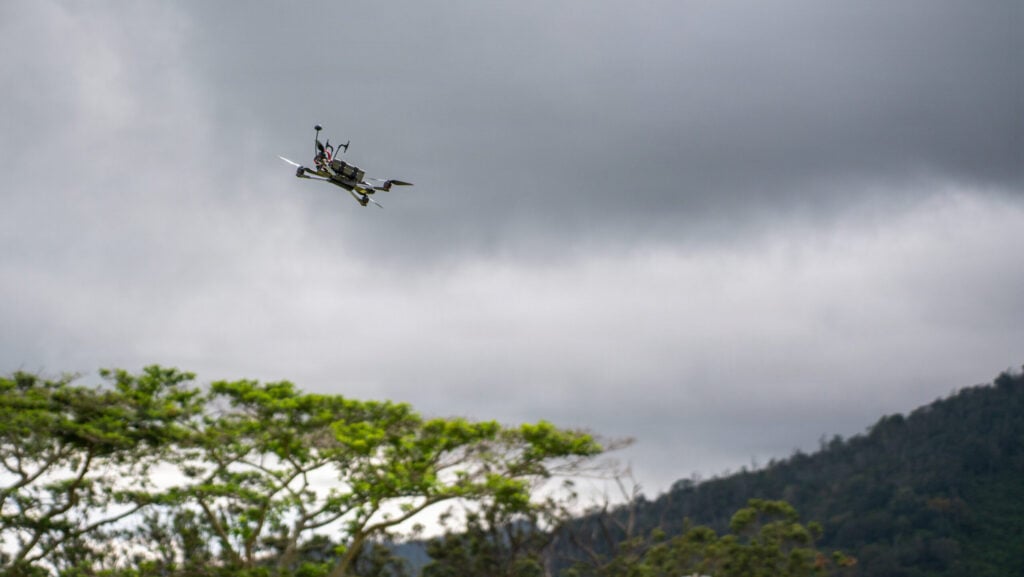
WASHINGTON —The Pentagon has begun accepting small, one-way attack drones as part of its larger push to boost production and provide every squad with the weapon later this year, according to the program’s website.
In total, the Department of Defense has ordered a total of 20,000 small, first-person view (FPV) drones from 10 of the top 11 vendors that competed in its Gauntlet 1 competition, according to the Drone Dominance “Leaderboard” website. That figure is 10,000 shy of the previously predicted order figure, though the company in third place, Napatree, has not yet been awarded a deal.
According to Leaderboard, Neros, which produces the Archer small quadcopter, is leading deliveries, having shipped all 2,400 of its ordered drones to the military with 1,040 of those accepted. The rest of the pack has now shipped a combined 560 drones to the Pentagon, all awaiting acceptance, while the remaining drones are in various states of production.
Cheap, FPV-style drones have played a prominent role in the Ukrainian and Russian war, leaving a string of combat vehicles from both sides smoldering on the battlefield. As the US has gleaned lessons from that conflict, Defense Secretary Pete Hegseth issued a directive last summer to “unleash” the drone industrial base, and have every squad outfitted with the small, one-way attack drones by the end of fiscal 2026.
“While global military drone production skyrocketed over the last three years, the previous administration deployed red tape,” Hegseth wrote in the Unleashing US Military Drone Dominance memo. “US units are not outfitted with the lethal small drones the modern battlefield requires.”
The Pentagon is now moving out with a broader plan to spend roughly $1 billion purchasing drones within a two-year window. As part of that push, it hosted the initial “Gauntlet” competition consisting of 25 companies competing before ranking the top 11 vendors.
Separately, the department tapped five additional companies as winners of a “lethality” challenge — Bravo Ordnance, Kela Defense, Kraken Kinetics, Mountain Horse and Northrop Grumman — to possibly provide payloads for Group 1 drones, those weighing 20 lbs. or less.
Looking ahead, the department is planning to host a second Gauntlet event to find drones ideally suited for long-range strike and tactical assault in close quarters operations. So far, the department’s website said 49 companies have been asked to bring 79 “unique” drones to Camp Grayling, Mich., for a qualifier event.
As the department moves out with its Gauntlet-style approach for evaluating various types of drones, the services are continuing to test and buy drones. Earlier this week, for example, the Army announced that it has awarded Griffon Aerospace with a $68 million deal to deliver an unspecified number of Outlaw Gen 3 drones by the end of March 2027 “in support” of the US war against Iran. While a company official declined to provide details about the Gen 3 design, the Outlaw Gen G2E is listed as a fixed-wing aircraft that is 8.7 ft. long with a 16ft. wingspan and can carry payloads between 20lbs. and 40 lbs. As for missions, the company lists the drone as ideal for intelligence, surveillance, and reconnaissance operations.
Breaking Defense Video