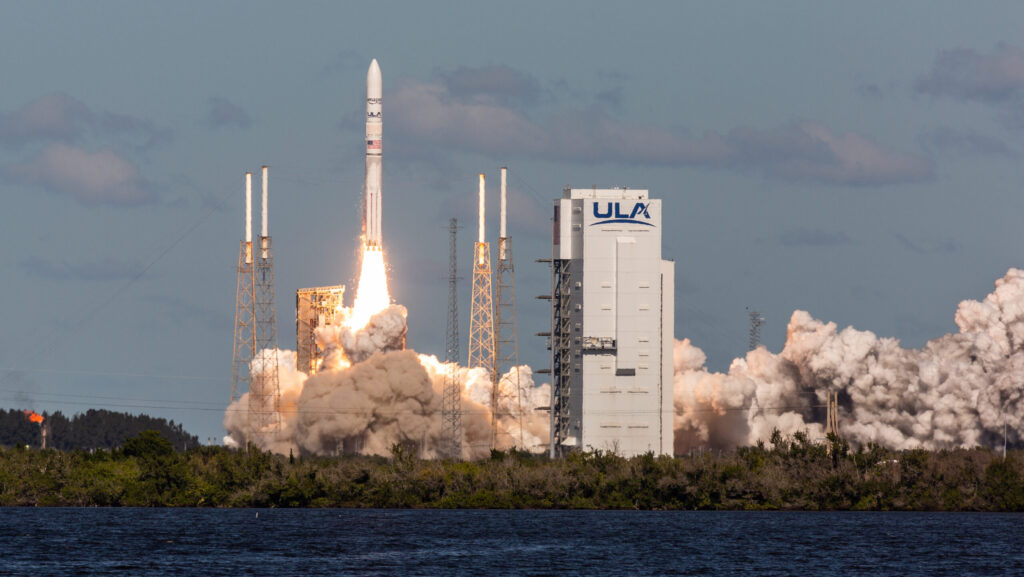
WASHINGTON — Sunday’s failed launch of United Launch Alliance’s (ULA) Vulcan rocket adds to growing concerns about the Space Force’s hopes to dramatically increase its launch cadence over the next few years.
The Vulcan suffered an anomaly about 10 minutes after liftoff, preventing the rocket from reaching orbit and destroying 40 satellites for Amazon LEO’s planned broadband network for low-Earth orbit. The failure will likely trigger a lengthy investigation that could ground the rocket for months, further limiting the number of US rockets available for both national security and commercial customers.
The incident further cements SpaceX’s near monopoly on US space launch. Aside from Vulcan, SpaceX’s Falcon 9 and Falcon Heavy are the only rockets currently authorized to carry critical payloads under the Space Force’s National Security Space Launch (NSSL) Phase 3 Lane 2 program — given that Blue Origin’s New Glenn also remains grounded following a launch pad explosion in May.
“We can hope that whatever caused this problem gets fixed. We can hope that Vulcan, New Glenn and other medium-lift vehicles come online soon, but this is really the same place we have been for the last several years,” Clayton Swope, deputy director of the Aerospace Security Project at the Center for Strategic and International Studies, told Breaking Defense. “But the launch bottleneck is real and set to get worse.”
While the failed Vulcan mission was carrying a commercial payload, it was also designed to serve as an important step toward the rocket’s return to the Space Force’s NSSL program.
Vulcan was grounded by the service in late February due to persistent problems with its solid rocket boosters. By Oct. 1, the Space Force reassigned six NSSL missions previously manifested on Vulcan to SpaceX.
ULA has yet to publicly announce the cause of the rocket’s failure shortly after liftoff, but the problem appears to have occurred in the booster stage, according to a report in Ars Technica. If the rocket’s BE-4 engines were involved, the failure could also have implications for Blue Origin’s New Glenn, which uses the same engines.

Mojave STOL and Gray Eagle® 25M: Complementary capabilities for the modern battlefield
Both aircraft are designed to evolve as threats and mission requirements change.
“If the issue is with the BE-4 that is a particularly thorny problem — for the Pentagon, for NASA, for Amazon and for anyone who needs a ride to space,” Swope said.
Meanwhile, SpaceX is making progress with development of its new, fully reusable Starship super-heavy launch vehicle. During a test flight on Nov. 14, the company demonstrated for the first time its ability to capture the rocket’s massive upper stage.
The company plans to shift all of its own launch operations to Starship around 2030, phasing out its Falcon rockets In September, SpaceX stopped taking commercial orders for Falcon rides post 2028. The company has also yet to announce plans to offer Starship launches to commercial or military customers.
Those decisions have caused widespread concerns about a potential multiyear gap between demand for US launch services and available capacity.
“I don’t see a magic wand here. I mean, the only thing that could happen is that somebody persuades Elon to keep Falcon 9 flying until there are viable alternatives,” said Martin Halliwell, of Luxembourg-based private equity firm New Space Capital.
Breaking Defense Video