
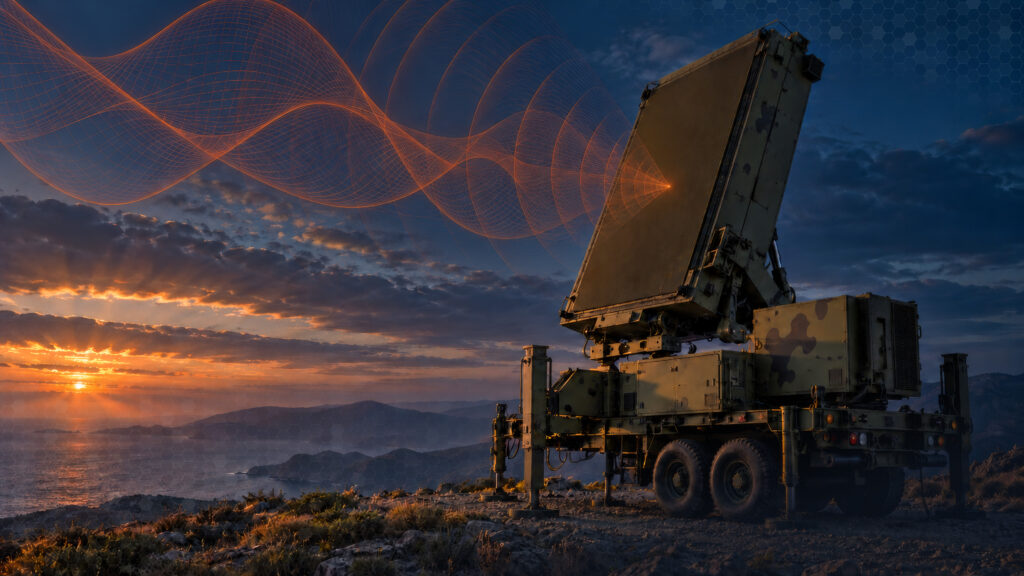
Military necessity to respond to emerging threats in near-real time is putting pressure on a traditional acquisition process built on lengthy Research, Development, Test, and Evaluation (RDT&E) cycles before a new capability can pass to warfighters. Nowhere is that more apparent than in radio frequency (RF) technology, where rapidly changing electronic warfare (EW) threats, new communications requirements for command and control, and expanding missions are forcing the defense industrial base to deliver more capability in less time.
The challenge extends beyond designing faster processors or more powerful RF amplifiers. Defense electronics must meet increasingly demanding size, weight, power, and thermal constraints for autonomous platforms, for example, while remaining adaptable to new waveforms, frequencies, and operational requirements. At the same time, supply-chain limitations and production schedules are the determining factor in how quickly those systems reach the warfighter.
For companies supplying electronics to prime contractors, the answer increasingly involves adapting proven designs rather than developing every capability from scratch. That approach reduces technical risk, shortens qualification timelines, and makes it easier to integrate new functionality into existing platforms.
“We don’t have time to field an entire platform, come back, see what happens, go do another one,” said Lorne Graves, senior vice president and chief technology officer at Frontgrade Technologies [Frontgrade]. “Those days are gone.”
Adapting to threats faster than traditional acquisition allows
As mentioned, there’s a mismatch between the pace of technological change and the time required to develop, qualify, and produce military electronics. For RF systems used in EW, tactical communications, radar, and space applications, requirements can change considerably during a traditional acquisition cycle. An architecture developed for one threat environment may need to accommodate different frequencies, waveforms, or operating conditions by the time it is fielded.
That puts a premium on adaptable hardware and designs that allow new capabilities to be introduced without replacing an entire subsystem.
“The time it takes to respond to these threats means that you wouldn’t field the platform,” said Graves. “The architecture better have adaptability to be able to change and counter those threats.”
Such adaptability doesn’t come from pursuing highly customized solutions for every requirement. Rather, the solution is increasingly the application of commercially developed capabilities and existing qualified designs “to effectively get a good enough solution without having to create a very bespoke solution to meet a very narrow set of requirements,” said Jack Kilian, senior vice president and chief growth officer for Frontgrade.
In practice, that could mean beginning with a design that already meets 80 percent of a program’s requirements, then adapting particular functions, interfaces, or performance characteristics. It could also involve qualification by “similarity”, using evidence from an existing design to reduce the testing needed for a related configuration, according to Kilian.
For the military, the advantage is not simply a shorter procurement timeline as it facilitates the bringing of evolved capabilities to the field sooner while preserving a path for subsequent upgrades as the threat changes.

Supply chain resilience becomes part of the mission
The same emphasis on speed is changing how electronics suppliers manage manufacturing capacity. RF systems depend on specialized semiconductors, materials, and mechanical components that can be difficult to source. Gallium nitride, widely used in high-performance RF applications, illustrates the challenge because of supply-chain exposure involving the raw gallium required for its production.
Kilian noted the concentration of gallium production in China and the export restrictions that have increased concerns about access to critical materials. Bearings, magnets, and other components can also create lengthy production delays.
Frontgrade is addressing those risks through multiple sourcing, strategic inventories of critical parts, and greater internal manufacturing capability. The company is qualifying additional suppliers to reduce dependence on individual manufacturers, and maintaining stocks of components used across multiple product lines so production teams can respond more quickly without committing inventory to a single, specialized design. Standardizing certain components across products can substantially shorten delivery schedules.
“It can significantly pull in these lead times from beyond 52 weeks to below 26 weeks in many cases for these deliverables,” said Kilian. That means, for example, that Frontgrade can get critical hardware and electronics into a prime contractor’s hands for integration onto a communications satellite.
Integrating the electronics backbone
Frontgrade’s advanced RF capabilities have expanded through the addition of Aethercomm (acquired in 2023), IDSI (the Defense Solutions division of Crescend Technologies acquired in 2025), and Tricom Research (2025), complementing its existing portfolio of antennas, radiation-hardened electronics, processing, and power technologies.
Together, those capabilities cover a substantial portion of the signal chain from RF signal acquisition and conditioning through conversion, digital processing, and storage – whether they be individual components or larger integrated systems.
“Our prime customers are looking for partners that can effectively deliver integrated subsystem solutions that are ready to layer their application software on top of it,” said Kilian, noting in that arrangement that suppliers like Frontgrade can deliver hardware together with the middleware and application programming interfaces needed to support higher-level software integration.
Customers can purchase components to build their own boards, obtain board-level subsystems, or use more complete integrated systems that already combine RF, digital conversion, processing, and storage. The objective is to let prime contractors concentrate on the application and mission requirements rather than having to integrate every underlying electronic component themselves.
For military users, the implications extend across multiple mission areas. EW, radar, SATCOM, and counter-UAS systems operate across different frequency bands, but they share the need for efficient RF amplification, signal conditioning, and reliable performance under demanding environmental conditions.
The company’s acquired RF capabilities from the acquisitions mentioned above include technologies with a storied history in counter-improvised explosive device (IED) systems dating to the early 2000s – particularly the Counter Radio-Controlled Improvised Explosive Device Electronic Warfare (CREW) system that jammed RF signals that set off IEDs. That heritage also informs applications involving counter-UAS and other EW missions.
Another important requirement for today’s military electronics is delivering greater RF power from smaller packages while controlling thermal loads. Frontgrade provides efficient power amplifiers for small spaces that operate in high-thermal environments. Those attributes’ constraints are especially significant in space, where spacecraft cannot rely on the cooling approaches commonly available in terrestrial data centers and communications facilities.
The result is an engineering tradeoff in which power output, efficiency, packaging, and thermal performance is considered together rather than optimized independently.
Building adaptability into the hardware
The next step is making RF electronics easier to modify after the initial system design has been completed. Graves distinguishes between scalability, which generally involves expanding an existing capability, and extensibility, which allows proven technology to be adapted for different operating environments and mission requirements.
Common design elements developed for space, counter-UAS, and EW applications can serve as starting points for related systems. Using previously qualified modules can reduce development effort and enable suppliers to meet more demanding deployment schedules.
For example, that philosophy informs the design of Frontgrade’s power amplifiers. Rather than treating an amplifier as fixed hardware with a single operating configuration, Frontgrade is incorporating telemetry, health monitoring, and software-controlled features that allow performance to be adjusted to changing requirements. Those features support changes in power efficiency and waveform characteristics without necessarily requiring a hardware replacement.
Graves described these devices as “smart” power amplifiers, with controls intended to make the RF chain more responsive to operational requirements. The distinction becomes critical for equipment deployed in space as physical access to satellites is generally unavailable, making software adaptability considerably more important.
With having software-controlled RF capabilities, operators can adapt to interference and maintain communications links needed to deliver information to warfighters. The goal is to preserve the usefulness of existing hardware as threats and mission requirements evolve rather than treating every new requirement as a reason to redesign the system.