WASHINGTON ― The Defense Department’s Office of Strategic Capital has recently announced three loans, worth a total of $450 million, to US space firms to bolster launch and space monitoring capacities.
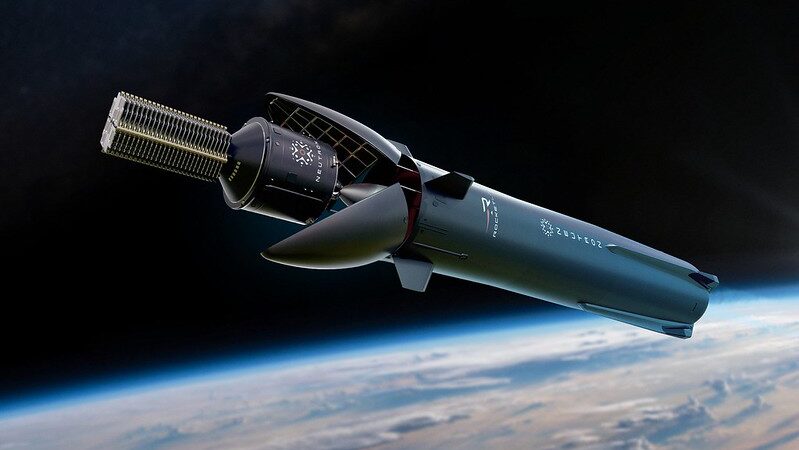
The most recent of these was a $150 million loan to Rocket Lab, announced on Monday, to help the firm “increase the flight rate of its reusable Neutron rocket beyond first launch to meet growing commercial and national security demand for access to space.”
Rocket Lab last month confirmed that Neutron’s first launch has been delayed from late this year until sometime next year. The firm originally had planned to launch the medium-lift rocket in 2024, then pushed that date back to late 2025.
Another $150 million loan was awarded on Oct. 26 to startup Stoke Space to help it build a second launch pad at Cape Canaveral Space Force Station in Florida for its planned Nova reusable rocket. Stoke originally had hoped to launch Nova in 2025, but now is planning lift off in March 2027.
Those two awards attest to the Pentagon’s growing unease about a potential gap in the availability of space launch vehicles post 2028, when SpaceX will stop flying commercial payloads on Falcon 9. An Oct. 29 report by Quilty Space found a likely shortfall of at least 150 launches between now and 2030, including for military payloads as Space Force demand increases.
Both Rocket Lab and Stoke were added in March 2025 to the Space Force’s pool of potential launch providers under the service’s National Security Space Launch (NSSL) Phase 3 Lane 1 program, which covers launches to easier to reach orbits, payloads with less mass, and missions that are not absolute must-goes.
The Pentagon also announced on Nov. 4 a loan worth $150 million to space monitoring firm LeoLabs to “accelerate the deployment of critical radar infrastructure and advanced decision science software,” in particular, deployment of the company’s new Scout mobile radar.

From directed energy to AI and hardening, JIATF-401 is widening counter-UAS options
There is no single answer to the drone threat, pushing the Pentagon toward a broader mix of defenses.
According to a Nov. 5 LeoLabs announcement, the award will help expand its domestic radar manufacturing capacity, including completion of “two large-scale manufacturing facilities by 2028.”
One industry source told Breaking Defense that the reason for the spate of new loan announcements is that the Pentagon “needed to finalize loans by the end of the fiscal year” and thus “have been rolling them out on a regular cadence since.” (While fiscal 2026 officially ended Sept. 30, DoD contract announcements often don’t come until after actual awards to allow for official paperwork to be completed.)
This spate of year-end activity by the Office of Strategic Capital includes loans for non-space related activities as well.
For example, DoD on Nov. 2 announced a “loan commitment of up to $450 million” to startup drone maker Neros to support the firm’s “planned expansion of vertically integrated domestic manufacturing capacity” to produce dual-use sUAS [small unmanned aircraft systems] platforms, ground control systems, and critical components like motors, radios, flight electronics, sensors, and batteries.”
And on Nov. 5, a $75 million loan to Halo Industries was announced to help the California-based firm scale production of its “innovative Silicon Carbide (SiC) semiconductor wafers.”
Like all loans granted by the Office of Strategic Capital, the three space company loans are “conditional,” requiring a process of due diligence about the grantee’s finances. In addition, the loans require a matching investment of company capital.
The office was created by DoD in 2022 under the Office of the Secretary of Defense for Research and Engineering, and subsequently was authorized by Congress to run a pilot investment program in the FY24 National Defense Authorization Act to run through FY28.
According to a September report by the Congressional Research Service, the Office of Strategic Capital’s remit includes both “direct debt financing for companies and the financing of venture capital, private equity, and other investment funds,” as well as “loans and loan guarantees to third-party investment funds.”
Further, the report explained that for FY26, Congress appropriated $97.8 million for its “capital assistance pilot program,” designed to “subsidize up to $4.4 billion in loans, loan guarantees, and technical assistance.” The Office of Strategic Capital also received $2 million for FY26 through the defense-wide research, development, test, and evaluation (RDT&E) account.
The office put out its first notice of $984 million in direct loan funding availability on a “rolling basis” in September 2024, accompanied by a Federal Register notice that listed 34 categories of dual-use technology for potential investment. While the office is focused largely on microelectronics and computer-related tech, three of these are space specific: “space launch; spacecraft; and space-enabled services and equipment.” Several more are space adjacent, including optical communications, sensor hardware and solar power.
The September CRS report added that the Pentagon’s FY27 budget request said the office would use $20 million in FY25 reconciliation funding for RDT&E activities during in FY26.
The FY27 request further includes $216 million in discretionary funding and $20 billion in mandatory funding for the Office of Strategic Capital’s capital assistance pilot program, as well as $19 million for the office’s RDT&E activities, CRS found.
Breaking Defense Video