Last month, the Army published “How the Army Fights.” It describes a force that wins through four things: convergence, strike, close battle and endurance, all inside a multi-domain (MDO) fight against an enemy with advanced reconnaissance, drones and precision munitions. Gen. Christopher LaNeve, the vice chief of staff (and now, chief of staff nominee) who provided the guidance, was blunt that the geometry of the battlespace has changed, but ground maneuver is not dead.
Now look at what we would send into that fight. Every combat vehicle in the Armored Brigade Combat Team is an analog machine with digital parts bolted on after the fact. None of them can fight effectively in a MDO environment, and sustainment dollars can’t fix that.
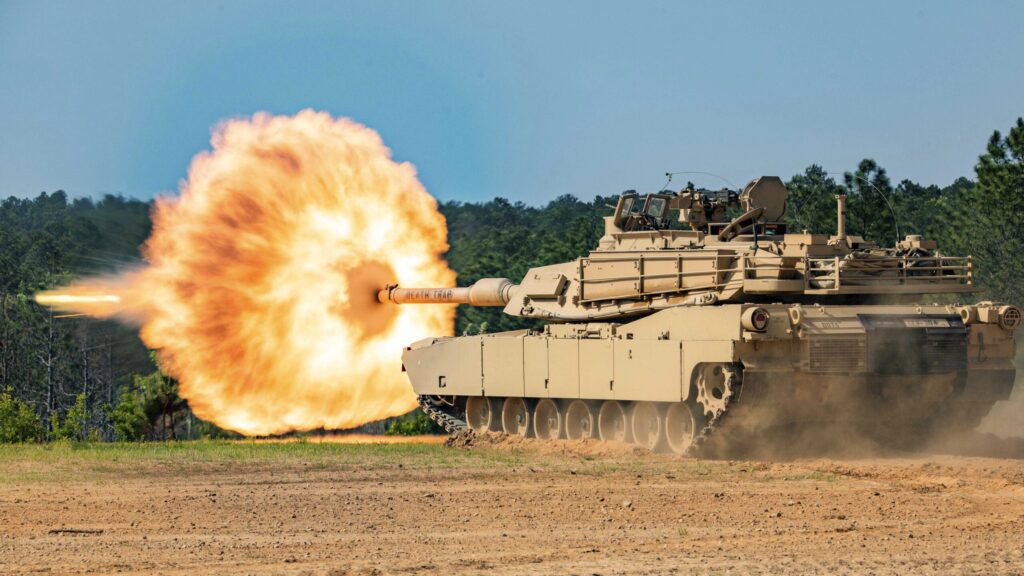
A symbol of these issues is the 45-year-old Abrams. It has run out of room for incremental upgrades, which is why the Army cancelled the M1A2 SEPv4 in 2023 and accelerated the M1E3. For decades those upgrades served the Joint Force well: digital architectures, advanced thermal sights, reactive armor and auxiliary systems layered onto a 1970s chassis. That approach is now slipping under its own weight.
The M1E3 is the tank the Army’s own warfighting guidance requires. We should evaluate it against the Army’s four elements.
Close Battle: The Tank Has To Survive To Get There
The guidance calls close battle the point where enemy forces are physically defeated and terrain is seized. Alongside our infantry, close battle is the tank’s job. It has been since WWI, WWII and both Iraq wars — and it will be again.
But a tank that can’t reach the fight, or can’t survive it, isn’t doing its intended job. Ukraine has dismantled our assumptions about passive armor. Cheap first-person view drones, fiber-optic loitering munitions and top-attack anti-tank guided missiles have inverted the survivability equation. Cage armor and bolt-on active protection systems are stopgaps, but they add parasitic weight, raise the silhouette, draw heavy electrical power and create blind spots. And in an M1A2, three of the four crew still sit in the turret under thin roof armor, right where the threat can be lethal.

How the Pentagon is advancing layered counter-UAS defenses through AI, directed energy and advanced sensing
There is no single answer to the drone threat, pushing the Pentagon toward a broader mix of defenses.
The M1E3 answers with design, not add-ons. An unmanned turret with an ammunition handling system moves the three-person crew down into the better-protected hull. Turret ballistic requirements drop, and so does weight. An integrated hard-kill active protection system covers 360 degrees plus high-angle top-attack threats, replacing the applique systems we bolt on today and the weight they carry.
Strike: Tempo Requires Mobility, And We’re Overweight
The guidance says effective strike depends on tempo and continuous mobility: the ability to disperse rapidly, aggregate to deliver effects and keep moving. Existing Abrams models simply don’t fit the guidance.
With the Trophy Active Protection System, the fielded M1A2 SEPv3 weighs over 76 tons. That’s more than most European and Indo-Pacific bridges can support, and more than organic recovery assets can tow. It also sits at the absolute engineering margin of tactical bridging and Heavy Equipment Transporters. The result is that commanders can often only commit armored brigade combat teams along the few avenues of approach that can bear the load. That funnels armor into predictable chokepoints, exactly where an adversary’s precision fires are already registered. Getting from port to a forward assembly area takes longer, and in a fight measured in days, every delay costs initiative.
Decades of counter-IED underbelly plating, composite armor packages and bolt-on survivability systems created this problem, and marginal modifications can’t undo it. The M1E3 targets a combat weight of roughly 60 tons. A 14-to-16-ton reduction requires a clean-sheet architecture, but it can restore the strategic, operational and tactical mobility that large-scale combat demands.
Convergence: A Tank Has To Be A Node, Not An Island
Convergence connects sensors to decision-makers and layers lethal and nonlethal effects at tempo. That is how MDO works: sense, fuse, decide and act faster than the enemy can react. It only works if platforms in the formation can plug into the network and leverage the capacity that transcends domains, agencies and echelons.
The SEPv3 added updated data buses and Line Replaceable Units, but it is still an analog-era chassis dressed up with digital parts. Every new capability means depot overhauls, custom power converters and tangled wiring harnesses, and the Army can’t wait years for an upgrade when the threat changes in months.
The M1E3 adopts Modular Open Systems Architecture from the start. Upgrades become software-defined and arrive in weeks, not depot cycles. Integrated battle management and automated targeting aids let a three-person crew take in and act on feeds from unmanned aerial systems and robotic ground vehicles without being overwhelmed. This makes the tank a node in the kill web, sharing what it sees and shooting what the network finds.
In the end, if we want to compel our will upon an intransigent opponent, we have to be where they are. The M1E3 becomes a protected node, penetrating enemy defenses, which brings to bear all domains under protection with improved mobility and firepower.
Endurance: The Tank That Doesn’t Need A Fuel Convoy
The guidance defines endurance as the ability to absorb the enemy’s best hit and keep fighting. The M1A2’s AGT1500 turbine delivers remarkable acceleration and torque, but it consumes fuel even while at idle. Its consumption exceeds the brigade’s organic fuel capacity, which ties every ABCT to large divisional fuel convoys. Those convoys are slow, predictable and visible. Against persistent aerial sensors and loitering munitions, a fuel tanker is a target whose vulnerability is unacceptable.
The M1E3’s hybrid diesel-electric powertrain cuts fuel consumption by 50 percent and shrinks the sustainment tail with it. High-capacity batteries can run sensors, communications and counter-UAS suites for extended periods with the engine off. For short distances, the tank can move on battery power with near-zero acoustic and thermal signature. And where the SEPv3 already runs near peak electrical load, the M1E3’s high-voltage architecture has the surplus power for what comes next. (Disclosure: I’m a board member on Sapa Transmission, which is one of many suppliers that would benefit from the M1E3 program; I have been advocating for this program long before that business interest.)
The Cost Of Standing Still
Critics will say that with limited money available, air defense, long-range fires and munitions stockpiles need to come first. Those are real priorities, but deferring the tank to fund them is a false alternative.
Sustaining the M1A2 means a growing stack of custom engineering patches, depot overhauls and rising sustainment costs. Those costs will soon exceed the amortized development and procurement cost of the M1E3. The Army would be paying more every year to keep a platform that can’t execute what its own guidance requires. The sunk-cost fallacy should not set requirements for the next war.
Fielding the M1E3 also secures the industrial base. The Joint Systems Manufacturing Center in Lima, Ohio, and its national supply chain need a predictable workload. Turning that footprint from a 20th-century overhaul-and-upgrade depot into an advanced manufacturing hub preserves a capability that would take years to rebuild if it were lost.
The Abrams anchored American ground dominance for half a century. But its weight, its fuel appetite and its vulnerability to today’s threats call for a generational leap, not another upgrade.
The idea that future land wars can be won with stand-off fires or cheap consumable mass is a dangerous illusion. In the vice chief’s words, close battle “is not a relic of an earlier age.” Someone still must seize and hold ground against an enemy who is trying to kill them, and that takes a main battle tank working inside a combined-arms formation and backed by the Joint Force.
The Army has described how it fights. Congress and Pentagon leadership now need to give it a tank that can fight that way, and develop and field the M1E3.
Retired Army Lt. Gen. Eric J. Wesley served as deputy commanding general of Army Futures Command and led the rewrite of the Army’s warfighting concept referred to as Multi-Domain Operations. He also commanded the Maneuver Center of Excellence, home of the Infantry and Armor schools. He currently serves on a number of defense related boards, including the Sapa Transmission Board.