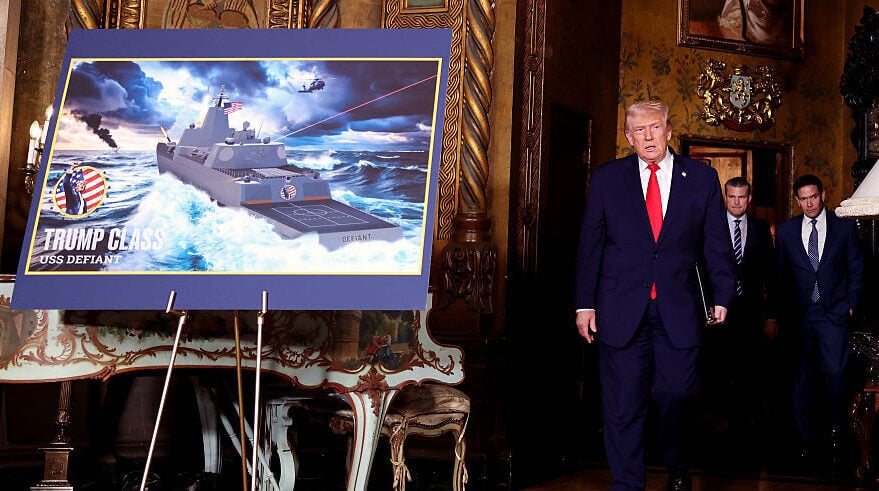
WASHINGTON — Golden Dome and the Trump-class battleship are among the programs for which the White House wants to see additional money or other authorities if Congress passes another stopgap funding bill in December, according to a list sent to Capitol Hill on Monday.
The list, which was reported by Politico on Monday evening, lays out almost two dozen defense programs for which the White House is seeking anomalies — or funding exemptions — if another continuing resolution (CR) is passed. The document notes that additional Defense Department anomaly requests are forthcoming.
Because a CR keeps federal funding stable at of the previous fiscal year and prohibits money from going to new programs, an administration requests anomalies when it wants to funnel more money into a program to start or accelerate it. Lawmakers have until the current CR expires on Dec. 11 to either pass full year appropriations — an unlikely prospect, given ongoing disagreements between Republicans and Democrats on funding — or to pass another stopgap bill.
In the anomalies list, the White House requested $5 billion for Golden Dome, its hallmark missile defense effort. Because the program “has no new funding under the current CR,” the White House states that “[w]ithout this anomaly, Golden Dome will be unable to continue production.”
It also asked for advanced procurement authority for the Trump-class battleship, noting that “[w]ithout this anomaly material delays would impact cost and on-time delivery of the Battleship.”
The Pentagon’s goal of ramping up weapons production could also face major headwinds if anomalies are not approved.
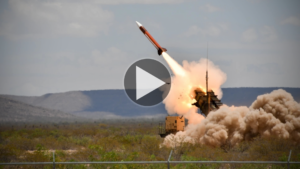
While the administration did not request additional funding for critical munitions programs, it is seeking “spend faster” authorities for several weapons — including PAC-3, Tomahawk, JASSM, LRASM, Precision Strike Missile and the Standard Missile family. The authorities would allow the Pentagon to obligate funding more quickly to meet planned increases in production rate.

Missiles and radar need more than demand – they need manufacturing capacity
Expanding manufacturing capacity is critical to producing missiles, radars, and launch systems.
Without anomalies, those munitions could face delays in funding that “would require contract renegotiation, disrupt prime and subcontractor planning, and reduce economies of scale. Higher unit costs will reduce purchasing power,” the White House warned.
For instance, the government is at risk of incurring a $400 million multiyear contract cancellation penalty for both LRASM and JASSM if anomalies are not approved. The White House also identified potential termination liabilities of $554 million for the SM-3 IIA and almost $1.6 billion for the SM-3 IB, according to the White House document.
If a CR stretches into summer without anomalies for multiyear production for Tomahawk missiles, the Army and Navy will not be able to award funding by a June 2027 deadline and could face cancellation charges of up to $4.4 billion, the White House stated.
Additionally, the Pentagon is seeking new-start and additional multiyear procurement authorities for counter-drone systems, which would allow the department to increase counter-small unmanned aircraft systems (C-sUAS) procurement from about 363 effectors to in fiscal 2026 to 853 in fiscal 2027.
It also asks for an increase of about $22 billion for the Virginia-class submarine, Columbia-class submarine and Ford-class carrier programs to keep ship construction on schedule.
A separate $400 million funding request is associated with “CVN-81 redesign activities” that have been deemed “a Presidential priority” — a likely reference to Trump’s intent to replace the Electromagnetic Aircraft Launch System (EMALS) on the future carrier USS Doris Miller with steam catapults.
While Congress usually looks kindly on anomalies meant to keep efforts like shipbuilding programs going during a CR, the current bipartisan stopgap approved by lawmakers in September did not include anomalies sought by the White House for the Trump-class battleship and munitions production.
Breaking Defense Video