
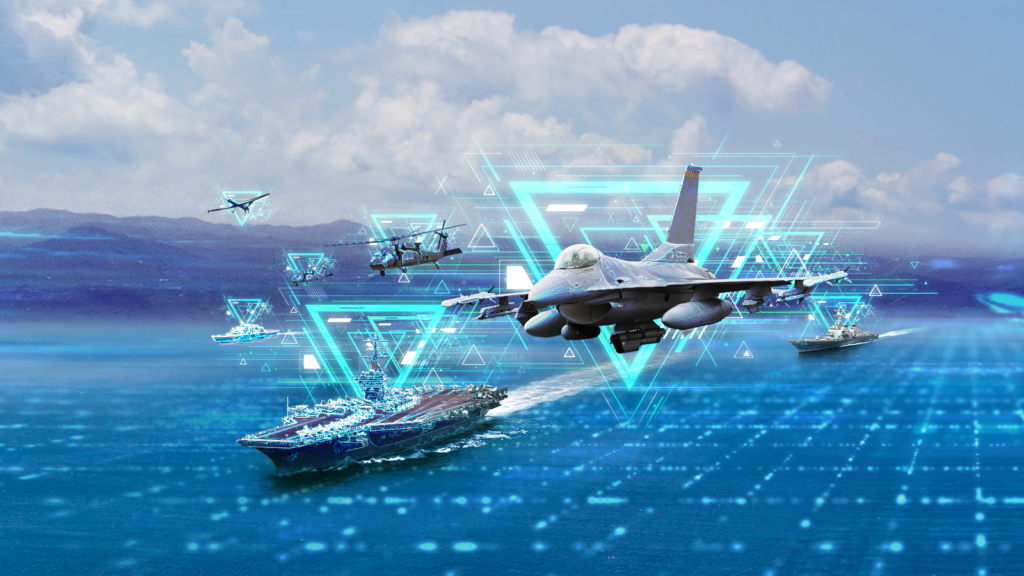
Identification Friend or Foe (IFF) technology has been around for decades, but as threats and platforms rapidly evolve, IFF must be adaptable to distinguish allied forces from potential threats and operate in contested and denied environments.
Breaking Defense spoke with Seth Guanu, Combat Identification Products program area director at BAE Systems, about how IFF technology is changing, how it can be used across both U.S. and allied forces, and how it must adapt to meet future threats.
Breaking Defense: IFF technology has been around for a long time. How is it critical to joint forces operations today?
Guanu: IFF is a question-and-answer system. It uses a waveform, which is electrical energy, to transmit data. If you’re a platform and you’re unsure of another platform’s friend status, you ask a question – which is called an interrogation – and the unknown platform responds via secure communications to positively identify itself. Interrogators ask the question, transponders answer the question, and combined interrogator transponders do both. We have these systems on aircraft, ships, land, and radar platforms.

When you look back on history, the introduction of radar was revolutionary. However, radar only showed that something was out there, not whether it was friendly. There needed to be some way of identifying friendly forces where you weren’t spoofed by the enemy. IFF was introduced in World War II and continues to be a critical system.
IFF works alongside radars, data links, sensors and many other systems. For instance, if an adversary attempts to attack our assets from the air, IFF allows our defensive measures to engage threats without endangering friendly forces.
Since that time, warfare has expanded into multiple domains, not only land and sea and air, but space and cyber. Today’s adversaries are more agile and with new technology the speed of conflict has increased dramatically.
When you bring in unmanned systems and associated swarms it adds further complexity beyond what our forces have had to deal with in the past. The Department of War’s Joint All Domain Command and Control strategy (JADC2) strategy helps manage this by connecting assets across domains.
IFF underpins the C2 part of the strategy. This allows joint forces to sense and make sense of data. Is it friend or foe? Then you need to act. You need to be able to do that in split seconds, or you’re not ahead of the adversaries.
With changing threats, such as the proliferation of drones, how is IFF evolving to meet that challenge?
Modern warfare demands technological advances including enhanced cryptology, faster processing, and detection at greater ranges. IFF must be easily upgradeable to meet future threats.
Migrating to software-based IFF skills and card-based solutions is key to providing agility. Our IFF systems use a modular design and open system architecture that allows new capabilities to be integrated through software updates rather than hardware changes. This reduces obsolescence and accelerates enhancements without modifying fleet infrastructure.
Additionally, as unmanned air systems (UAS) expand in threat environments, new technologies are needed to equip the platforms that don’t overload the already crowded IFF frequency band. We are developing this technology and working with the IFF community to define enhancements to Mode 5 to address these changes to the combat environment.
How can IFF be used across both U.S. and allied forces? What are the challenges to ensuring that IFF is being used effectively across joint forces and across all domains?
If you look at IFF or at these missions, say across the U.S. and its coalition, what are the things that you want? You want interoperability and standardization for U.S. and allied operations. Mode 5, the latest secure IFF waveform, is a NATO standard and supports worldwide interoperability.
The challenges associated with ensuring the effective use of Mode 5 across joint forces come from the significant number of different nations, platforms and manufacturers deploying unique IFF systems. In the U.S., the Air Traffic Control Radar Beacon System (ATCRBS), Identification Friend or Foe (IFF), and Mark XII Systems (AIMS) office ensures compatibility across U.S. and NATO forces.
Certifying equipment at both the box level and platform level is critical to overall system performance. The recent AIMS box-level certification of our AN/APX-127(V)1 Combined Interrogator Transponder is a major milestone. The new CIT provides advanced, multi-function capabilities while supporting the latest crypto and cybersecurity resilience requirements. The AIMS certification means the product is ready for use and can serve as a drop-in replacement for current systems.
In addition to having the same tools and waveform, everyone must operate under a consistent concept of operations (CONOPS), otherwise interoperability breaks down and then challenges can occur.
What are the benefits of a combined system and how does it differ from a standalone interrogator or transponder?
Ships typically use interrogators as a key element of their combat ID system to identify airborne objects while aircraft generally carry transponders to respond to questions.
A combined interrogator transponder (CIT) provides both capabilities in one box. This is essential for tactical aircraft that need to engage and where space for equipment is limited on the platform.
By combining both functions, CITs reduce size, weight and power demands and require only a single supporting infrastructure. Whether a platform uses an interrogator, transponder, or both depends on the mission and CONOPS.
How do you work around concerns about things such as jamming and spoofing?
IFF is a radio frequency (RF)-based solution, which can be subject to electronic warfare (EW) attacks. There’s constant evolution with RF so staying ahead of threats is crucial.
We are one of the key co-architects of the secure Mode 5 waveform, and our systems employ anti-jam techniques to operate in this contested environment.
We’re constantly maturing our technology, to support the latest crypto, anti-jam and cybersecurity resilient requirements. At a recent AIMS User Working Group, we successfully demonstrated our latest transponder’s resilience by introducing live RF jamming during the demo.
How long has BAE Systems been involved with IFF? What are your key areas of focus in IFF as you look forward?
BAE Systems has more than 80 years of IFF experience. Since Mode 5’s introduction in the mid-2000s, we have delivered more than 1,500 interrogators, 6,000 combined interrogator-transponder systems and 16,000 transponders across 140 platform types in more than 40 countries. Our systems support U.S. and coalition forces and air defense, weapons systems, air traffic control, and range instrumentation.
We develop solutions to outpace modern threats. We’ve seen a huge improvement in capability driving advanced performance while reducing size, weight and power. Modular firmware and software-defined architectures enable upgrades and integration into next-generation platforms.
Adversaries are agile so we must be faster by anticipating threats, developing counter technology and fielding updates quickly. Our next-generation products are designed as drop-in upgrades. With robust hardware processing capability, we can constantly update firmware and software after deployment to provide a new capability to address new threats.
Our enhancements, such as anti-jam and cyber resilience features, continue to lead in the industry. We’re listening to our customers. The future of IFF is a system that’s easily upgradeable, integrated, affordable and effective.
I’m proud to be part of the team at BAE Systems and our mission: “We Protect Those Who Protect Us.” We remain committed to delivering systems that meet today’s requirements and can rapidly adapt to tomorrow’s challenges.