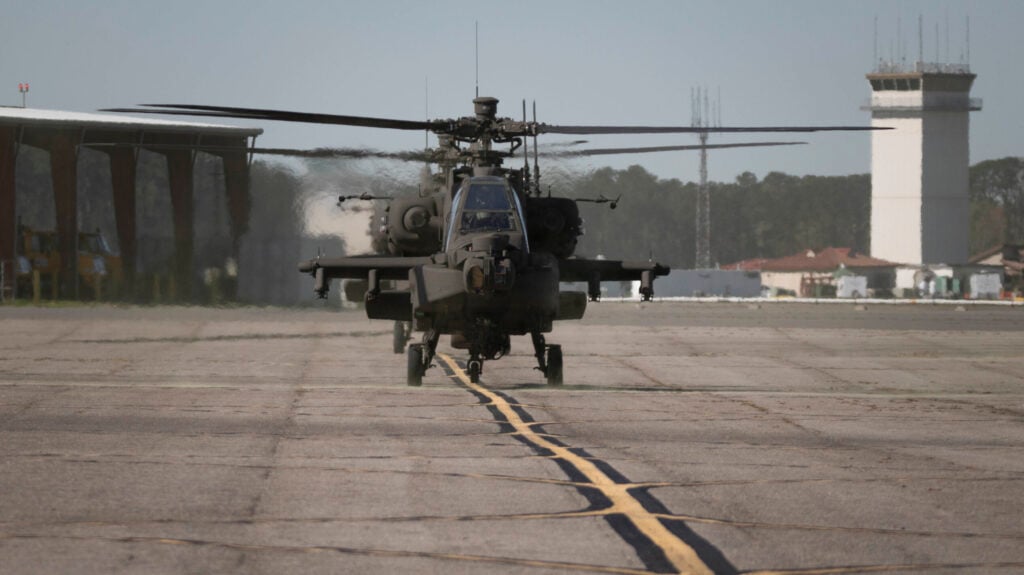
WASHINGTON — As the Army faces declining aviation readiness numbers and an increase in accidents over the past year, the service’s number two civilian had a bleak message: “We have to change something.”
Army Undersecretary Michael Obadal told an audience today that the service’s manned aviation fleet’s fully mission capable (FMC) rates are sitting at “a norm” of below 60 percent — well below the service’s goal of 75 percent. Army aviators are also facing an accident rate “that’s gone up exponentially,” which Obadal linked to insufficient flight time for pilots and crews to maintain proficiency.
“We actually had more accidents this year, and we flew 150,000 hours less than we did three years ago. So more accidents, less hours, less readiness,” Obadal, a retired Army aviator, said during an AUSA Hot Topic event today. “Pilots don’t fly as much, crews don’t fly as much. Eighty two percent of our Class A accidents are human factors. It has to change. We cannot put any more lives [into] that because we ignore the problem.”
Army aviation safety data paints a more complicated picture. Although the service’s Class A mishap rate improved in FY25, its overall Class A-C flight mishap rate was higher than in any of the previous 10 years, according to an Army newsletter [PDF] published in January. Class C mishaps have increased in each of the past three years, even as flying hours have declined, the newsletter noted.
Obadal did not specify the types or severity of the accidents over the last year, nor did he provide specific figures.
The readiness picture has been less encouraging. Data on Army Aviation’s FY25 FMC rates is not yet available, but a Government Accountability Office report from March found that the service did not meet its FMC goals for FY24, though the report did not provide an exact rate. The Army had previously published its FY24 figures in an online newsletter, but that page is no longer available.
“What we are doing is looking at the trends, and year over year, our trends of fully mission capable are going down. We have to change something,” he said.
To improve readiness, Obadal said the Army is turning to its Weapons 360 platform, which provides real-time readiness data on the service’s major weapons systems and helps identify bottlenecks down to the part and supplier level.
“The way that we sustain our major end items has been very sporadic, and it’s got about six different organizations that touch it,” he said. “So I’m pulling all of them together into an Army sustainment model.”
Regarding his plan to prevent future aviation accidents, Obadal said the service is “completely changing” its aviation training base. One such effort is Flight School Next, a program to acquire a new helicopter and develop new training curriculum focused on the basic stick-and-rudder skills for helicopter pilots.
The Army is also going to transfer both commissioned and warrant officers back into aviation formations “where they belong” and “out of staff jobs” to help address the increase in accidents, Obadal said.
“Our aviation is fundamental, and we have to fix it,” he said.
Breaking Defense Video