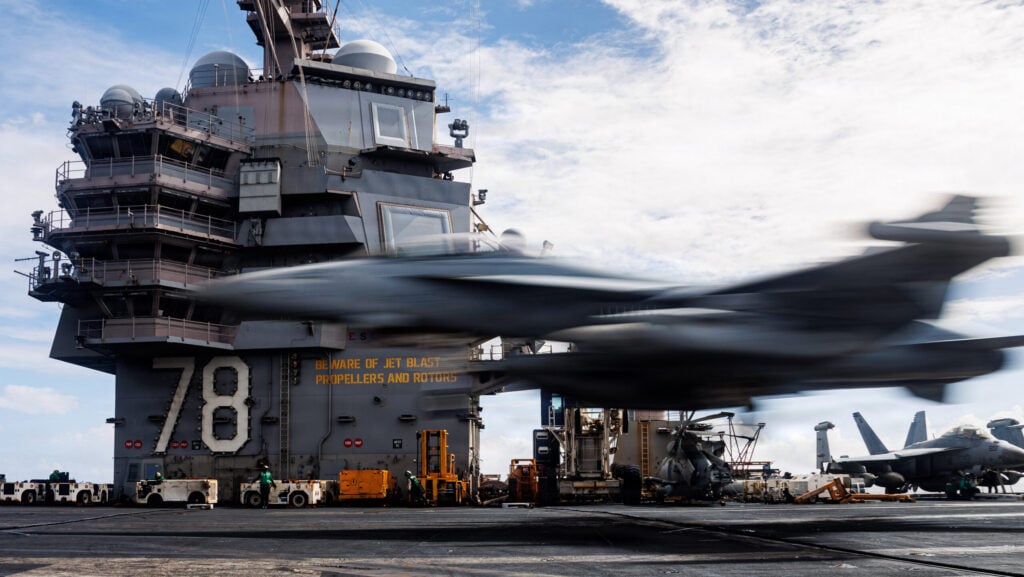
WASHINGTON — Lawmakers from both sides of the aisle urged Acting Secretary of the Navy Hung Cao to reconsider plans to return to steam catapults for the Ford-class aircraft carriers, following President Donald Trump’s instructions in August to reinstate the technology.
“Secretary Cao, returning to steam is a non-starter, and everybody needs to understand that,” Chairman of the Senate Armed Services Committee Sen. Roger Wicker, R-Miss., said today during Cao’s confirmation hearing to become secretary of the Navy.
The Ford class employs the Electromagnetic Aircraft Launch System, or EMALS, which uses electromagnetic energy rather than steam to launch aircraft from the flight deck. In August, Trump issued a National Security Presidential Memorandum that directed the Navy to instead equip Ford-class aircraft carriers with traditional steam-powered catapults and hydraulic aircraft elevators, similar to those on Nimitz-class carriers. The directive would apply to ships such as the Doris Miller, currently under construction at HII’s Newport News Shipbuilding.
Trump has long criticized EMALS and indicated last year he would direct the Navy to return to steam. In the August memo, he argued that overly complex ship designs and repeated changes have contributed to shipbuilding cost increases, delays and cancellations. He called on the Navy to prioritize “proven, reliable, and affordable technologies and ship designs.”
Critics argue that returning to steam would add costs and complexity while reverting to older technology on a carrier class designed around EMALS. Both Republican and Democratic lawmakers have pushed back on the plans, as well.
Prior to Wicker’s comments, Sen. Tim Kaine, D-Va., told Cao that he had recently visited the Ford and spoken with sailors who were “very complimentary” of EMALS. Asked whether the Navy should return to steam catapults, Cao said EMALS and the electromagnetic elevators outfitted on the Ford are contributing to carrier delays.
But Kaine warned that reverting to steam would drive up costs with “diminished capacity.”


Precision at scale: APKWS counters the threat
APKWS® laser‑guidance kit provides reliable precision‑guided munitions across missions and platforms, delivered quickly to meet evolving operational demands.
“And so, just because the president directed it, I do hope you’ll consider the experience of those who’ve been operating these launches on the Ford in deciding before you decide to go down a path that will be more expensive and also less capable,” he said.
Iran Conflict and Transparency
Trump announced in September that he would nominate Cao to serve as secretary of the Navy. Cao has led the service in an acting capacity since April, when former Navy Secretary John Phelan was ousted by the Trump administration and Cao — then the Navy’s undersecretary — assumed the role.
During his confirmation hearing, Cao faced questions about the impact of the conflict with Iran and the aircraft carrier Abraham Lincoln’s extended deployment from November 2025 to October 2026 — including quality-of-life issues and eight suicide attempts during that period.
Pressed by Sen. Kirsten Gillibrand, D-NY, on his characterization of the incidents as “suicide mitigations,” Cao pointed to his own deployment experience and said he understood the strain facing sailors.
“I think you are minimizing what mental health strain is on these service members,” Gillibrand said. “If it was your son or your daughter, would you be minimizing and saying, ‘Well, there was mitigation?’ I don’t think you would. I think your response is inhumane. I think it’s inadequate. I don’t think it understands the stress and strain that these men and women are on because of these poor conditions.”
Cao also pledged to include Democrats in classified congressional briefings after Sen. Mike Rounds, R-SD, raised concerns about their exclusion from previous hearings and argued that it would make approving funding and policy changes difficult.
Sen. Tammy Duckworth, D-Ill., meanwhile, questioned whether Cao had warned Defense Secretary Pete Hegseth about the strain the Iran conflict was placing on the Navy. Cao responded that Hegseth “knows my stance on our readiness and the strain it takes on our sailors.”
“I cannot vote for you because you’re going to be another yes man,” Duckworth said.
On the other side of the aisle, Sen. Jim Banks, R-Ind., voiced support for Cao, saying it was “fundamentally important” to have a confirmed Navy secretary for the next two years and lauded Cao for his efforts supporting Naval Support Activity Crane in Indiana.
Cao enlisted in the Navy as a seaman recruit in 1989, and later graduated from the US Naval Academy in 1996. He served more than 20 years as a naval officer before retiring in 2021 from the service as a captain.
Military retirees must have been retired for at least seven years to serve as a service secretary, meaning Cao will need waivers from both the House and Senate to be confirmed.
Breaking Defense Video