WASHINGTON — President Donald Trump has ordered a return of the steam catapult to Ford-class aircraft carriers along with the establishment of a new, fifth public shipyard to take on submarine repair, a White House official confirmed to Breaking Defense.
The provisions — along with the establishment of a new component repair center in an effort to cut submarine repair delays — were included in a National Security Presidential Memorandum that the president signed today, the White House official said.
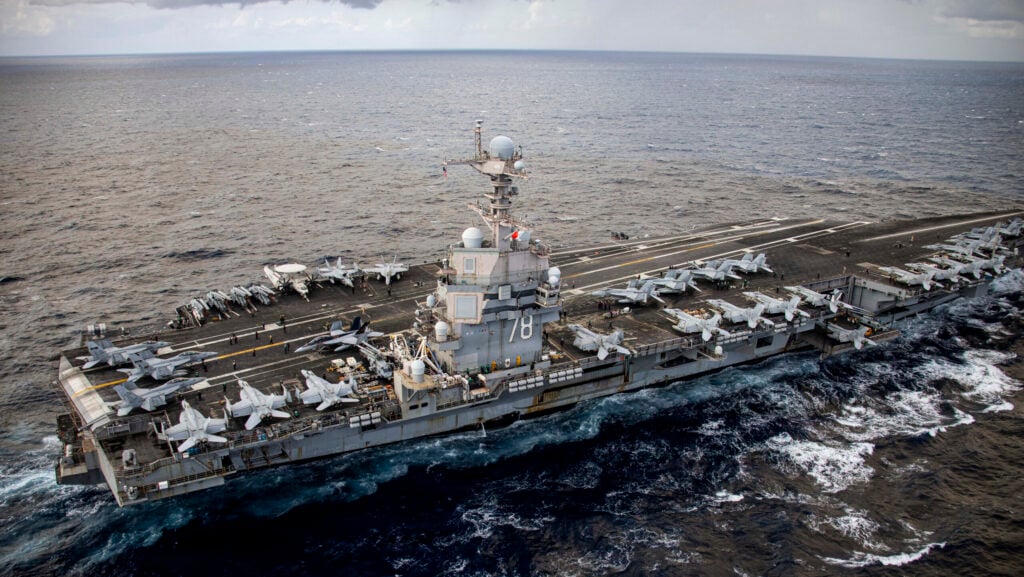
Specifically, the memo orders for Ford-class aircraft carriers like the Doris Miller being built at HII’s Newport News Shipbuilding to include the traditional steam-powered catapult systems and hydraulics for the ship’s elevators like those on the Nimitz-class carriers. The USS Ford, the first in its class, currently uses the new Electromagnetic Aircraft Launch System, known as EMALS, to send off aircraft from the flight deck — a system that Trump has historically railed against.
The Wall Street Journal first reported the changes to the aircraft carriers.
Trump signaled last year that he would sign an executive order instructing the Navy to move forward with such changes.
“Seriously, I’m putting out an order. I’m going to sign an executive order. When we build aircraft carriers, it’s steam for the catapults and it’s hydraulic for the elevators. We’ll never have a problem,” Trump said aboard the aircraft carrier George Washington in October.
General Atomics builds the EMALS system, and the firm claimed that failing to move forward with it on the Doris Miller “warrants careful reconsideration.”

Building a predictive defense industrial base begins with artificial intelligence
AI-enabled workflows accelerate production, but cybersecurity and governance remain central.
“With nearly 50% of production complete, changing course now would introduce significant cost, schedule, and integration risks,” General Atomics said in a statement today.
“The decision will have broader implications for carrier readiness, national security, and U.S. technological superiority, potentially creating opportunities for adversaries to close the capability gap,” the firm added. “It also comes at a time when strengthening the U.S. supplier industrial base is a national priority, making workforce stability, production capacity, and the ability to sustain critical technologies more important than ever.”
Bryan Clark, director of the Hudson Institute think tank’s Center for Defense Concepts and Technology, said that the Navy employs electricity rather than steam for a host of functions on the Ford-class carriers like cooking, heating, and water purification, in addition to powering the catapults and arresting gear.
“These functions all used steam in previous carrier classes. Restoring steam lines to at least the catapults will require extensive redesign of the ship,” Clark told Breaking Defense. “Also, the Navy has not bought a steam catapult in more than 20 years, so it is unlikely the suppliers are able to build them without substantial up-front investment and time to establish the necessary production lines.”
The memorandum also calls on Secretary of Defense Pete Hegseth to submit a report to Trump within the next 120 days a proposal to bolster submarine and aircraft carrier readiness, utilizing both the private sector and an additional public shipyard.
“The plan for the fifth yard shall address: sufficient drydock capacity to service the planned growth of the fast attack submarine fleet over the next two decades; locations proximate to the United States Pacific Fleet, including in the continental United States, Alaska, Hawaii, and the United States territories; site options that include up to three new drydocks designed and built to hold the ranges of every current and projected class of submarine; innovative financing mechanisms such as public-private partnerships; and timelines and resourcing requirements,” the memorandum said.
Office of Management and Budget Director Russ Vought said in June that the administration was “pushing hard for an additional public shipyard” to accommodate a growing fleet.
“If we’re going to spend a one-and-a-half trillion dollars, or have the types of direct foreign investment that’s coming in, we want to make sure that we have the ability to have enough public shipyards to do maintenance,” Vought said at the Washington Times’ IndoPac 2026 event in June. “You’re going to have contracts with companies that are doing maintenance [in private shipyards], and that’s all fine, and will continue, but … to do it at scale is something that is absolutely vital.”
Private shipyards also perform maintenance on military vessels, but the nation’s four public shipyards in Virginia, Maine, Washington, and Hawaii are the ones that typically complete maintenance overhauls and modernization efforts for the Navy’s nuclear-powered aircraft carriers and submarines.
Chief of Naval Operations Adm. Daryl Caudle told reporters at the Sea Air Space Symposium in April that the Navy has been examining the possibility of a fifth public shipyard. However, Caudle said that adding another yard presents questions on whether there is a sufficient workforce to staff it, and what it would require to build that presence.
“A new yard is expensive, and so is that infrastructure worth it if I can’t get the workforce there?” Caudle said.
The Navy referred Breaking Defense to the White House when asked for comment.
This is a breaking news story and may be updated.
Breaking Defense Video