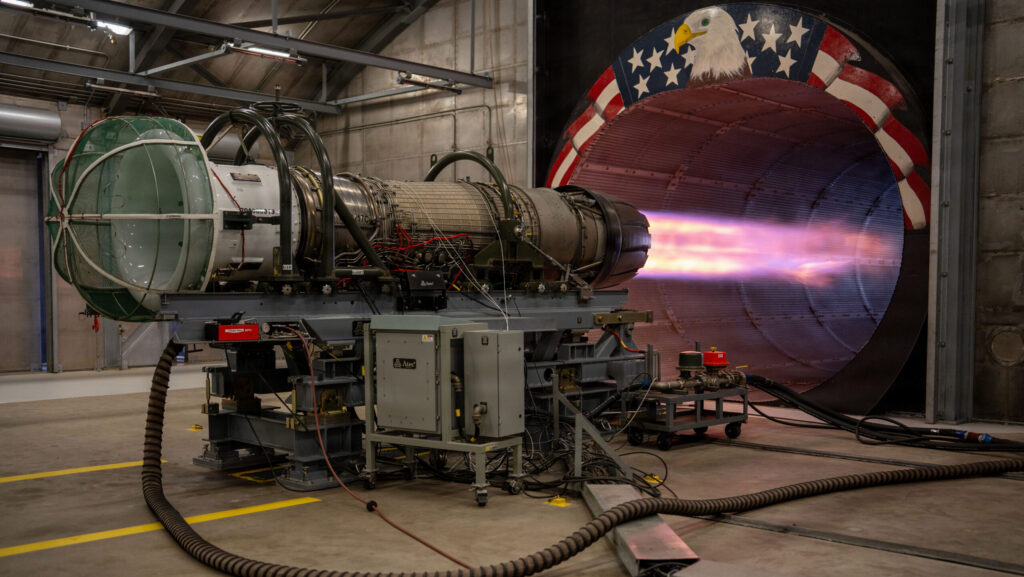
WASHINGTON — The Air Force today named dozens of companies as awardees for a group contract potentially worth $16.1 billion over the next 15 years for “advanced propulsion enterprise work” — though the winners are only seeing a small fraction of that to start.
The contract, announced today, was issued to a total of 58 vendors, who have each been awarded $1,000. The expected work period could stretch to November 2041.
“This contract provides for the continuing enhancement of propulsion technology across all areas and lifecycle phases of propulsion development,” the contract award reads.
The Air Force earlier this year revealed the opportunity for the large contract vehicle, outlining an “Advanced Propulsion Acquisition Contract” in industry solicitations. But a March notice stated the service had not yet secured funding for the initiative, and would not issue contracts until doing so, according to Air & Space Forces Magazine.
Another notice, also posted in March, said the initiative is meant to “enable[] a rapid response applicable to all areas and lifecycle phases of propulsion development, including technology maturation, concept development, concept demonstrations, integration, procurement, production, fielding, operations, and sustainment to quickly meet current and future propulsion system requirements, while maximizing the use of the digital environment.”
The Air Force did not immediately respond to a request for comment seeking further clarity on the contract’s funding and expected scope of work.
The contract’s awardees encompass a range of firms, from startups to established engine primes, who the notice says were each competitively picked. Structured as an indefinite delivery, indefinite quantity contract, the Air Force is not necessarily obligated to spend the full amount.


Winning the information war through ideas and perception
As social media and AI amplify dis- and misinformation campaigns, effectively countering them requires a coordinated response.
The award comes as the Air Force seeks new and more effective ways to power its existing and future platforms, from drone wingmen to large mobility aircraft. The service has recently tapped several vendors to open up options for different sizes of drones and missiles, and is also developing an advanced engine that could power future platforms like the F-47 stealth fighter.
Breaking Defense Video