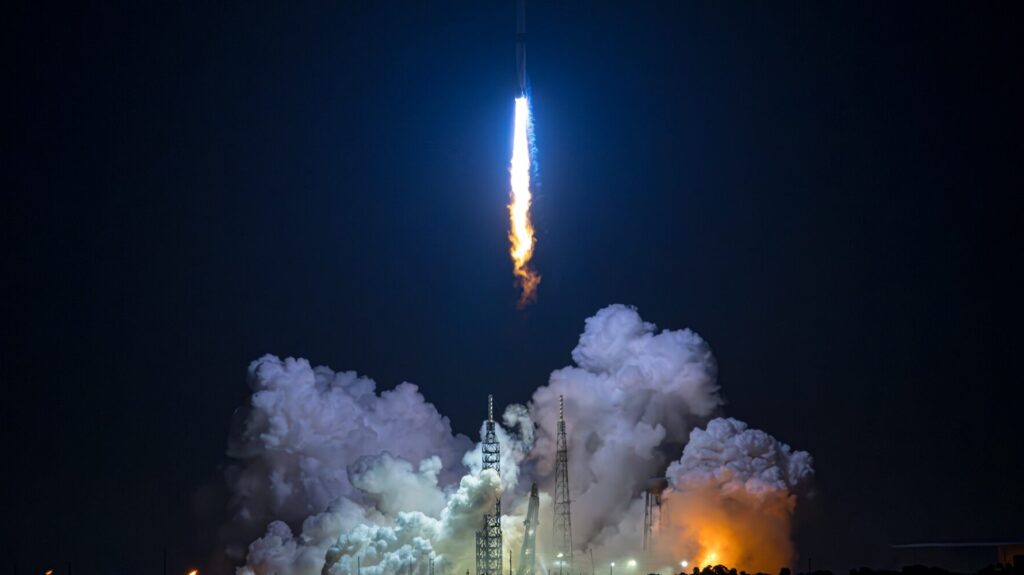
WASHINGTON — The May 28 explosion on the test pad of Blue Origin’s New Glenn heavy lifter at Cape Canaveral is unlikely to have an impact on the Space Force’s national security launch schedule, industry officials and experts said.
Even if it takes the company as long as a year to get back into orbit due to the damage to the pad, the Space Force’s current plans don’t envision manifesting the rocket under the National Security Space Launch (NSSL) Phase 3 program until 2028 at the earliest.
“For NSSL, there’s time to get [New Glenn] back on track,” said one industry representative.
In addition, the Space Force always can fall back on SpaceX to carry its payloads if it becomes necessary down the road to reschedule launches planned for New Glenn.
“The most immediate setbacks are to Amazon’s deployment of its LEO [low Earth orbit] constellation and testing of the lunar lander for NASA. NSSL will be okay because it can still rely on the [SpaceX] Falcon 9 workhorse,” said Todd Harrison, senior fellow at the American Enterprise Institute.
Indeed, in a show of support, the Space Force did not backtrack on its award to Blue Origin of an NSSL Lane 1 task order for launch of a satellite for the National Reconnaissance Office (NRO), which was made just hours before the accident.
“The U.S. Space Force (USSF) and NRO remain committed partners with Blue Origin and will work with them on the New Glenn vehicle anomaly experienced during its integrated vehicle hot fire test yesterday evening,” the service said in its May 29 announcement.

From directed energy to AI and hardening, JIATF-401 is widening counter-UAS options
There is no single answer to the drone threat, pushing the Pentagon toward a broader mix of defenses.
The NSSL program’s Lane 1 contracts small-to-medium launch services for its less risky and/or complex missions such as those going to LEO. The Space Force in July 2024 tapped Blue Origin, SpaceX and United Launch Alliance (ULA) for its pool of potential providers of Lane 1 missions through June 2029.
The NRO mission is the first to be tasked to New Glenn under that pool contract. The satellite is slated to lift off to LEO sometime between late 2027 and early 2028.
“The National Security Space Launch program will continue working closely with our Blue Origin partners to help identify the root cause and implement corrective actions,” Col. Eric Zarybnisky, acting Space Force portfolio acquisition executive for space access, said in the service’s release.
Meanwhile, Blue Origin has yet to be certified for launches under NSSL Lane 2, which covers high-value, must-go payloads and/or those headed to orbits that are more difficult to achieve. The company has completed three of the four successful missions required under its tailored accreditation plan for the Space Force. NSSL Lane 1 providers, by contrast, do not need to be certified.
“At this time, the full impact of the integrated launch vehicle hot fire test anomaly on Blue Origin’s NSSL certification process is unknown,” a spokesperson for Space Systems Command (SSC) told Breaking Defense.
SSC’s System Delta 80, which manages the NSSL program, “remains committed to working alongside Blue Origin to identify the root cause, implement corrective actions, and address any second and third order effects resulting from the anomaly,” the spokesperson said.
However, the spokesperson stressed that the accident “does not eliminate Blue Origin from the NSSL Phase 3 Lane 2 certification process. Our NSSL Certification team continues to partner closely with Blue Origin on both certification flights and the extensive engineering insight required to independently validate the New Glenn Launch System.”
The service in April 2025 contracted Blue Origin, SpaceX and ULA for the NSSL Lane 2 pool, with 54 total missions expected to be tasked between fiscal year 2025 and 2029. The service generally awards individual task orders two years prior to a planned mission, thus the contract funds launches through FY31.
At the time of the award, the Space Force envisioned New Glenn undertaking only seven launches, with the first not expected to lift off until sometime in FY28.
This story was updated 06/02/26 at 1:25 pm to include a statement from Space Systems Command.
Breaking Defense Video