WASHINGTON – Senate appropriators are proposing nearly $1.1 trillion in defense spending for fiscal 2027, a historic figure that includes key priorities but still falls well short of the $1.5 trillion figure sought by the Trump administration.
Until tonight’s release of a proposed spending plan, the Senate Appropriations defense subcommittee was the last of the four defense committees to put forth a budget offering. Now its $1.1 trillion figure will have to be sorted out with a slightly lower topline from its House counterparts. (The Armed Services Committees in the House and Senate both included a topline $1.14 trillion figure, though it is not directly comparable to that of the appropriations committees.)
The Trump administration’s $1.5 trillion ask was split into two categories: $1.15 trillion in the base budget and $350 billion in a reconciliation bill. So far, lawmakers have not moved out with that reconciliation request that funds big-ticket priorities like Golden Dome, critical munitions and the bulk of a $55 billion push for the new Defense Autonomous Warfare Group (DAWG).
The White House has pushed to still pass that $350 billion by reconciliation, but there has been little sign that will happen. According to Punchbowl News, the top Republican in the Senate, John Thune, declined today to say whether a defense-only reconciliation bill is being actively considered.
RELATED: The fight over the FY27 defense budget is on. Here’s 13 key issues for Congress to resolve.
Senate appropriators are not fans of the reconciliation process, as it takes control of the money out of their hands and gives it to the authorizers. That sentiment was seemingly echoed in a statement from Sen. Mitch McConnell, the defense appropriations subcommittee chair who is retiring at the close of this Congress, who wrote, “This bill is a roadmap to sustainably and responsibly delivering generational investments in the national defense … The nature of warfare is changing, and America’s adversaries are working together to threaten us. Deterring these threats is a project bigger than one-time surges of cash.”
Instead, Senate appropriators are now seeking to funnel some of the Trump priorities into items in their proposal.


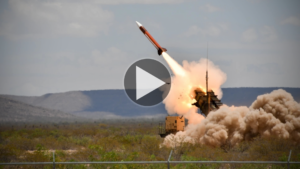
Missiles and radar need more than demand – they need manufacturing capacity
Expanding manufacturing capacity is critical to producing missiles, radars, and launch systems.
“Of this $1.1 trillion, nearly $69 billion, that was initially requested as one-time mandatory spending by the administration, is provided as discretionary funds in order to provide stable, sustainable, and predictable funding for critical capabilities across the Joint Force,” lawmakers wrote in a summary [pdf] of the proposed legislation.
For example, their spending bill includes $9.4 billion for Golden Dome and $3 billion for DAWG; both totals fall far short of the Pentagon’s request, but would be enough keep both initiatives going. The proposed bill includes $47.2 billion to buy munitions with the bulk of the funds, $40.6 billion, directed towards multi-year contracts like Advanced Medium-Range Air to Air Missile, Patriot Advanced Capability-3 Missile Segment Enhancement and Precision Strike Missile Increment 1 – key agreements that are in place, in principle, with contractors but have yet to be funded.
Appropriators would also move to rescue other high-priority items like F-35 fighter jets amid dim prospects for a reconciliation bill. Noting that the Trump administration banked on reconciliation to fund 53 jets alongside 32 in its base budget request, appropriators would add roughly half that amount, budgeting an increase of $4.1 billion to buy an additional five conventional takeoff and landing F-35As, five jump-jet F-35Bs and 15 carrier-launched F-35Cs.
Under the SAC’s plan, the Army would see an increase in both procurement and research, development test and evaluation funds, mainly for its aviation programs.
The committee recommended increasing the funding for the Boeing-made Chinook CH-47 helicopters from $210.6 million in the president’s budget to $570.6 million. This is also more than the House committee recommended for the program at $456 million.
The committee also recommended adding $185 million for the Improved Turbine Engine Program which was zeroed out in the president’s budget. The House committee previously recommended $155 million for the program — which aims to field an engine designed to provide a 50 percent increase in horsepower and a 25 percent improved fuel efficiency rate for the service’s Apache and Blackhawk helos.
Regarding counter drone capabilities for the Army, the committee recommended an increase of $150 million for more Coyote Block 2 and Block 3 platforms, but recommended a decrease of $65.6 million for the Enduring-High Energy Laser program, stating it is “ahead of need.”
When it comes to shipbuilding, the Senate panel included $42 billion with $1.9 billion in additional funding for a second DDG 51 destroyer.
To help pay for unforeseen costs, senate appropriators also included $1.7 billion to “mitigate the department’s projected FY2027 fuel shortfall,” along with $1.9 billion in “flexible readiness funding” to address emerging and unfunded requirements.
Next Steps
The Senate spending bill still needs to work its way through the chamber and receive a vote on the floor before Senate and House leaders decide on the next steps for passing a single bill to the president. And Congressional leaders need to sort it all out by Dec. 11, when the continuing resolution funding the government expires; otherwise, they will have to extend the CR or face a government shutdown.
While US President Donald Trump and Defense Secretary Pete Hegseth have continued to publicly push for $1.5 trillion to fund the Pentagon this year, in September the department’s comptroller Jules Hurst told Breaking Defense said he is prepared to work with lawmakers to figure out how to shuffle key priorities.
“If we really want to fund those things, then we have an opportunity to go back to the appropriators before they finalize the bill, at least I think we will…. it’s a conversation, obviously,” Hurst said at the time.
“The question would be, what’s more important to have money for in FY27 [or] can it wait for FY28,” he later added. “And, a lot of these technological areas [are] evolving so fast. Some things we need the money right now to invest in change. … Other things we need to do a little more research and development.”
Breaking Defense Video