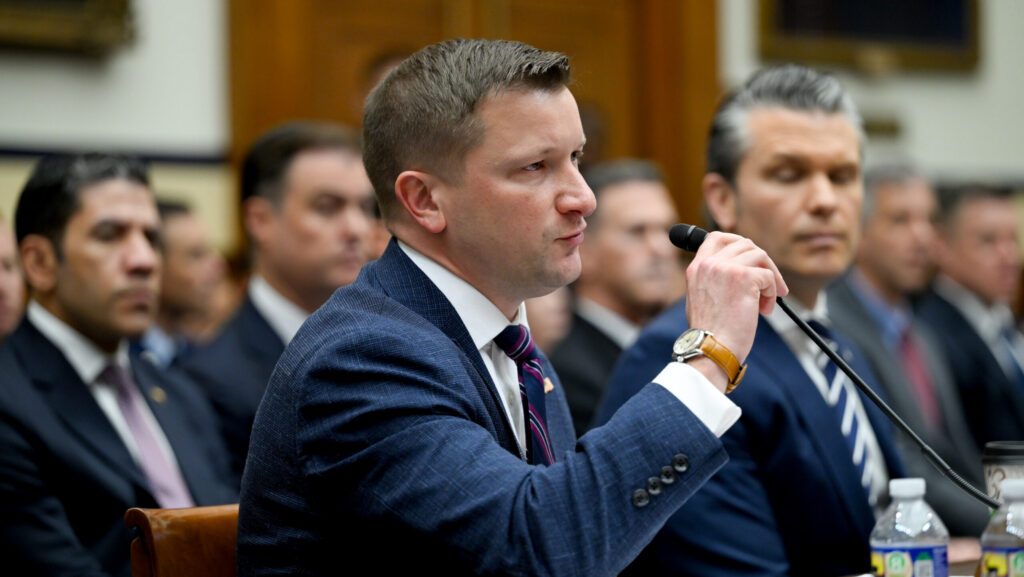
WASHINGTON — If Congress does not pass the full $350 billion reconciliation funding requested by the Pentagon, the department is prepared to work with lawmakers to figure out how to shuffle key priorities into the base budget, the department’s comptroller Jules Hurst told Breaking Defense today.
That plan, though, means the department would need to work with appropriators to cut investment in other places or defer them until 2028.
“If we really want to fund those things, then we have an opportunity to go back to the appropriators before they finalize the bill, at least I think we will…. it’s a conversation, obviously,” Hurst said on the sidelines of the NDIA Emerging Technologies Conference.
But at this point, Hurst said it is “too premature” to know exactly what those decisions will be and what the trade-offs will require.
“The question would be, what’s more important to have money for in FY27 [or] can it wait for FY28,” he added. “And, a lot of these technological areas [are] evolving so fast. Some things we need the money right now to invest in change. … Other things we need to do a little more research and development.”
Hurst’s comments come as the Department of Defense weighs its options over a possible failed attempt to secure $1.5 trillion next year through two separate bills — $1.15 trillion in the base budget and $350 billion in a reconciliation bill. That strategic bet placed big-ticket priorities like Golden Dome, munitions and the Defense Autonomous Warfare Group (DAWG) inside that reconciliation pot.
But with three weeks left until FY27 kicks off, Congress has only made incremental headway on the base request, while not moving forward with the reconciliation request. And with midterm elections looming in November, members opted to pass a continuing resolution (CR) until Dec. 11 to keep the department funded.
However, past years have shown that the first CR may lead to a second CR, pushing final budget decisions into the next year. Hurst indicated the Pentagon is bracing for that, saying of the final budget decisions, “I think it’ll probably happen in the new calendar” year.
“The department’s going to make its priorities known because we think all these investments are important,” he said. Those conversations are already ongoing, he added, noting that they include things like autonomous warfare and space.
They also include securing dollars to ink the multi-year munition deals the department has been eyeing, both to refill US stockpiles, and provide allies and partners with the weapons they have ordered.


Biodefense is force protection: Ready today, prepared for tomorrow
A decorated combat aviator and biotech CEO advocates preparing for novel viral threats before the next crisis.
“Those [munition deals] really fundamentally change when we buy things from contractors, because for the first time we’re making them put in CapEx…. If they don’t meet these targets, these production targets, it’s going to hurt their profitability, and they have a real incentive to meet them,” he said.
“A lot of these munitions that we want to buy, we’re not the only ones,” Hurst added. “There’s countries across the globe who are US allies and partners who are also involved. So we have a fundamental responsibility as America to make sure we can produce enough arms and armors for all of our partners and ourselves.”
Any decisions on what to potentially cut or delay would require service leaders to weigh in, and officials have begun sounding the alarm in recent weeks.
Space Force Gen. Michael Guetlein, who is charged with making Golden Dome a reality, has warned that work on the national air defense shield could come to a grinding halt in October if lawmakers do not figure out a way to continue funding for the presidential initiative.
Lt. Gen. Steven Marks, who is working on the Pentagon’s ambitious drone development task force, warned Wednesday that the DAWG could stumble if it didn’t get “something.”
“We’re at a point where there is a potential for us to get, uh, some money out of the FY27 budget, the president’s budget, that will go directly to DAWG,” he said. “[I] don’t know if we’re going to get the full ask of $53.6 billion, but my greatest concern is, if we don’t get something, then the momentum that we have created since DAWG has been stood up, over a year ago, will be waning.”
Breaking Defense Video