
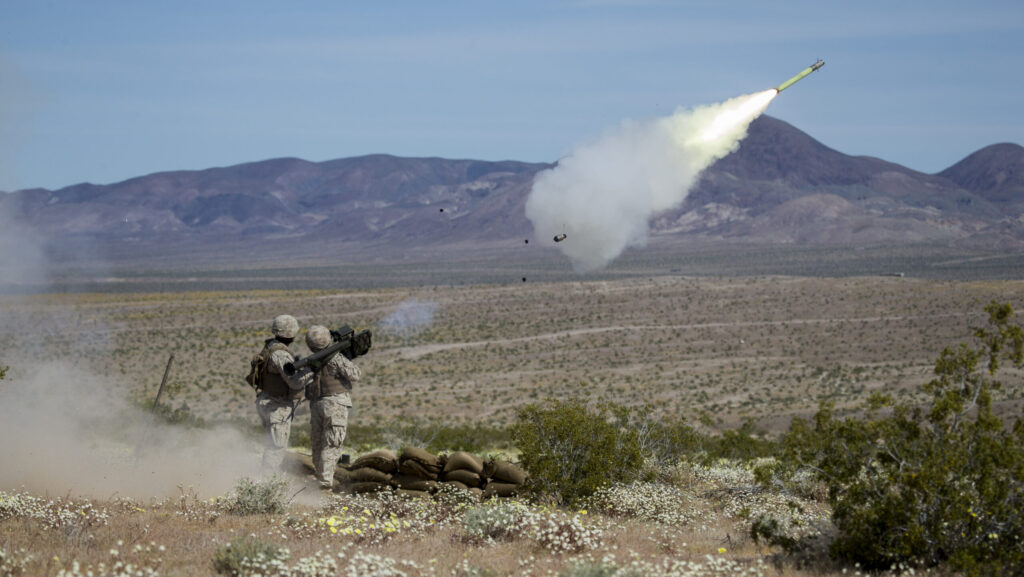
BELFAST — German weapons maker Diehl Defence and RTX’s Raytheon have taken a major step towards coproduction of parts for Stinger missiles in Europe, in order to “support increased global capacity” of the surface-to-air munition amid an urgent rush on the continent to rearm at pace.
In a statement today, Diehl said the new memorandum of understanding agreement “lays the groundwork for the extension of production for Stinger missiles at Diehl Defence [facilities] as part of the company’s growth plan.”
It added that assessment of “various options for increasing production capacity, both at existing sites and possibly other locations,” is already underway.
Diehl, which is famed for making the IRIS-T air defense family of surface-to-air missiles, has also been producing Raytheon’s AIM-9X Sidewinder under license in Europe since the 1960s, according to company literature.
Tom Laliberty, president of land and air defense systems at Raytheon, said that the US manufacturer is “seeing historically high demand for Stinger because of its unrivaled effectiveness and success against a variety of short-range threats,” per the statement.
Stinger, which has been supplied by the US to Ukraine, is a lightweight, shoulder launched weapon capable of targeting aircraft and cruise missiles.
The system was out of production for 18 years prior to the outbreak of the war in 2022. In response to the sudden demand, the Pentagon awarded Raytheon’s Tucson, Ariz., division a four year Stinger contract, valued at $624 million for the production of 1,300 missiles.
“We can’t disclose specific production rates, but we are doubling our Stinger production capacity over the next five years,” a Raytheon spokesperson told Breaking Defense in a statement.
Wes Kremer, the former president of Raytheon, estimated that it would take 30 months for those Stinger units to enter production, because of factory set up time and employee training, noting that retired employees had been drafted in to teach existing staff how to build the missile.
As Breaking Defense previously reported, Raytheon has also acknowledged that alongside the dearth of contracts placed by the DoD before the Ukraine war, some Stinger parts have become unavailable, prompting the company to prioritize a redesign of some electronics, integral to the weapon’s seeker head.
“Stinger is the surface-to-air missile of choice for 24 countries, including Germany and nine other NATO members,” Laliberty added today.
Under plans to field a Stinger replacement, the US Army shared in a 2022 industry notice that it is eyeing “production of 10,000 [Maneuver-Short Range Air Defense] M-SHORAD Inc. 3 missiles beginning in FY27.”
Competitors were asked to put forward solutions with “capabilities equal to or greater than the current Stinger missile (with Proximity Fuse capability).”