Air Warfare

Air Force AI writes battle plans faster than humans can — but some of them are wrong

“While we're getting faster results and we're getting more results, there's still going to have to be a human in the loop for the foreseeable future to make sure they’re all viable,” said Maj. Gen. Robert Claude.

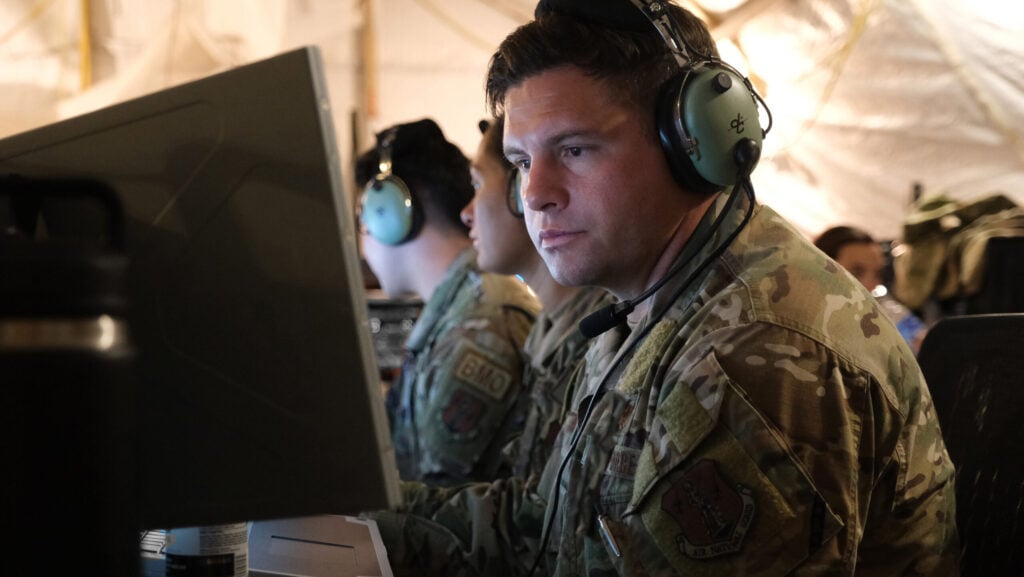
United States Airmen participate in the Tactical Operations Center-Light experiment at the 805th Combat Training Squadron, also known as the Shadow Operations Center – Nellis, Capstone 24A experimentation event at Nellis Air Force Base, Nevada, June 28, 2024. (U.S. Air Force photo by Keith Keel)

AFA 2025 — In a recent Air Force experiment, AI algorithms generated attack plans about 400 times faster than human staff, a two-star general told reporters here at the Air Force Association’s Air, Space and Cyber conference. The catch? Not all the AI-generated plans would actually work.

The challenge in the exercise, called DASH-2, was to come up with detailed “Courses Of Action” (COAs) for how to strike a given set of targets with a given set of aircraft and weapons, explained Maj. Gen. Robert Claude, a member of the joint Air Force/Space Force team for the Advanced Battle Management System (ABMS). Human staff using traditional methods generated three COAs in about 16 minutes, Claude said, while AI tools generated 10 COAs in “roughly eight seconds.”

Some quick math averages those rates out: The AI generated 1.25 COAs every second, the humans generated one COA every 5.3 minutes. That’s a 400-fold difference in speed.

That’s radically faster than in the inaugural experiment in the series, this summer’s DASH-1, where the Air Force claimed AI sped up planning “seven-fold” — without making any more mistakes than humans. But not all AIs are created equal, and the best-laid plans of mice, men and machines oft go awry.

In DASH-2, Claude said, “while it was much more timely and there were more COAs generated [by AI than humans], they weren’t necessarily completely viable COAs.”

While he didn’t go into details, he said the errors were not blatant but subtle: more along the lines of failing to factor in the right kind of sensor for specific weather conditions, rather than trying to send tanks on air missions or put glue on pizza. (Of course subtle errors are harder to catch and require more expertise for a human to correct.)

The lesson, Claude said: “What is going to be important going forward is, while we’re getting faster results and we’re getting more results [from AI], there’s still going to have to be a human in the loop for the foreseeable future to make sure that they’re all viable [and] to make the decision.”

That said, Claude was confident future iterations of AI planning aides can get that error rate back down. The name DASH stands for “Decision Advantage Sprint for Human-Machine Teaming,” and as both “dash” and “sprint” imply, the emphasis was on speed, with the participating software development teams having just two weeks to build custom planning tools.

“It’s all, obviously, in how they build the algorithm. You’ve got to make sure that all the right factors are included,” Claude said. “In a two-week sprint, you know, there’s just not time to build all that in with all the checks and balances.”

That’s an acceptable tradeoff for a quick experiment to explore the art of the possible, not for a deployed military system. “If we pursue this route, if we do this for real,” he said, “it’s going to be longer than a two-week coding period.”

The third and final DASH of the year is already underway at the ominously named Shadow Operations Center — Nellis in Las Vegas. “I was actually out for the beginning of DASH-3 last week,” Claude said.

The general was powerfully struck by how much incoming information the Air Force planners in the exercise, known as battle managers, had to cope with.

“They sat me in front of a scope and it was an eye-opening experience for me to see … from a battle manager standpoint, what it is they go through,” he said. “If we successfully get to the point where we’ve got a good human-machine team arrangement, how valuable that could be.”

PHOTOS: AFA 2025

PHOTOS: AFA 2025

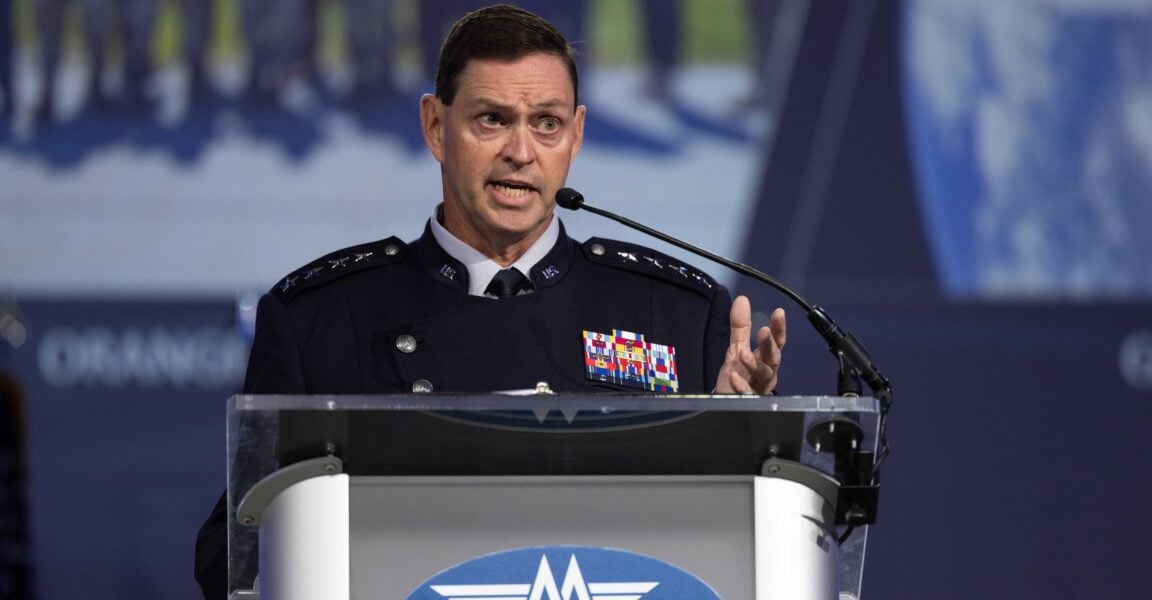
Space Force Chief of Space Operations Gen. B. Chance Saltzman delivers his keynote address, Sept. 23, 2025. (Jud McCrehin/Air & Space Forces Association)
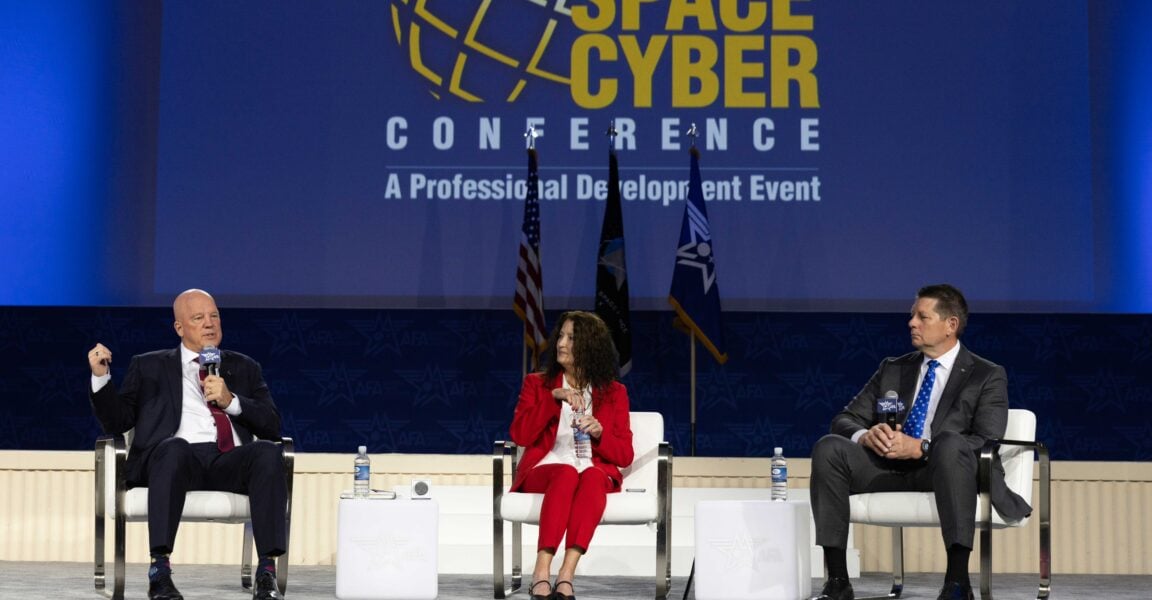
Jay Raymond (left), former Space Force chief of space operations, and David Thompson, former vice chief of space operations, speak on a panel moderated by Nina Armagno, former Space Force staff director, Sept. 23, 2025. (Jud McCrehin/Air & Space Forces Association)
Griffon Aerospace displays its Valiant vertical takeoff-and-landing drone, designed for field reconnaissance on the go, Sept. 23, 2025. (Aaron Mehta/Breaking Defense)
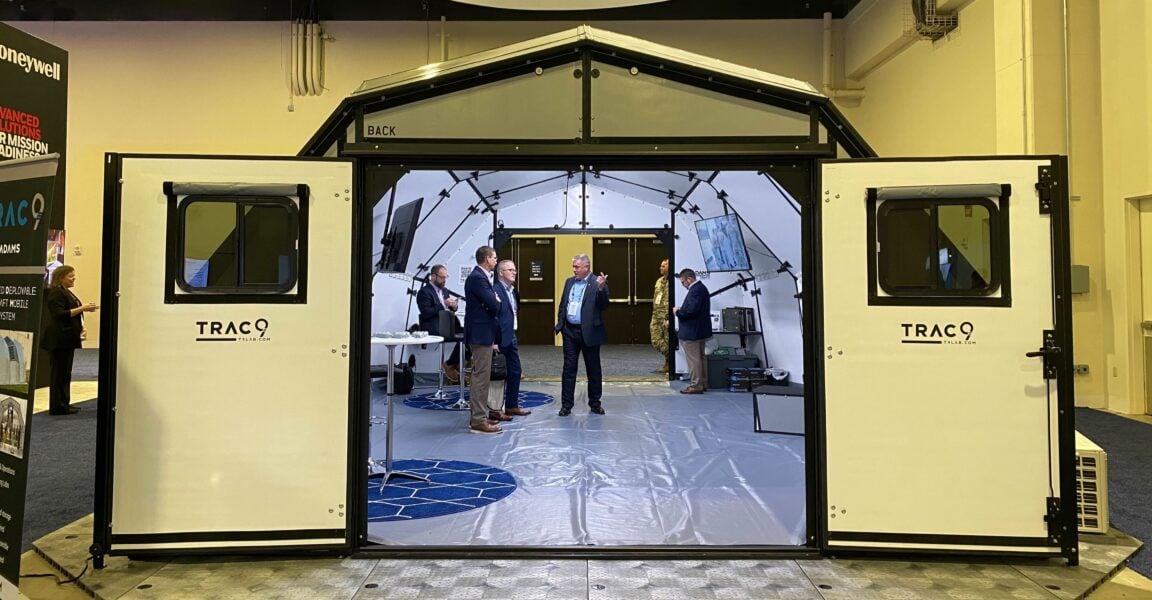
Trac9 shows its Advanced Deployable Aircraft Mobile System, a portable hangar, Sept. 23, 2025. (Aaron Mehta/Breaking Defense)
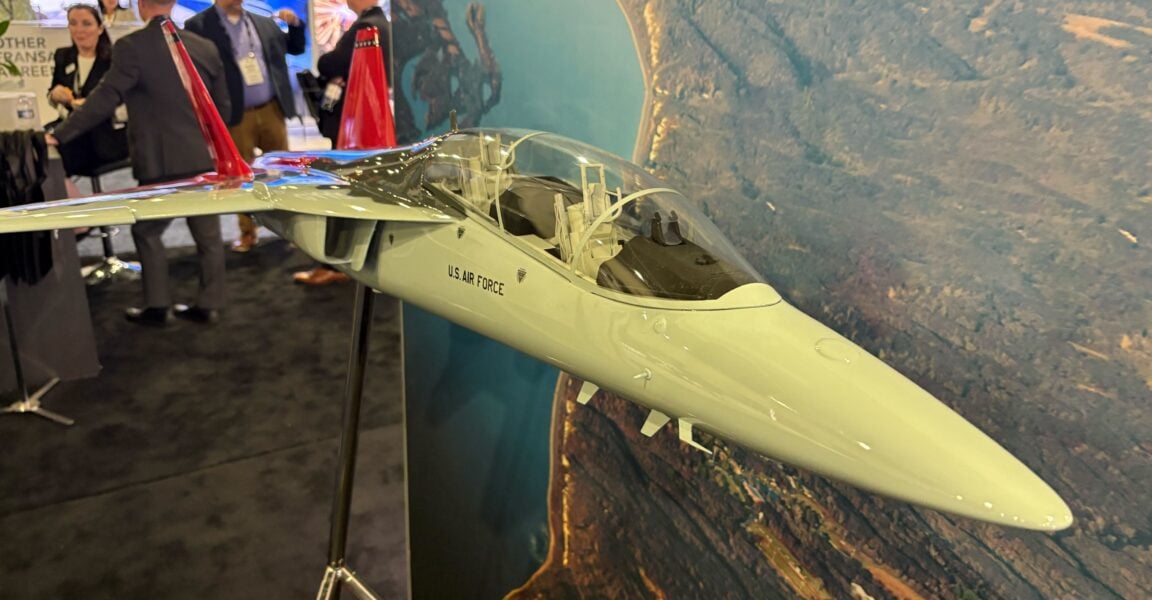
A model of Saab-Boeing's T-7 Red Hawk jet trainer, Sept. 23, 2025. (Daniel Woolfolk/Breaking Defense)
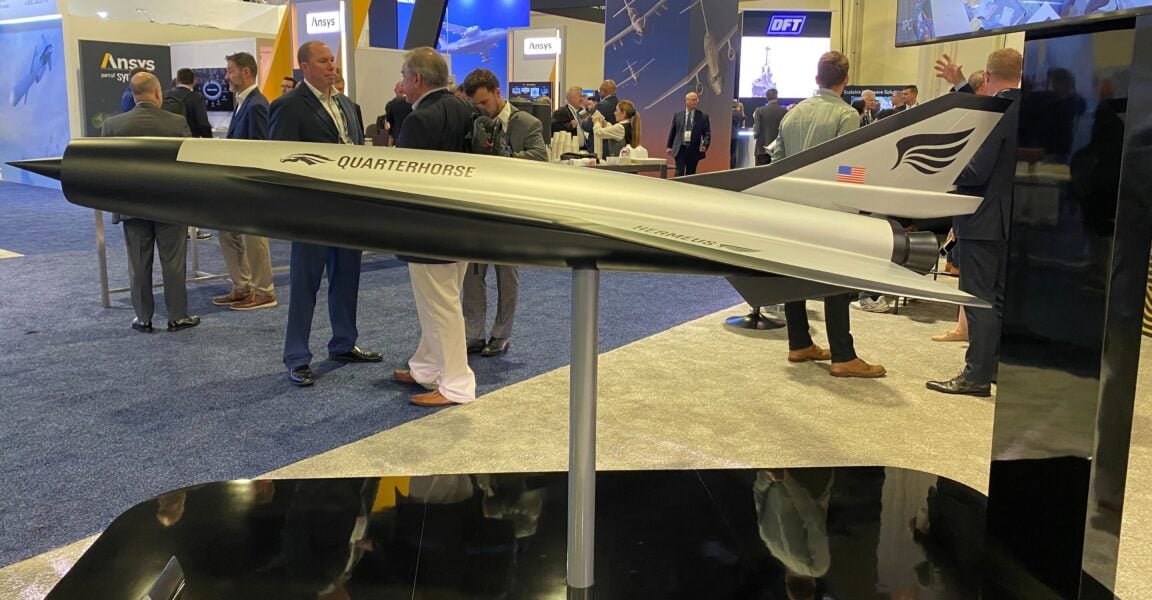
A 1/6th-size model of the Hermeus supersonic jet sits below a live feed of the company's production line in Atlanta, Ga., Sept. 23, 2025. (Aaron Mehta/Breaking Defense)
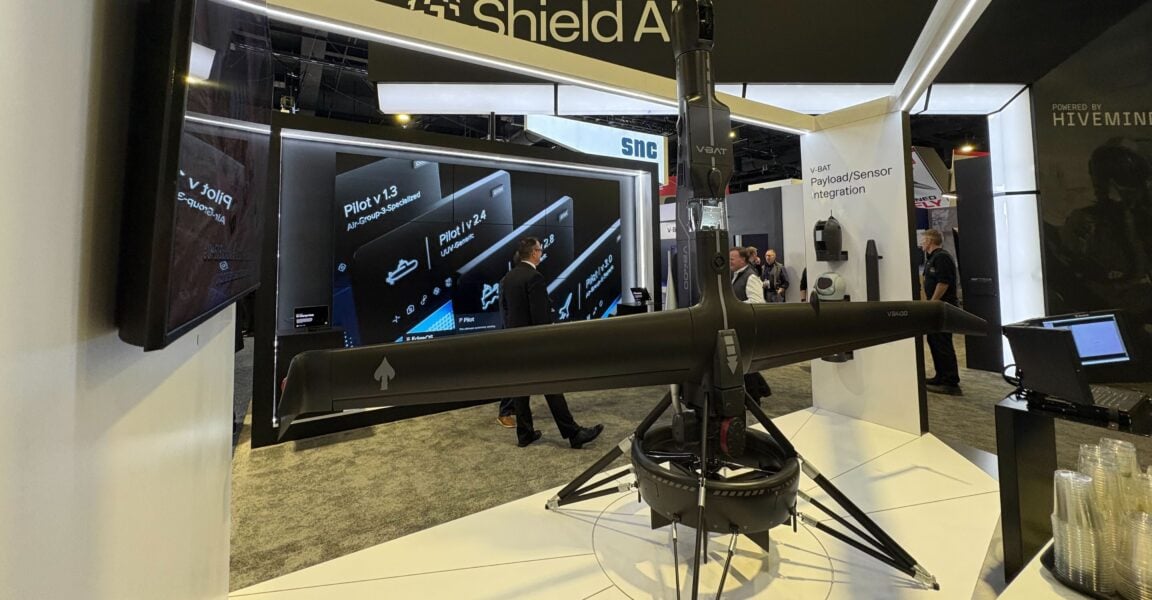
Shield AI's V-BAT vertical takeoff-and-landing drone, sits on display, Sept. 23, 2025. (Daniel Woolfolk/Breaking Defense)
The Air Force Research Laboratory displays a missile designed under its "Angry Tortoise" program, a partnership with Ursa Major, that looks to develop hypersonic missiles that can be deployed en masse for millions of dollars less than more traditional munitions, Sept. 22, 2025. (Rachel Cohen/Breaking Defense)
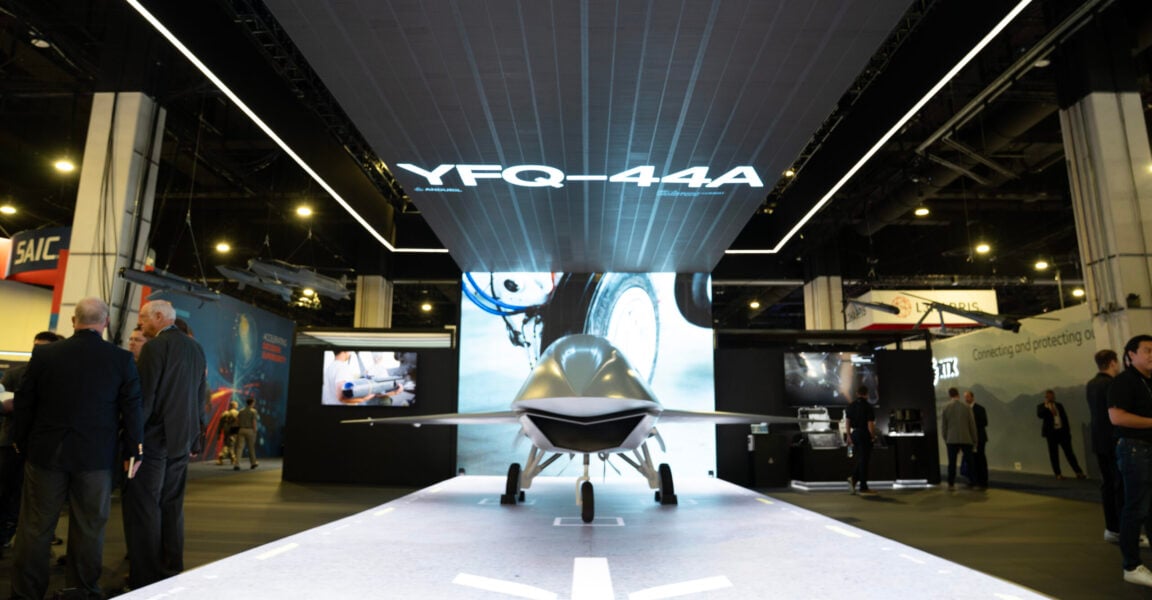
Anduril’s YFQ-44A Fury drone, an entrant in the Collaborative Combat Aircraft drone wingman program, sits on display, Sept. 22, 2025. (Daniel Woolfolk/Breaking Defense)
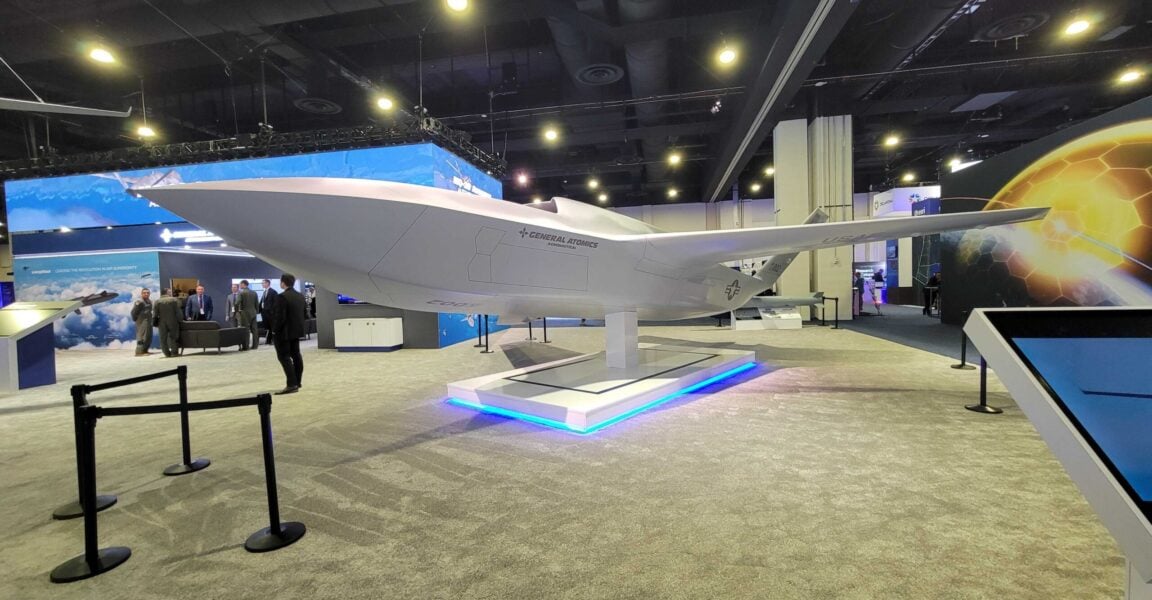
General Atomics’ YFQ-42A, another CCA entrant, sits on display, Sept. 22, 2025. (Rachel Cohen/Breaking Defense)
JetCat shows several small jet engines designed to power munitions or kamikaze drones at a fraction of the cost of larger engines, Sept. 22, 2025. (Rachel Cohen/Breaking Defense)
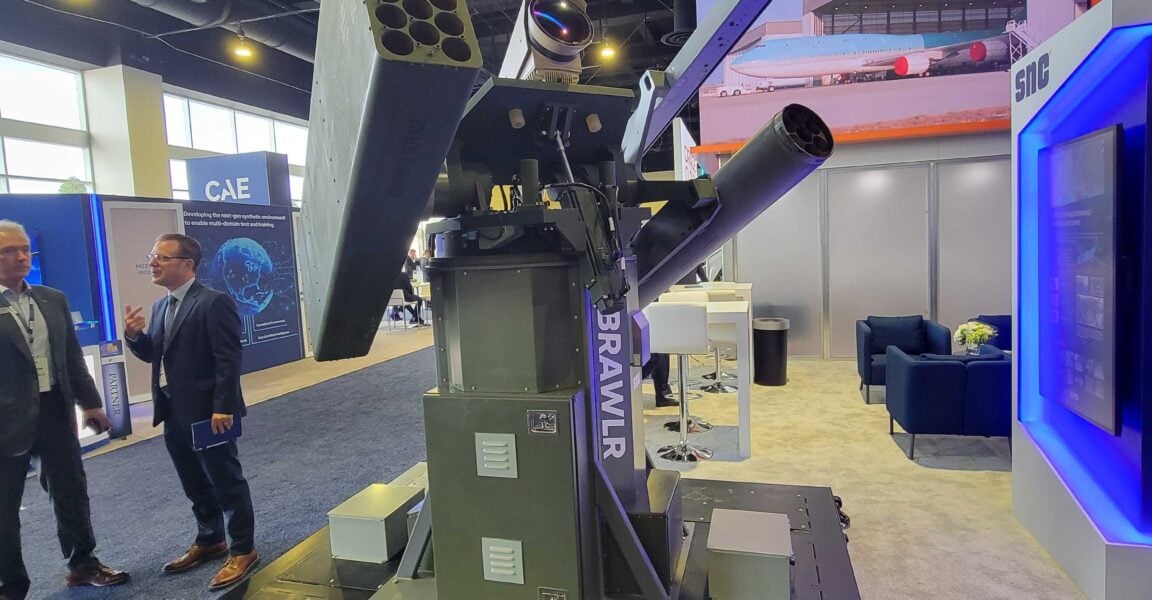
Sierra Nevada Corp.’s Battery Revolving Adaptive Weapons Launcher (BRAWLR), a reconfigurable counter-drone system in use by at least one classified foreign customer, makes its defense trade show debut, Sept. 22, 2025. (Rachel Cohen/Breaking Defense)
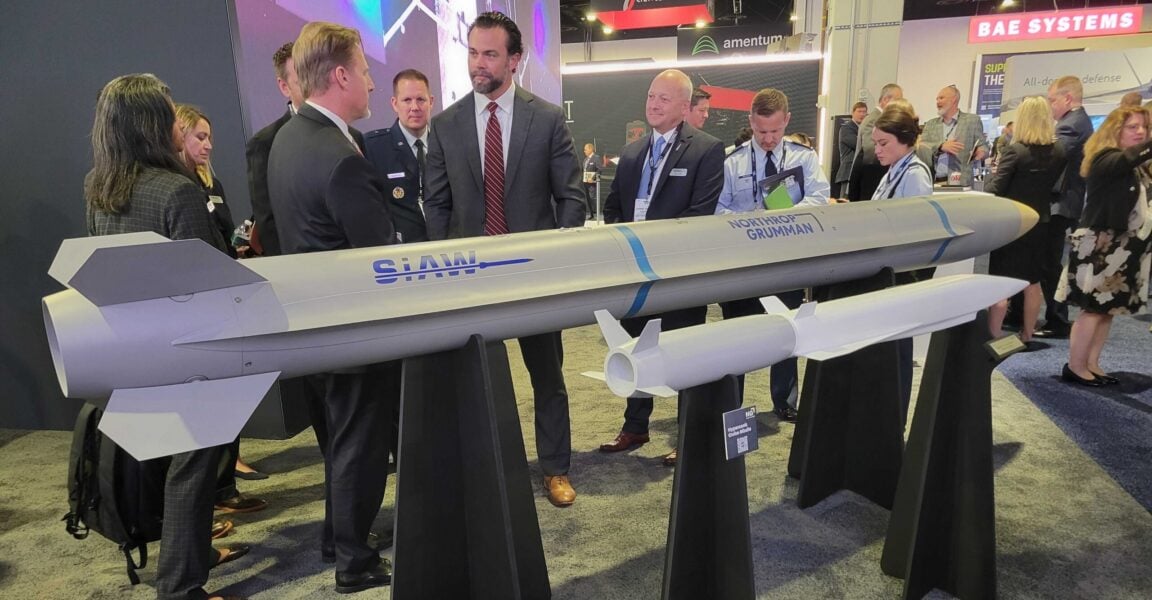
Air Force Undersecretary Matt Lohmeier visits the Northrop Grumman booth, where the Stand-In Attack Weapon and Hypersonic Cruise Missile are on display, Sept. 22, 2025. (Rachel Cohen/Breaking Defense)
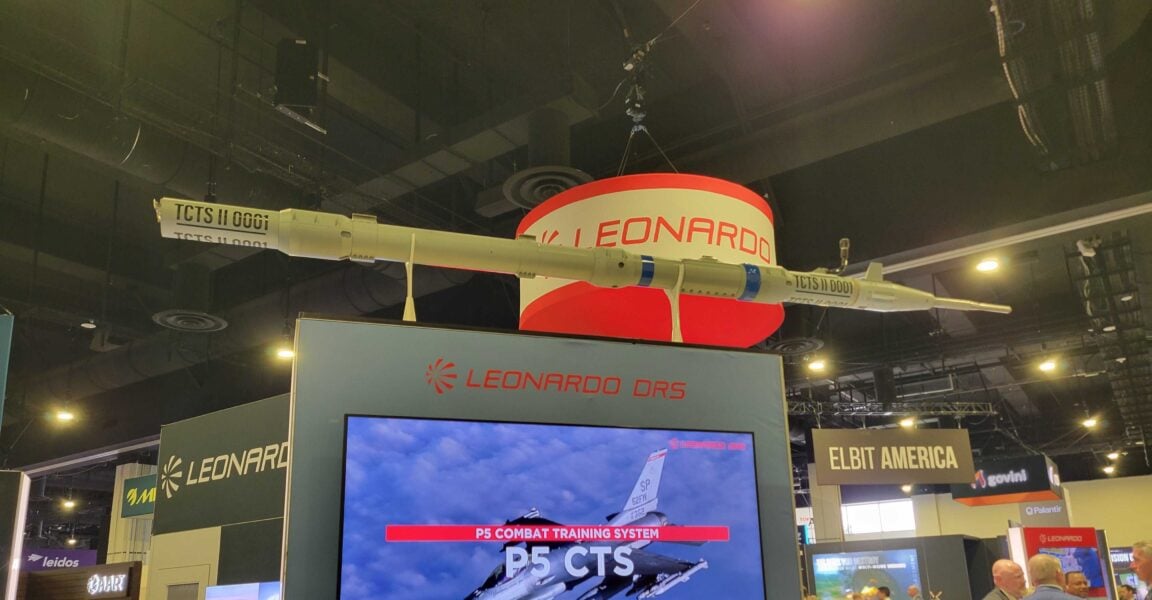
The Tactical Combat Training System Increment II connects live aircraft to a simulator in training, allowing remote troops to practice in real-world conditions. (Rachel Cohen/Breaking Defense)

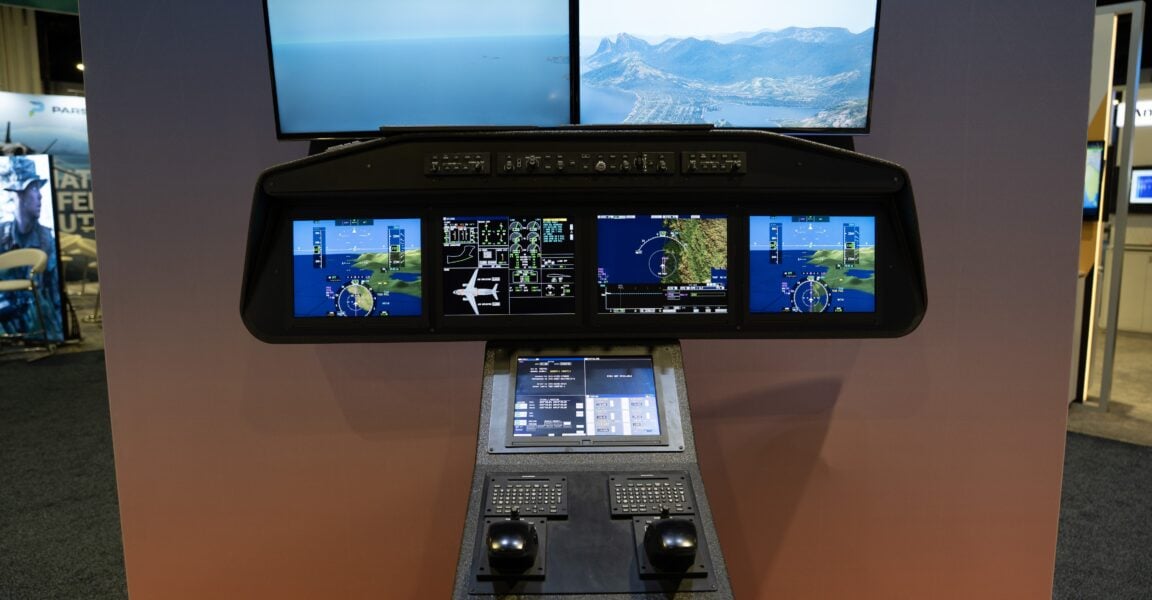
Could you fly Embraer’s C-390? (Daniel Woolfolk/Breaking Defense)

Embraer aims to convince the Air Force that its C-390, shown in miniature on Sept. 24, 2025, could be a boon to the service’s airlift fleet. (Daniel Woolfolk/Breaking Defense)
J.P. Nauseef, president and chief executive officer of JobsOhio speaks during ASC, Sept. 24, 2025. (Jud McCrehin/Air & Space Forces Association)
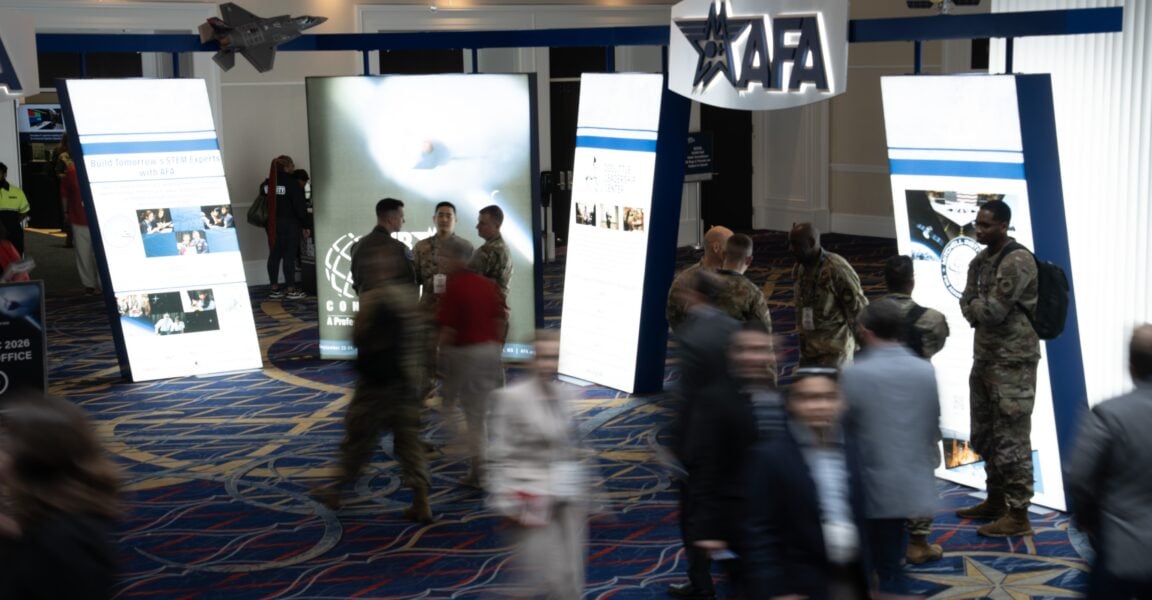
Attendees traverse the show floor on the final day of the conference, Sept. 24, 2025. (Daniel Woolfolk/Breaking Defense)
Attendees mill about near the main show floor doors at the Gaylord National Resort & Convention Center, Oxon Hill, Md., Sept. 24, 2025. (Daniel Woolfolk/Breaking Defense)
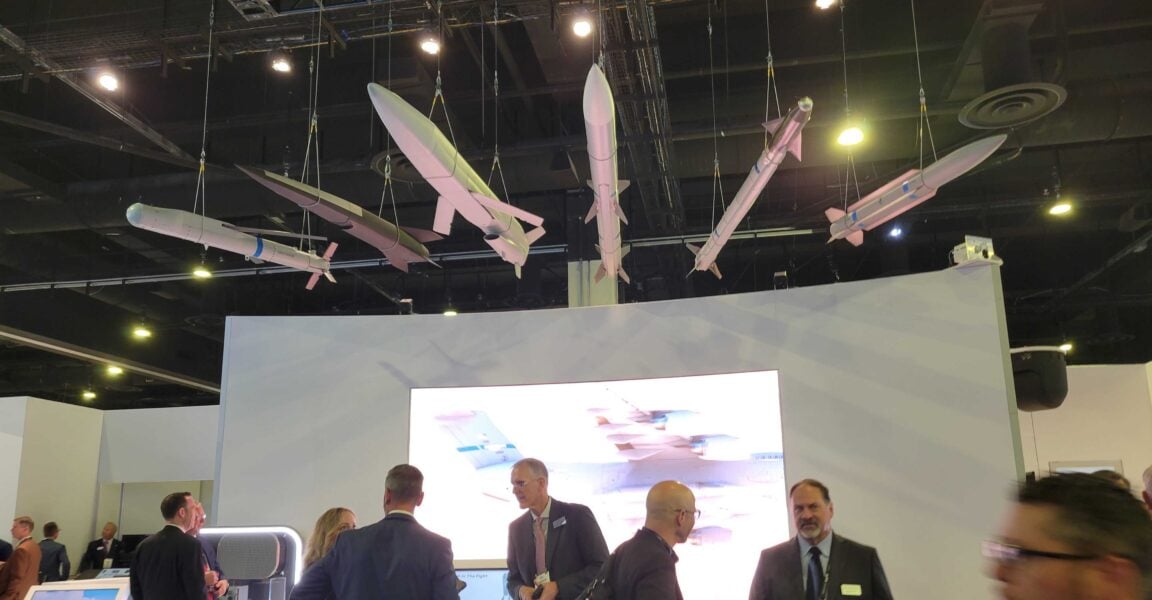
RTX shows off munitions at its booth on the show floor, Sept. 22, 2025. (Rachel Cohen/Breaking Defense)