AFA 2025 — Venerable aviation supplier GE Aerospace teamed with seven-year-old Merlin Labs to add AI to GE avionics used on a wide range of military and civilian aircraft, the companies told Breaking Defense ahead of an announcement at the Air Force Association annual conference here.
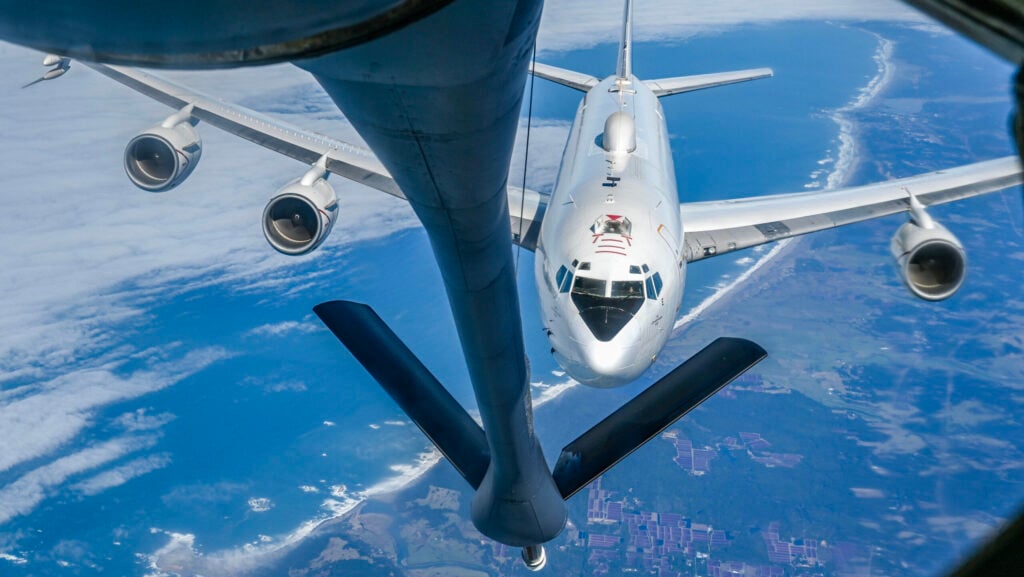
The firms’ first target is likely to be the Air Force’s planned cockpit overhaul for the aging KC-135 tanker, the Center Console Refresh (CCR), for which the formal competition could kick off as early as this fall, executives told Breaking Defense. But in the slightly longer term, they envision their combined product assisting human pilots on multiple aircraft, allowing the human crew of, for example, the C-130J transport to be cut from two to one — and even, ultimately, to zero.
The current plan is to have a human pilot “in the loop” to oversee, and if necessary, override the AI, GE general manager for “connected aircraft” Jeremy Barbour told Breaking Defense. But as Merlin’s technology matures, he said, “I’m excited about where the relationship could grow over time, so we’ll see how that evolves.”
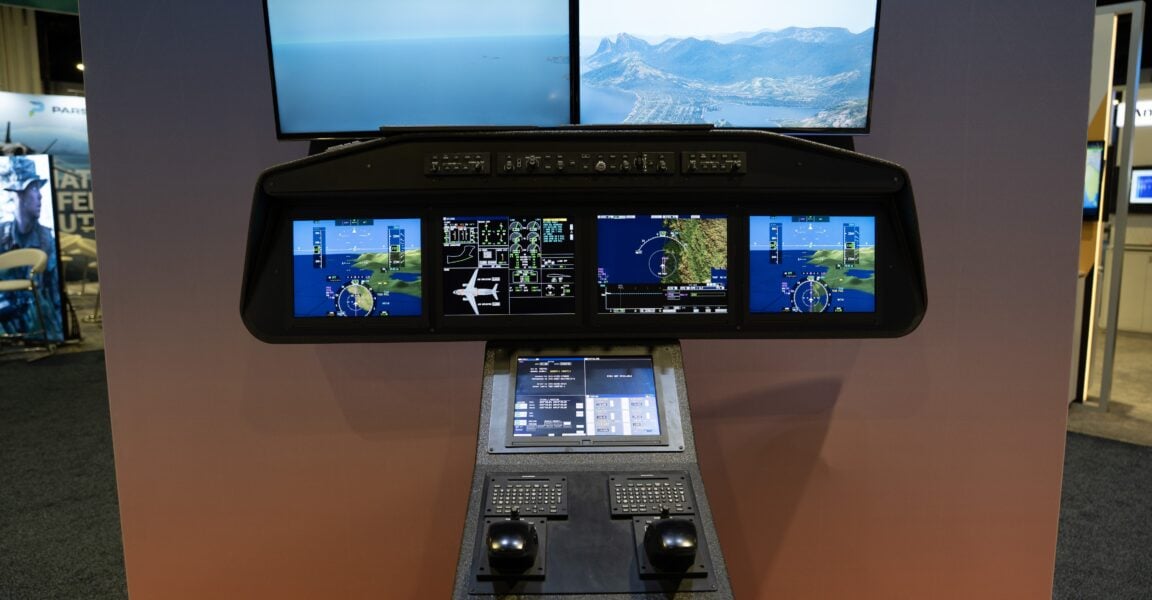
While GE Aerospace is best known for its jet engines, it also builds sophisticated Flight Management Systems (FMS) installed on over 14,000 large, multi-engine aircraft, both military and civilian, from the Boeing 737 (and its Navy derivative, the P-8 Poseidon) to the C-130J transport and the KC-46 tanker. Pilots can program their FMS with their flight plan — including military-specific complications like where to air-drop supplies or to orbit waiting for fighters to refuel — which the FMS then turns into detailed instructions for the autopilot, which then flies the plane. But the current state-of-the-art FMS isn’t particularly adaptable to changing circumstances, so a human has to manually enter updated instructions from Air Traffic Control or any other adjustments to the plan.
Meanwhile, Merlin is developing what it calls an “aircraft-agnostic” AI, which it’s tested on five different types of plane since its 2019 first flight. Last year Merlin won both a $105 million from Special Operations Command to integrate the “Merlin Pilot” on the C-130J and another contract (value undisclosed) with the Air Force to test the AI on the KC-135. The Merlin Pilot is designed to plug into an aircraft’s existing control system — preferably, a full-featured FMS like GE’s product, although it can work with more primitive controls if suitably modified — and make it more user-friendly and flexible. For instance, the AI has natural language processing capabilities that let it listen to air traffic control instructions and automatically turn them into detailed instructions the FMS can execute, without a human having to manually enter each one.
In the current scheme, once the AI has generated such a revision to the flight plan, the human pilot would need to review and approve it. But ultimately Merlin aims for the AI to fly the plane by itself, without needing a human pilot either in the cockpit or at a remote-control station on the ground, as is required today for many unmanned aircraft. In the company’s flight tests, starting in 2019, the AI has been able handle every aspect of piloting “from takeoff to touchdown,” Merlin exec Matt George told Breaking Defense.
“What we focus on is true onboard autonomy, meaning it does not need any link to the ground,” George said. “All the software lives on board the airplane [and] makes its own decisions based off sensors … on the airplane.” It doesn’t even need a GPS signal to find its way, he said, although he couldn’t disclose the details of the alternative navigation systems employed.
In the short term, the two companies need to work out the details of plugging the Merlin Pilot into the GE Aerospace Flight Management System. (The main unanswered question is which of several possible Application Programming Interfaces, or APIs, to use).
They’re also eager for Air Force feedback on how to refine the tech: “That’s why we’re making the announcement at the Air Force Association meeting,” Barbour said.
PHOTOS: AFA 2025

 Gallery