MELBOURNE — India’s recently-announced plans for a multi-layered integrated air and missile defense shield are an ambitious undertaking, one likely to require the development of new systems to complement existing capabilities, with an expected emphasis on indigenous production, analysts tell Breaking Defense.
Indian Prime Minister Narendra Modi announced the launch of Mission Sudarshan Chakra, a plan to develop an integrated air and missile defense system for India, in his Independence Day address on August 15.
He said that all important places in India, including strategic areas as well as civilian ones like hospitals, railways and centers of faith, will be given “complete security cover” under the plan by 2035. The air and missile defense network will also be integrated with cyber defense systems and counter-strike weapons and will progressively be expanded, strengthened and modernized over the next decade and designed to take into account future threats and advances in technology.
The announcement has echoes of the White House’s planned Golden Dome effort, as well as Turkey’s Steel Dome concept or the European SkyShield — all of which, in turn, owe respect to Israel’s integrated missile defense networks. But trying to meet Modi’s demands for a country as physically large, and population dense, as India won’t be easy, a pair of analysts warned.
Arzan Tarapore, a research scholar who focuses on Indian defense policy at the Center for International Security and Cooperation (CISAC) at Stanford University, told Breaking Defense that Sudarshan Chakra is being described as the overall program title for many diverse systems designed for air defense.
“It will include systems that are already in service, as well as others that are in various stages of development,” Tarapore said.
He noted that the recent conflict between India and Pakistan was characterized by stand-off strikes, with the extensive use of drones and missiles at long ranges — something almost certainly front of mind for military planners of Sudarshan Chakra, which appears to be designed to address exactly those threats.
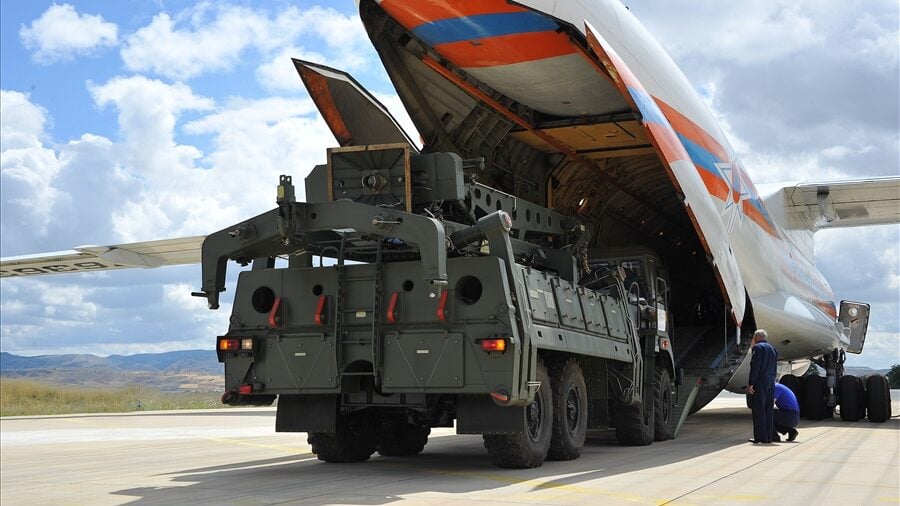
However, Tarapore pointed out that while India’s air defenses performed well during the conflict, with its air force chief claiming that its Russian-built S-400 missiles shot down six Pakistani aircraft from long range, India will have to look at procuring a significantly larger number of launchers and missile stockpiles in the event of a larger conflict.
While importing foreign systems seems a likely necessity, India is likely to aim to keep as much of the program indigenous as possible, said Indian-based independent air power analyst Angad Singh. (However, India’s deepening ties with Russia, on display last weekend, could open up Delhi as a much needed weapons export market for Moscow.)
But loopholes are possible. For instance, the Barak 8 surface-to-air missile, developed together with Israel, may not be a purely domestic weapon, but could be slid under that header.
In terms of purely domestic systems, there are already existing programs to develop next-generation air and missile defense interceptor systems.
Chief among this is Project Kusha, a ground-based system for air and missile defense being developed by India’s Defence Research and Development Organisation (DRDO). Project Kusha will develop an interceptor that can be fitted with various boosters for maximum ranges from 150 km (90 miles) to 400 km (250 miles) and will supplement the Barak 8 and S-400 air defense systems currently operated by India.
In August, the DRDO also carried out a test launch of the Integrated Air Defence Weapon System (IADWS), a short-range air defense system that in equipped with missiles and a high-powered laser that can be used to counter a wide spectrum of threats that includes drones. It is also developing a new Ballistic Missile Defense (BMD) system in addition to the Prithvi and Ashiwin family of BMD and anti-satellite missile systems.
However, Tarapore said that it is currently not clear whether Mission Sudarshan Chakra is just an umbrella term for any air defense-related systems or if India intends to integrate all its components into a system of systems.
“The latter goal is obviously more demanding. One of the biggest and most obvious potential stumbling blocks is systems integration: the ability to ensure that all constituent components can communicate and function together,” he added.
Singh noted that another potential pain point for the program would be the ability to meet delivery timelines and whether the ambitions for the program would be sufficiently funded.
“But the announcement was suitably vague as to actual programme targets and milestones, so it feels more like it will be played by ear.”