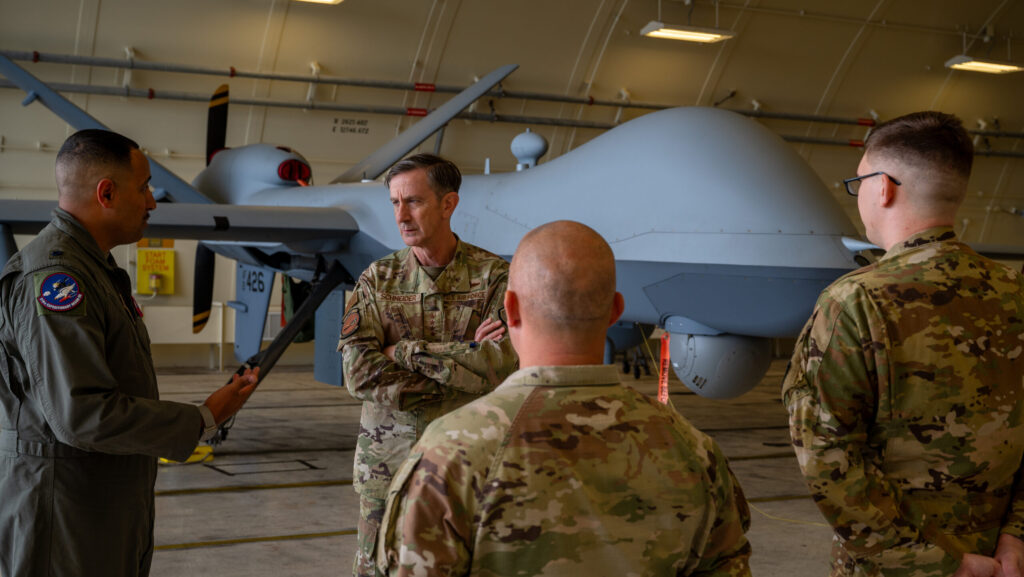
WASHINGTON — The Air Force needs to invest more in command and control to manage forces in battle if it wants to stay ahead of adversaries, especially China in the Indo-Pacific, a top Air Force official said Tuesday.
“I’d say that’s one of the areas on which we can improve, which is probably a way of saying, no probably not at this point,” Pacific Air Forces Commander Gen. Kevin Schneider said in a virtual discussion hosted by the Mitchell Institute, when asked whether his command has the people it needs to perform C2 battle management functions.
Pointing to missions like air superiority and mobility, Schneider said, “The tree that that hangs on, the tree of our platforms and our capabilities is command and control, and I see a need for us to continue to invest and improve. And that’s people.
“So a long way of saying, there are opportunities for us to improve the people, the pipes and the processes for command and control battle management,” he said.
C2 battle management, Pentagon parlance for directing tactical forces in the field to accomplish an objective, relies on an intricate network of sensors, communication systems, data analytics and people to make sense of it all. Military officials warn that adversaries like China would attack C2 capabilities in a conflict in an attempt to blind or confuse US forces.
Throughout his talk, Schneider stressed the need to invest in C2 battle management, reasoning that those skills are an essential foundation for modernized platforms like the forthcoming B-21 Raider stealth bomber and F-47 sixth-generation fighter to fully realize their potential. While “perhaps overly simplified,” Schneider said C2 battle management investments “pay out in the near-term before some of the other modernization efforts will deliver on their timelines.”
The Air Force has multiple ways to manage forces in battle, including through air operation centers on the ground or on airborne platforms like the aging E-3 Sentry. In the long run, the Pentagon hopes to link sensors and shooters through an integrated global network called Combined Joint All Domain Command and Control (CJADC2).
The Air Force, for its part, plans to contribute to the overall CJADC2 plan through an effort called the Department of the Air Force Battle Network headed by Maj. Gen. Luke Cropsey, the program executive officer for command, control, communications and battle management (C3BM).

Schneider called for a “layered approach” in constructing a resilient C2 architecture, which would consist of “multiple pathways” to pass data to a relevant user. That could look like equipping specific communications capabilities and sensors on systems like bombers or tankers, with Schneider saying that innovation can find ways to turn “every platform” into a C2 pathway or node. (Critics have warned the recent decision to forgo buying the E-7 Wedgetail surveillance and early warning aircraft could complicate Indo-Pacific operations, though Schneider didn’t directly address that decision.)
RELATED: To kill the kill chains: How Space Force could use AI to avoid ‘operational surprise’ on orbit
Just as adversaries like China will try to go after C2 capabilities, Schneider said the US should pursue the same strategy, adding that requirements for future systems will likely need to incorporate longer range detection and weaponry to match.
At the end of the day, however, Schneider made clear he’d prioritize dollars for shoring up his own C2 battle management capabilities if given the choice.
“If I had a dollar, or a couple of dollars, that is where I would first look to spend it,” he said.