MELBOURNE — The US Justice Department has revealed that in 2024 American authorities seized two China-bound mission crew trainers (MCTs) that it says were designed to train the Chinese military in anti-submarine warfare, were based on tech improperly derived from the US and were exported “illegally” — allegations vehemently denied by the South African firm that exported the equipment.
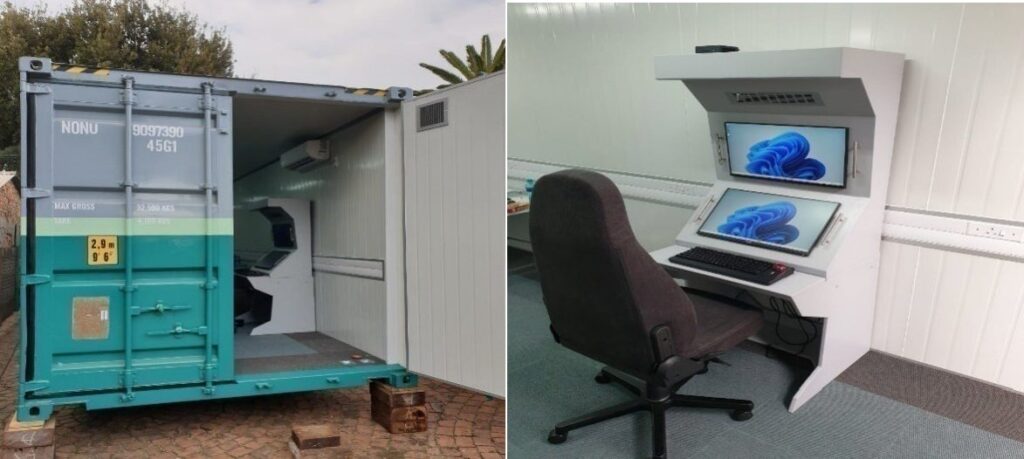
“The MCTs are mobile classrooms, housed in shipping containers, intended to assist the PLA [People’s Liberation Army] to train personnel on the use of airborne warning and control system (“AWACS”) and antisubmarine warfare (“ASW”) aircraft, focused mostly on the capabilities of the U.S. ASW maritime patrol aircraft (“MPA”) P-8 Poseidon, manufactured by Boeing,” says a forfeiture complaint filed in a Washington, DC, court on Thursday.
The DOJ says software used in the MCTs was based on a basic flight simulator program designed and marketed by a US company, which was then enhanced by software engineers working for the exporter, Test Flying Academy of South Africa (TFASA), using technical data from Western anti-submarine warfare aircraft, including the P-8 Poseidon. The layout of the trainers in the containers were modelled after the Poseidon’s, the complaint says. (As it’s a forfeiture complaint, the court document lists the shipping containers themselves as defendants, not TFASA.)
In the 37-page forfeiture complaint, the DOJ says that the two MCTs were seized in Singapore while on board a China-bound container ship belonging to Chinese state-owned maritime transportation company COSCO. The seizure was conducted under the Export Control Reform Act (ECRA) and Arms Export Control Act (AECA).
“TFASA masquerades as a civilian flight-training academy when in fact it is a significant enabler of the Chinese air and naval forces and a pipeline for transferring NATO aviation expertise, operational knowledge, and restricted technology directly to the People’s Liberation Army,” said Assistant Attorney General for National Security John A. Eisenberg in the departmental press release. “The National Security Division will continue to act decisively to preserve the U.S. military’s qualitative edge by preventing U.S. technology from falling into the hands of our adversaries.”
In a statement posted on its website, TFASA said it “strenuously rejects the allegations and implications made in that release as factually incorrect or misleading.”
“In particular, the Company rejects any suggestion that NATO expertise was transferred, or that any U.S. military technology, defence technical data, or other restricted information was exported in breach of applicable laws,” the statement says. “The containers in question were basic mobile classroom units and did not comprise or represent any form of tactical simulators, advanced systems, or any classified, sensitive, or mission-specific, tailored military training capabilities; they were limited to non-sensitive, procedural and instructional use, using publicly available and commercially licensed inputs, and were designed as mission crew training (MCT) systems aimed at supporting crew resource management (CRM) functions within maritime patrol aviation environments.”

How the industrial base is responding to Air Force, Space Force needs
Demand signals from leadership are shaping investments in design, engineering and manufacturing.
The company added that it expected the export could be “subjected to heightened international attention” and therefore had the equipment vetted by “the appropriate authorities.” The company also published on its website what it called “an independent, fact-based investigation,” which concluded, “There is no evidence of illegal software or export violations.”
“The shipment proceeded lawfully and in good faith, with the expectation that the contents would withstand scrutiny by any competent external authority,” the company said.
Concerns Over China’s Pursuit Of Western Expertise, Tech
Experts have told Breaking Defense that the Chinese People’s Liberation Army Navy (PLAN) was likely to be seeking to train its aviation crews on anti-submarine warfare (ASW) processes closely modelled on Western practices. Senior US and Western officials have also vocally warned Western former pilots about attempts by Chinese-backed organizations to draw on their expertise.
“It is an established fact that PLAN models their processes and CONOPs very much on US and by extension, NATO practices, which they appear to perceive more often than not best practice and therefore relevant to learning from,” said Australian naval analyst Alex Luck.
Collin Koh, a senior fellow and coordinator of maritime affairs at Singapore’s S. Rajaratnam School of International Studies, suggested to Breaking Defense that learning could also go the other way tactically as well, providing insights that could aid PLAN submariners and surface warship crews in devising effective countermeasures against the P-8.
Luck told Breaking Defense it was unclear how much insight the MCTs would provide the PLAN in areas such as P-8 capabilities or operational procedures given the uncertainty over the exact amount and quality of US origin data purportedly compromised.
“Nevertheless, considering the political situation between the US and China, Washington has every interest to prevent even the slightest possibility of expertise flow off,” he said.