
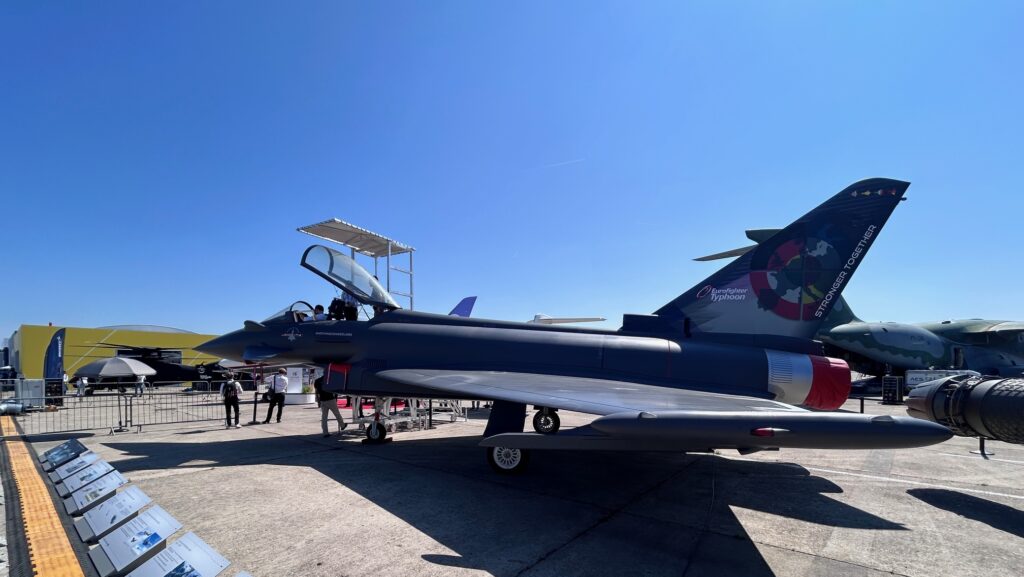
ROME — The head of the Eurofighter Typhoon consortium has said Turkey’s $10.7 billion order of the fourth-generation combat jet could be the impetus for more customers to move out with other lucrative export acquisitions of the aircraft.
In Turkey’s case, “we start with 20 [aircraft], it might grow even further and it may have a wake-up call effect with the rest of the nations,” Eurofighter CEO Jorge Tamarit Degenhardt told Breaking Defense on the sidelines of the International Fighter conference Wednesday.
“We would be expecting all other export campaigns to materialize — Saudi [Arabia], Qatar, Portugal, Austria. Let’s see,” said Degenhardt. Eurofighter is also campaigning to secure new business with Poland.
Additionally, Turkey’s acquisition could double in line with a pact signed with Britain at the International Defense Industry Fair.
New export opportunities covering Austria, Poland, Saudi Arabia and Qatar amount to a total of 134 aircraft, according to an infographic shared at the conference here.
One major upside for the consortium, should the wave of additional contracts arrive, is that the volume of export aircraft on order would be greater than those signed by the Eurofighter home nations of Germany, Italy, Spain and the UK.
Degenhardt told Breaking Defense and other media in June that the consortium is eyeing a production ramp up to reach a rate of 30 aircraft a year beginning in 2028, more than doubling existing output — a target tied to inking new export contracts.
“We could [eventually] reach a critical mass of backlog,” said Degenhardt this week, stating that the present backlog stands at 157 jets.
Setting out in 2023 to meet an ambitious target of securing contracts in the region of 150 to 200 new aircraft — figures that raised eyebrows at the time — Degenhardt said that the plan to hit that goal “was structured” even if it looked “optimistic” from the outside. “It’s not based on dreams,” he added.
Since then, with the exception of the UK, the home nations have all placed new orders as they look to recapitalize their combat jet fleets amid Russia’s war against Ukraine and a worsening threat environment across Europe more generally, due to Moscow’s series of drone incursions.
As European air forces grapple with how the Eurofighter and Lockheed Martin fifth-generation F-35 Lightning II jets can overcome interoperability issues and work hand-in-hand, Degenhardt said that, at least conceptually, the two types offer a “very synergetic operation.” The US aircraft could perform Suppression of Enemy Air Defense (SEAD) missions while the Typhoon deployed in an “assassin role” delivering strike capabilities.
But, he warned, “interoperability needs to be developed, even from the technical aspects” if the two types of aircraft are to work together.
Backed with support from the four home nations, Eurofighter has started “preliminary discussions” with its management body and contracting authority — NATO Eurofighter and Tornado Management Agency — to reform an existing contracts model, added Degenhardt. The changes could incorporate regulation and framework updates, while also enabling a reduction in supply chain lead times.