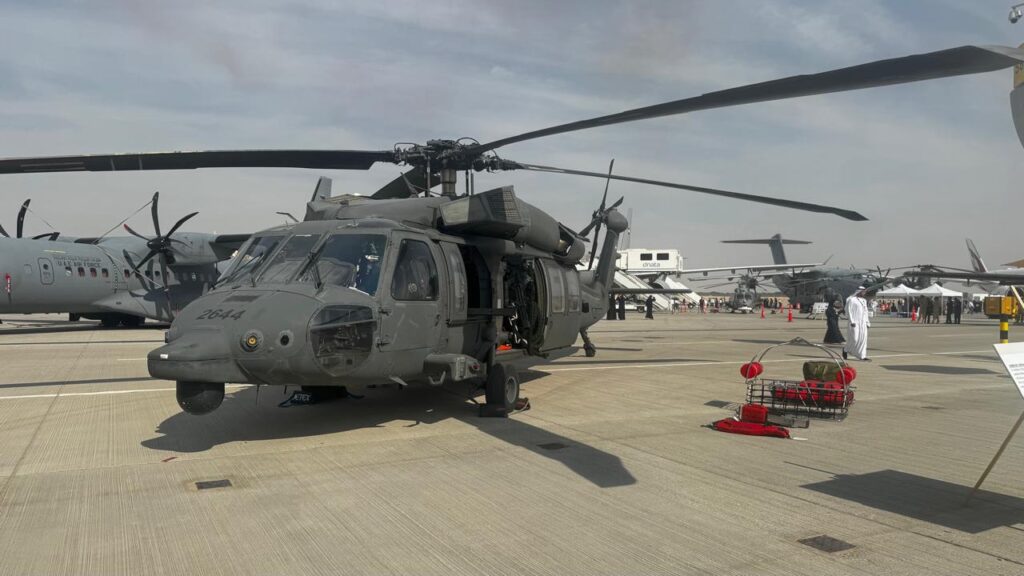
DUBAI AIRSHOW — Just weeks after unveiling a prototype Black Hawk helicopter reimagined from the ground up as an unmanned rotorcraft drone, Sikorsky has a new pitch to Middle Eastern customers: Let us help convert your aging Black Hawks into pilotless S-70 UHawks.
“Customers with old Black Hawks, Lima models or Alpha models, as they start to retire those aircraft, there might be another use for that aircraft to extend its life by this different sort of autonomous application, and so we think that’s very exciting, and that also ensures that, from a customer perspective, it’s certainly more cost efficient,” Ramsey Bentley, director of strategy, at the Lockheed Martin subsidiary, told reporters Tuesday. “We’re simply taking a customer’s existing aircraft and outfitting it for a different purpose with the Matrix autonomy kit, with fly-by-wire software, and then removing a variety of components, like the cockpit.”
Beth Parcella, Sikorsky’s vice president of strategy and business development, said the company could use “local industry” in the Gulf and elsewehere in the Middle East for the months-long conversion.
“Our thought process is that we would send a small team from Sikorsky to help overseas with the conversions, but it would be local industry that actually does it,” Parcella said.
“Our approach is, we want to be listening to our teammates, and you know how they want to execute this. Because, you know, even though our prototype is a LIMA model [UH-60L], we can do this with any Hawk, whether it’s a Seahawk, Black Hawk,” she said.
Several Middle Eastern or North African nations fly the traditional Black Hawk, including Egypt, Jordan, Tunisia, the United Arab Emirates, Turkey and Saudi Arabia.
The inclusion of local industry in any conversion would especially play into pitches for the UAE or Saudi Arabia, where local governments have mandated half of all defense products be locally manufactured by 2030.
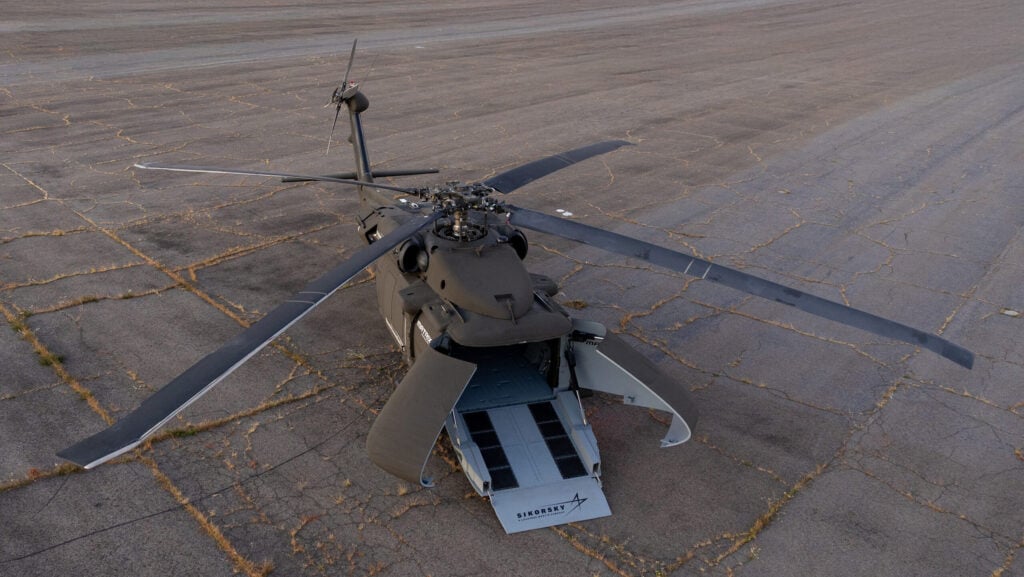
Parcella told journalists that the conversion can be done by integrating Matrix autonomy system into existing Black Hawks.
Bently described Matrix as a “non-aircraft specific autonomy system.”
“It was a co-development with the DARPA agency, and we have matured it over the last few years. We’re flying it on multiple different types of aircraft, from rotary wing to fixed wing to UAS aircraft, and we’ve got over 1,000 flight hours on our matrix autonomy system,” he said.
RELATED: Unmanned Black Hawk program in Army’s hands as ALIAS robo-helo takes likely last flight
He added that Matrix allows scalable autonomy, giving the operators multiple options.
“We can fly with two pilots in the aircraft. We can dial up the autonomy. We can fly with one pilot, so the autonomy provides a competent co-pilot, if you would, or we can dial it up all the way and be a fully autonomous system with no pilots in the aircraft,” he said.
The tech would need an export license for foreign conversions, Bentley said, something Sikorsky is working on now.
The UHawk, as unveiled at the Association of the US Army annual conference in the US in October, removes the pilot’s cockpit completely in favor of front-loaded storage space.
“[It] is a UAS with 10,000 pounds of payload capability, and really has a number of missions that it can undertake,” Parcella said.
Sikorsky officials said that flight testing of the UHawk will start by mid-2026 and anticipated production to start by the end of that year.
PHOTOS: Dubai Airshow 2025

 Gallery




Breaking Defense Video