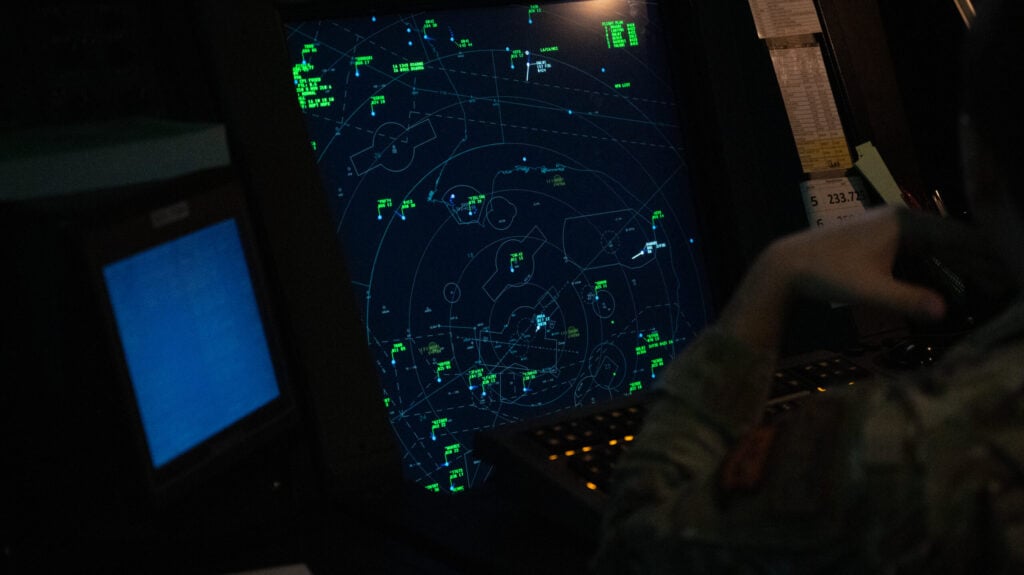
SPACEPOWER 2025 — The Space Force and the National Reconnaissance Office (NRO) are working to craft an acquisition strategy based on multiple contract awards for developing and fielding satellites that can track aircraft and drones, Air Force Secretary Troy Meink said today.
“The drivers we’re getting in the department is: deliver capability very quickly. So the focus is going to be on delivering AMTI [airborne moving target indication] capability very quickly. But we also have to make sure that we have a long-term strategy that goes with that. So we’re in the process of researching what that looks like,” he told reporters during the Space Force Association’s Spacepower 2025 conference here in Orlando.
“It’s going to be a competitive acquisition, probably be multiple awards to different contractors so we don’t end up with a single source. So that’s what we’re going through right now,” Meink added. “We’re gonna start building the capability pretty quickly.”
He explained that one of the challenges is that because the program is being jointly funded by the service and the spysat agency, it requires getting authorizations and appropriations from different congressional committees.
Chief of Space Operations Gen. Chance Saltzman said during the press briefing that there are also technical challenges to AMTI.
“So GMTI [ground moving target indication] and AMTI sound like they’re really close, just because one little letter that is all you changed, [but it] turns out they’re pretty different. What it takes to accomplish AMTI is different than what it takes to accomplish GMTI,” he said. “Things on the ground move slower than things on the air, so require different levels of fidelity tracks.”
Meanwhile, Meink said, the Department of the Air Force is working with Congress to address lawmakers’ concerns about the Trump administration’s plan announced in June to cancel the E-7 Wedgetail program in favor of a space-based system. The E-7 had been envisioned as a replacement the outdated E-3 Sentry Airborne Warning and Control System fleet, with Boeing winning a whopping $2.6 billion award last August for two rapid prototypes to be delivered by fiscal 2028.
Along with provisions aimed at preventing the Wedgetail’s termination, the fiscal 2026 National Defense Authorization Act (NDAA) would also authorize a total of $846.7 million to continue the radar plane’s development and procurement. The House passed the policy bill on Monday; it now is in the hands of the Senate.
Meink said the Air Force would complete the E-7’s “rapid prototype test” as directed by the NDAA.
In addition, he stressed that the Wedgetail “already is being flown by some of our allies and partners,” and the Air Force is “working with them to see how they fit into the production run going forward on each set of new capability that the rapid prototypes will bring on.”