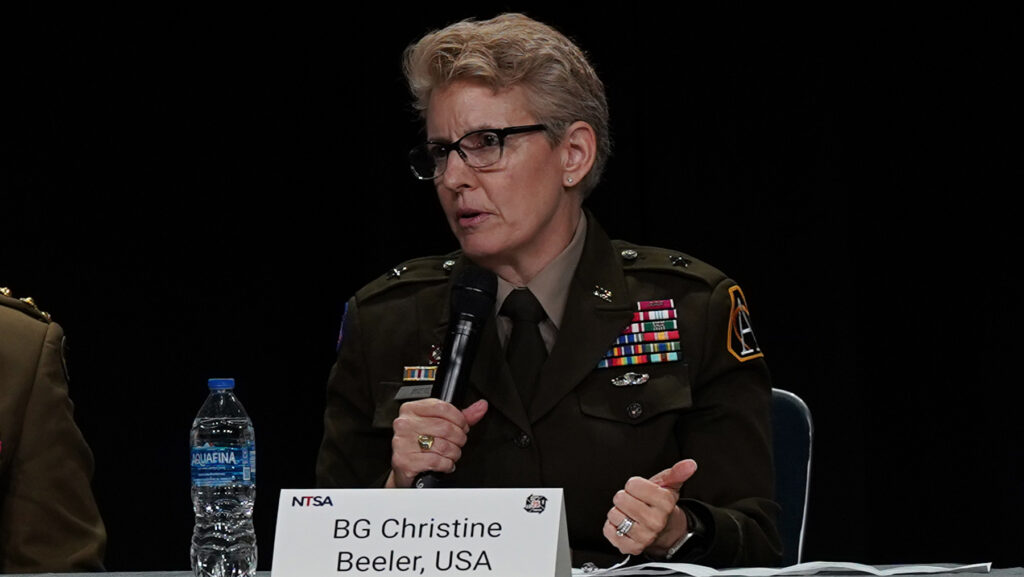
I/ITSEC 2025 — The Army’s recent, dramatic acquisition overhaul offers the service the chance to further modernize its digital network and break down “stovepipes” that had hindered other initiatives, including moving some capabilities to the cloud, according to a senior training and simulation official.
“[R]ight now we can’t take advantage of opportunity as fast as we would like, and I think that’s part of the challenge with the way things are kind of bucketed out,” Brig. Gen. Christine Beeler told Breaking Defense in an interview Thursday. “I’d like to be able to take advantage of moving to the cloud faster, putting training capability and training services in in the cloud, so that any soldier anywhere can pull that training down, platform agnostic.
“The work we do in simulating that and building those models and bringing that to life absolutely improves our lethality and our understanding in that space,” she added.
Beeler is the Army’s Capability Portfolio Executive (CPE) of Simulation, Training and Instrumentation (STRI), one of the organizations seeing an organizational change under Secretary of Defense Pete Hegseth’s acquisition reforms.
The reforms eliminate Program Executive Offices (PEOs) and instead created Program Acquisition Executive offices (PAEs). The new PAE for command and control and counter C2 comprises three former PEOs (which are now called CPEs): STRI; intelligence, electronic warfare and sensors; and command, control, communications and network. Under the new PAE, Beeler said CPE STRI will deliver “core services” such as simulation and “threat representation” to the network.
“So by putting us all under one PAE, we’re going to be able to break down those stove pipes and be able to synergize in that space instead of doing things separately — not that we weren’t coordinating before — but as a new PAE, the three CPEs will be able to see where there are advantages, disadvantages, where we can take great opportunities, and where maybe there’s some friction points that we need to reshow,” Beeler said at the I/ITSEC conference here in Orlando.
The reorganization of the Army’s acquisition offices aims to lessen the number of people in charge of requirements and combine offices who already shared some of the same capabilities and missions. The goal: Streamline the time it takes to deliver capabilities to the warfighter, Army Secretary Dan Driscoll told reporters when the Army’s restructuring was announced.
This will hopefully create more flexible pots of money, Beeler said, which will allow STRI to further push along its goals such as transitioning its simulation and training platforms to a fully cloud-accessible environment. Being able to access such tools from almost anywhere will ultimately enhance soldier lethality if successful, she said.
Beeler said in 2026 the Army will focus on working out some of the “friction points” in the acquisition transition, and in 2027, she hopes they’ll start to see real results like some of her cloud-transiting goals come to life as well as other goals leadership has set for the entire service.
Further, Beeler said that sometimes, especially with big acquisition pushes like the one happening now, the mission of STRI can get forgotten in the mix of bigger, flashier weapons systems programs.
“Training devices aren’t glamorous, right. Sometimes they’re not considered the most glamorous, but they are absolutely essential,” Beeler said. “I think now there’s more people who realize we’re not that different than anybody else, and we provide exponential value for the resources that are applied in this space.
“The way we’re looking at it is, we simulate the fight, we replicate the threat so that we can win in all domains,” she said.