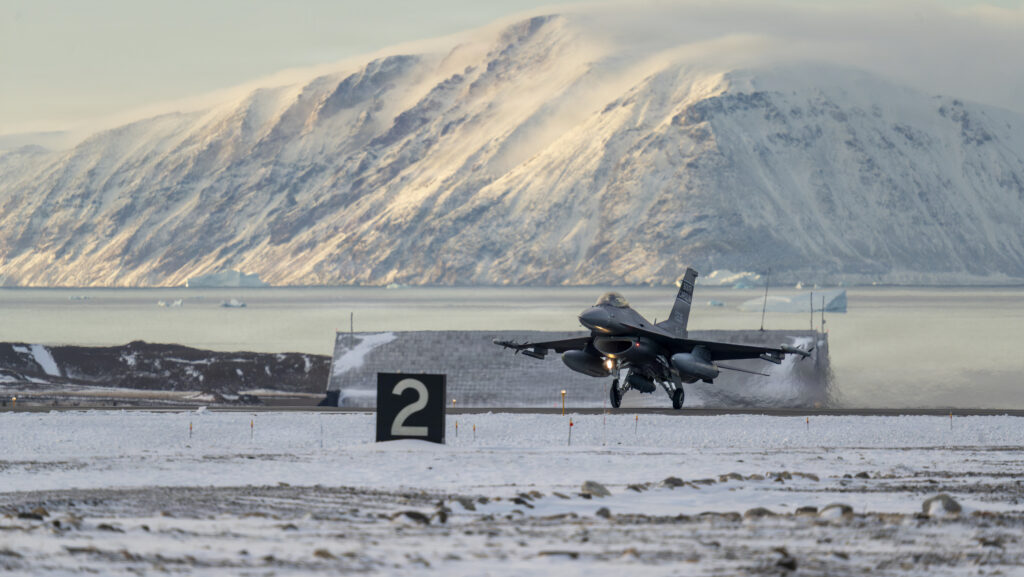
BELFAST — Denmark said its defense forces in and close to Greenland will be increased “from today” in partnership with NATO allies. The move, which Copenhagen says is in response to “security tensions” spreading to the Arctic, comes after days of rhetoric from the Trump administration focused on acquiring Greenland — a semi-autonomous island that sits within the Kingdom of Denmark.
“The purpose [of the increased troop numbers] is to train the ability to operate under the unique Arctic conditions and to strengthen the alliance’s footprint in the Arctic for the benefit of both European and transatlantic security,” noted a Danish Ministry of Defense statement.
“As part of the increased presence in the Arctic and the North Atlantic, the Danish Armed Forces are deploying capacities and units in connection with exercise activities from today, which will result in an increased military presence in and around Greenland of aircraft, ships and soldiers, including from NATO allies, in the coming period.”
Finland foreign minister Elina Valtonen stated today that the Nordic nation is assessing a request from Denmark to send troops to Greenland, according to local media. Additionally, Germany has agreed to deploy 13 troops to the island, per Reuters.
After the Danish announcement, Greenland’s foreign minister Vivian Motzfeldt and Denmark’s foreign minister Lars Lokke Rasmussen met at the White House with Secretary of State Marco Rubio and Vice President JD Vance for critical talks on the Greenland issue.
“The discussions focused on how to ensure the long term security in Greenland and here, our perspectives continue to differ,” Rasmussen told reporters. “I must say, the [US] President has made his view clear, and we have a different position. We, the Kingdom of Denmark, continue to believe that the long term security of Greenland can be insured inside the current framework, the 1951 agreement on the defense of Greenland, as well as the NATO treaty.”
Rasmussen also stressed that “ideas that would not respect territorial integrity of the Kingdom of Denmark and the right of self determination of the Greenlandic people are, of course, totally unacceptable.”
Should Washington seek to increase its presence in Greenland, he added, as set out in the 1951 defense treaty, “we would examine any such request.

How integrated modeling and simulation accelerates Europe’s defensive edge
Lockheed Martin’s ACES platform delivers a shared virtual battlespace that strengthens readiness, interoperability, and faster decision-making through advanced, integrated modeling and simulation capabilities designed for evolving global threats.
“We have been [for] a while in NATO, [calling] for a stronger collective role in Greenland, together with a number of allies. And we are eager to work with the US on advancing this agenda,” said Rasmussen.
Ahead of the meeting, Motzfeldt said, “Greenland does not want to be owned by, governed by or part of the United States. We choose the Greenland we know today — as part of the Kingdom of Denmark,” per a social media post from Danish ambassador to the US Jesper Møller Sørensen.
If the US was to cut a deal with Greenland to acquire the island, it would come with a price tag in the region of $700 billion, reported NBC News, citing three people familiar with the estimate.
Despite Washington not ruling out potential military action to take the territory by force, European analysts have said such a scenario is “unlikely” as diplomatic efforts to bring about a resolution take shape.
Danish Prime Minister Mette Frederiksen recently warned that a US attack on a NATO ally would spark the end of the alliance. During the Global Europe Forum in Brussels on Tuesday, NATO Secretary General Mark Rutte refused to comment on whether any allied country would support the US taking Greenland by force.
“[W]hen we talk about the security of the Arctic there is no disagreement within the alliance when it comes to that issue, and that is not only pertaining to the seven [countries] who border the Arctic,” he said.
Breaking Defense Video