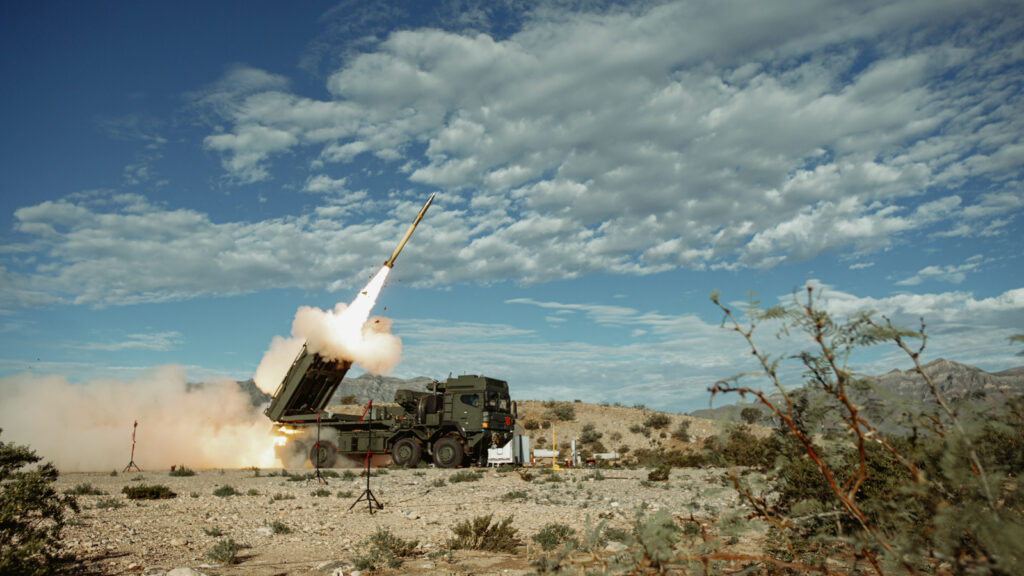
WASHINGTON — The Army has officially opened up four of its domestic testing ranges and one international range where private industry can blast off interceptor missiles they have developed with their own funds, in hopes of getting promising candidates into the acquisition pipeline faster.
Currently, defense companies, particularly smaller nontraditional vendors, often face wait times of up to 12 to 18 months to secure a spot on ranges — namely White Sands Missile Range — to test their systems, Secretary of the Army Dan Driscoll told reporters today.
“That is not sufficient,” Driscoll said. “If you look at what Ukraine has done so incredibly well, it’s this innovation through necessity and it’s innovation at the speed that is near or close to matching the commercial sector. So what we, the Army, are trying to do is break down every single barrier that we have put up over the last 20 or 30 years.”
Driscoll said the Army’s goal is to get companies onto testing ranges within 30 days of when they submit a request through a newly launched website which Driscoll said will provide “concierge access to every range.” Participating firms are expected to use Internal Research and Development (IRAD) money to develop their offers.
Maj. Gen. Patrick Gaydon, commanding general of Army Test and Evaluation Command, said the four domestic ranges open for IRAD testing are Camp Grayling in Michigan, Camp Shelby in Mississippi, Dugway Proving Ground in Utah, and West Cibola, which is an “unused part” of Yuma Proving Ground in Arizona. The location in Arizona is currently being used for IRAD funding at a small scale, Gaydon explained, but the initiative announced today expands its use.
The international range is the Multidomain Training Area hosted in Morocco, Driscoll added. He said a private start-up company, called Covenant Industries, successfully tested their Anthem missile there on Thursday.
Covenant executive Abby Denburg told reporters that the company is “preparing to begin delivering production-ready assets for our manufacturing line at the beginning of 2027 and put Anthem into the hands of the operators that need it.” Neither Denburg nor Driscoll would say if the Army was currently in contract negotiations with the firm.


Biodefense is force protection: Ready today, prepared for tomorrow
A decorated combat aviator and biotech CEO advocates preparing for novel viral threats before the next crisis.
The multidomain training center in Morocco is one of the “primary elements” of a new Africa Multidomain Training and Experimentation Center, created through a memorandum of understanding signed between US Africa Command and the Moroccan Royal Armed Forces last month.
Driscoll added that he hopes to work with other allied nations to gain access to additional testing ranges.
“In a perfect world […] this will continue to grow — double, triple, quadruple in the coming weeks and months. What we are hopeful for is that it’s not just American companies that can come in and [test] on these ranges, but it’s also allies, companies, and allied nations around the world, because that is how we and our allies will continue to outpace the threats that exist,” he said.
Beyond requiring companies to spend their own money on the interceptor development, Driscoll said the Army didn’t plan on subsidizing travel or other accommodations.
“The intent is not to artificially get companies who are not quite ready yet, whether they’re not in their funding journey far enough along, or that they have a good idea but haven’t quite gotten it to the place that it is ready to be tested. Those are not what we are talking about today,” he said. “What we are talking about today is the pent up demand.”
“There’s this concept in startup world — sometimes called escape velocity — where if you build a product and you bring it to the right market, what you want is you want so much demand to have just been sitting there, and all of a sudden your sales skyrocket, even if your product’s still in MVP [minimum viable product] stage, because it’s just been so necessary,” Driscoll continued.
The Army aims to “unleash escape velocity here,” he said.
UPDATED 8/10/26 at 11:20 a.m. ET to correct that Covenant is not based in California.
Breaking Defense Video