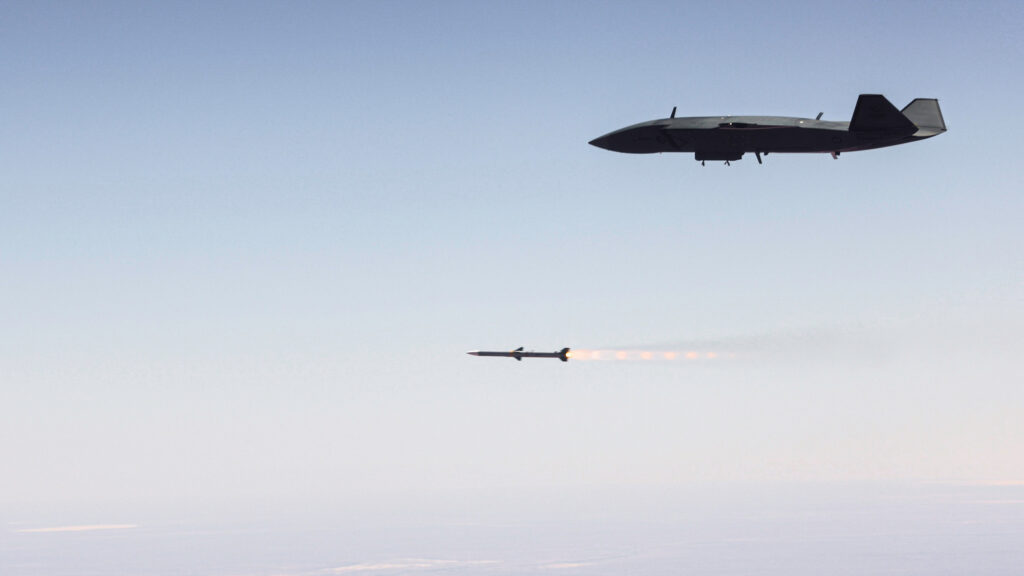
MELBOURNE — Canberra has green-lit a third tranche of the Australian-designed and -built MQ-28 Ghost Bat Collaborative Combat Aircraft from Boeing, an AUS $754 million (US$500.6 million) deal that will include several modifications to the design, including an internal weapons bay.
The new tranche will see Boeing deliver seven additional drones — six in the Block 2 configuration and the first Block 3 aircraft — over the next three years, to support the development of an operational capability by 2028 as well as supporting infrastructure under Australia’s AIR6015 Autonomous Collaborative Platforms – Air program.
Australia has previously ordered eight Block 1 and three Block 2 Ghost Bats, meaning when delivery of this tranche is complete, the Lucky Country will have 18 total MQ-28s.
Pat Conroy, the country’s Minister for Defence Industry, called the MQ-28 a world leading platform and the future of air warfare during a media conference announcing the contract.
“The future is here and the future is right now in Australia with Aussie made world-leading capabilities like the Ghost Bat,” he said.
Conroy also revealed during the contract announcement that the MQ-28 had engaged and shot down an aerial target at the Woomera range complex in southern Australia, an important milestone to show the drone’s capability.
Speaking during a separate media briefing detailing the engagement, Boeing’s MQ-28 Global Program Director Glen Ferguson said that the air-to-air engagement saw the MQ-28 working together with a Boeing E-7 Wedgetail Airborne Early Warning and Control Aircraft and F/A-18F Super Hornet multirole fighter of the Royal Australian Air Force (RAAF) to engage the aerial target with an AIM-120 Advanced Medium Range Air-to-Air missile.
He added that the development of the air-to-air capability for the MQ-28 took just over eight months, starting with a decision at the Avalon Airshow in March to the missile firing
The MQ-28 was flown semi-autonomously for the engagement and Colin Miller, Vice President and General Manager of Boeing Phantom Works, said during the briefing that the operator only issued four major commands during the flight: having the drone take off, conduct a combat air patrol, commit to an intercept on the target and clearing it to arm and fire on the target.
In a news release, Boeing said that all three aircraft involved launched from separate locations for the test, with an operator on board the E-7 took custodianship of the MQ-28 ensuring safety and engagement oversight, with the crew from the Super Hornet then teaming with the CCA in combat formation to provide sensor coverage.
Targeting data was shared across all three platforms after the Super Hornet identified and tracked the target, following which the MQ-28 adjusted its position and received authorization from the E-7A to engage and successfully destroy the target.
Ferguson did not disclose the type of target nor the engagement range, although he described it as “fighter representative target” engaged at an “operationally representative range.”
He added that the MQ-28 provided mid-course guidance of the missile during the engagement using an unspecified onboard electronic warfare sensor that was “effectively an AESA (Active Electronically Scanned Array radar) that has been specifically designed for a bunch of specialized functions.” However, Ferguson declined to elaborate on that system any further.
The engagement saw the E-7 operating somewhere between 100 to 200 miles behind the MQ-28, and although the Super Hornet flew alongside the CCA during the event, it could operate at much further distances away during real world operations, said Ferguson.
Colin Clark in Sydney contributed to this report.