WASHINGTON — Replicator lives, top Pentagon officials said today, though under a new name and with more of a focus on fielding larger attack drones.
Replicator was launched by Biden-era Deputy Secretary of Defense Kathleen Hicks and aimed to acquire thousands of low-cost ‘attritable’ drones, particularly for the Pacific, within two years. But the ambitious effort was met with criticism, including from lawmakers, and its fate was left in question, especially amid other drone initiatives announced by the new Trump administration.
But today Adm. Samuel Paparo, the four-star chief of Indo-Pacific Command, said Replicator is far from dead.
“It’s alive. It’s alive,” Paparo said at the Reagan National Defense Forum in California. “The deputy secretary of defense has focused it in an autonomous warfighting group, and it is very much alive.”
Paparo appeared to be referencing the Defense Autonomous Warfare Group (DAWG), which The Wall Street Journal first reported was the new home of the Replicator initiative.
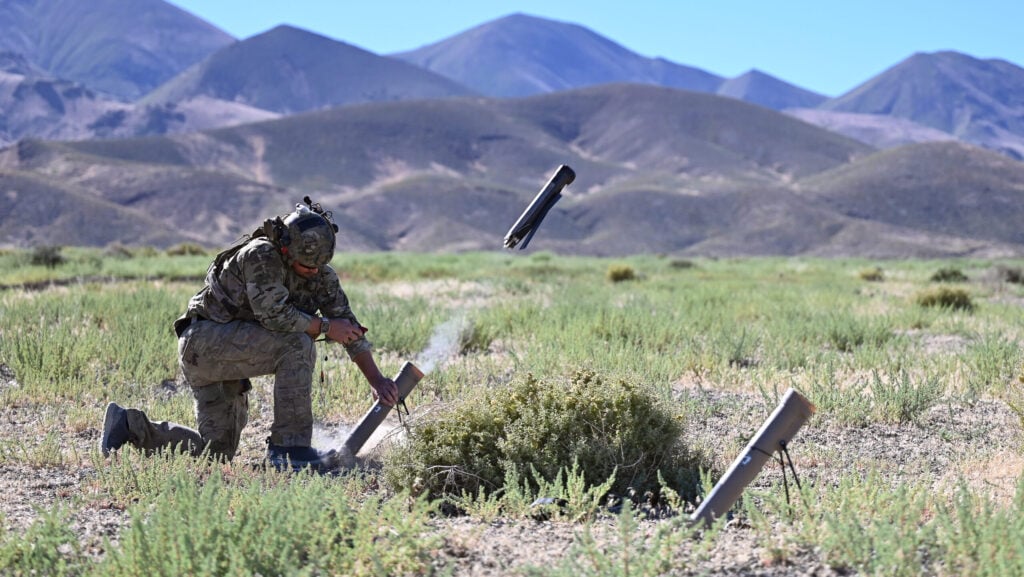
What does “alive” mean here? It means wargames, Paparo made clear: both live exercises with real equipment that exists today — conducted in locations safely distant from prying foreign eyes — and simulations of how the tech could help win a future fight.
“We are simulating to it,” Paparo said. “We’re exercising to it, live — not in any space in the Western Pacific, but in secure spaces where we can do our maximum learning.”
The renamed Replicator is specifically focused on larger types of drones, added the Pentagon’s Chief Technology Officer, Under Secretary for Research & Engineering Emil Michael. Meanwhile, in parallel, Defense Secretary Hegseth’s newer Drone Dominance campaign emphasizes smaller systems for use by small units, like the First-Person View (FPV) drones used to deadly effect in Ukraine.
(While Michael didn’t say so explicitly in the fast-moving panel discussion, military professionals and experts mostly agree that the vast expanses of the Pacific would require longer-ranged and therefore larger drones than the knife-fight distances of the Ukrainian front).
“We have embarked on a Drone Dominance initiative … funded by Congress, and that’s for smaller drones,” Michael said, speaking alongside Paparo at the Reagan Forum. “What we’re working on with Adm. Paparo and the [Defense] Autonomous Warfare Group is larger drones, one-way attack drones.
“We have to be dominant in both. We can be dominant in both,” Michael continued. “What we’ve learned from the Ukraine-Russia war is that the front lines of a conflict over territory are robot-on-robot now.”
There’s a third imperative in this domain as well, the R&D chief added: counter-drone defense — especially for the US homeland, and above all for high-profile events like the 2026 World Cup and the 250th anniversary of the Declaration of Independence.
“We’ve got to make sure those sites are protected,” Michael said. “So we have to have a robust small-drone program, a robust large-drone program, and even more robust counter-drone program.”
RELATED: Three reasons why defense is beating offense in Ukraine – and why it matters for Taiwan
The good news here for the US and its allies, Paparo argued, is that the proliferation of drones and other advanced technologies is shifting the balance of power from aggressors to defenders. By whatever name, the DAWG/Replicator effort aims to capitalize on that strategic shift.
“It’s been renamed from Replicator, but the quality of it is the same,” the admiral said. “In some spaces you need not fight for air or maritime superiority. All you need do is deny it to another.”
Paparo’s (somewhat opaque) comments here need to be understood in context of an epochal shift in American strategic thinking: After three post-Cold War decades of seeking absolute “dominance” over air, land, and sea in places like Afghanistan and Iraq, the US military is looking at more formidable adversaries and realizing it doesn’t have to dominate them, just deny them their objectives. Kyiv and its allies don’t have to march on Moscow: They win if Russia can’t conquer Ukraine. Taipei and its allies don’t have to burn Beijing: They win if China can’t conquer Taiwan. Once Pentagon analysts looked at long-range, high-tech, multi-layered defenses — what insiders clunkily called Anti-Access/Area Denial — primarily as a barrier to US operations; now they’re realizing the US can use “A2/AD” to protect the Free World.
“This gets back to that … changing character of warfare,” Paparo said. “The commoditization of drones has made assault more costly. … Having the kind of capability, that can be quickly deployed in that space and make assault cost-prohibitive, will inherently benefit a denial defense and will inherently benefit a state that does not care to have another state…change the facts on the ground with force.”