Readers, 2026 in the Middle East and North Africa is expected to be a year of prospective fighter jet deals, a push for air and missile defenses, and — possibly — a step toward peace talks between Arab states and Israel.
While all eyes are on fifth-generation fighter jets, efforts to bring the US-built F-35 to the United Arab Emirates and Turkey remain tangled. Hurdles in the UAE deal include its use of China’s Huawei network, which the US views as a security threat. And Turkey’s purchase of Russian S-400 air defense systems, which the US has argued can gather data on the F-35 that could help Moscow target them, continue to complicate Ankara’s quest to fly the stealth fighter.
The UAE might turn to different sources to procure a fifth-generation fighter jet, like South Korea’s KF-21 Boramae that was reportedly included in a $15 billion arms package offered to Emirati officials.
[This article is one of many in a series in which Breaking Defense reporters look back on the most significant (and entertaining) news stories of 2025 and look forward to what 2026 may hold.]
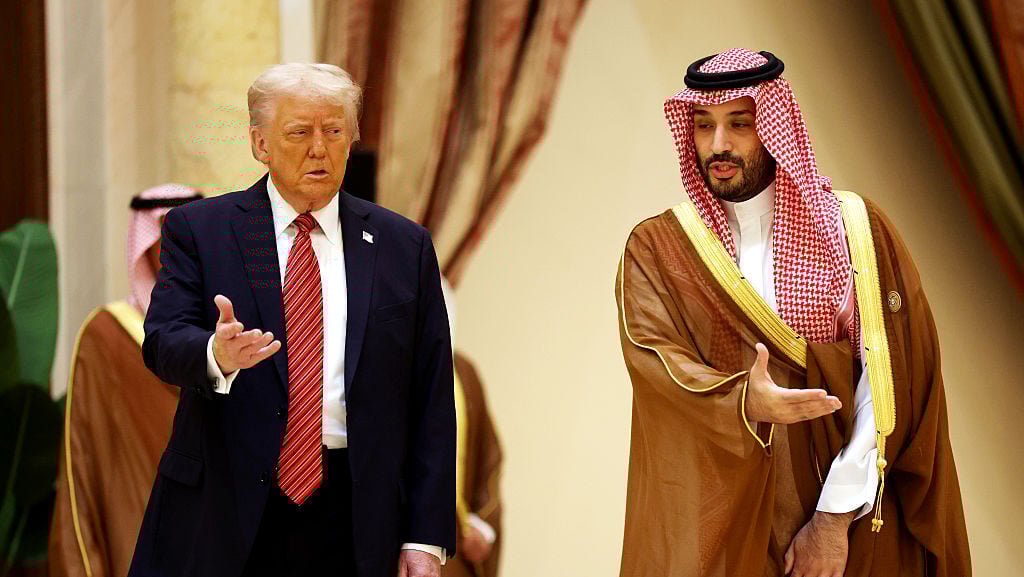
Instead, the Kingdom of Saudi Arabia could become the first Arab nation to join the F-35 program. In November, the White House said it would allow Riyadh to purchase an unspecified number of F-35s, granting its long-sought access to the coalition. The Saudis may ink a letter of intent formalizing the announcement and the deal must still be approved through official channels.
Earlier this month, Turkey’s Foreign Affairs Minister Hakan Fidan said that Turkey and the US would find a way to remove sanctions levied by the US Congress under the Countering America’s Adversaries Through Sanctions Act (CAATSA) very soon. Turkish President Recep Tayyip Erdogan has asked Russian President Vladimir Putin to take back the S-400 missiles, potentially smoothing the path to membership in the F-35 club once again.
“The United States is in ongoing discussions with Türkiye regarding their desire to rejoin the F-35 program and their possession of the Russian-made S-400 air defense system,” US Ambassador to Turkey Tom Barrack said Dec. 9 on social media.
A breakthrough could solve a considerable number of Turkey’s problems: the F-35 might fly high in Turkish airspace, and eventually, a separate deal for F-16 fighters that had stalled as well as Ankara’s pursuit of US-made engines for its homegrown fifth-generation KAAN fighter jet could move forward.
Turkey has made large strides toward creating its locally built KAAN fleet, but only has the engines to operate the prototypes. If the imported General Electric F110 turbofan engines aren’t delivered from the US on time, the Turkish air force will receive its first KAAN later than originally expected in 2028. That could delay the program until 2032, by when the Turkish-made TEI engine is slated to be ready.
Ankara also views its envisioned layered air and missile defense system, Steel Dome, as a possible solution for gaps in its neighboring countries’ missile defenses. A large production facility is expected to be operational by early 2027.
Gulf states — especially after the Israeli strike on Qatar — have started to dive deeper into their integrated missile defense platforms and capabilities, and have revived the Gulf Cooperation Council’s collaboration on intelligence sharing, early missile warning and joint defense plans. The upcoming year might see the actual implementation of data-sharing networks amongst all six Gulf states.
Arab states in 2026 will look closely at how the US fulfills its commitment to the region — especially the practical implications of a major US-UAE defense partnership, US President Donald Trump’s executive order to assure the security of Qatar, and the US-Saudi strategic defense agreement.
And when it comes to the Levant, expect the unexpected. Announcements in 2025 paved the way for a security agreement between Israel and Syria, with pressure on Israel to withdraw from Syrian territory it entered in December 2024. Historic direct negotiations between Lebanon and Israel are expected to continue as well. But they may not be enough to ward off a larger conflict, especially if Hezbollah continues to resist disarmament.
Breaking Defense Video