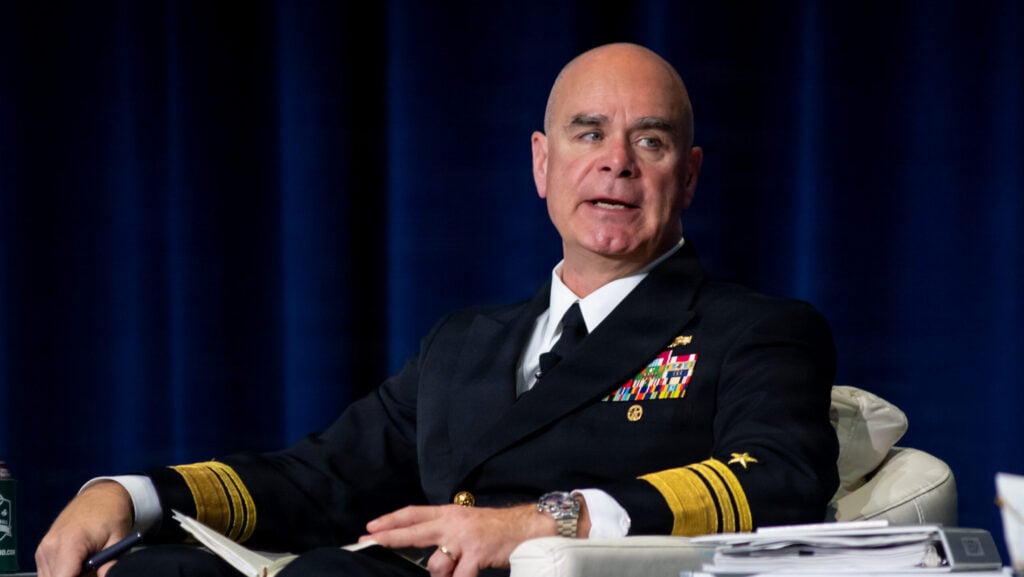
WEST 2026 — The Navy will start experimenting with new pairings of unmanned vessels and carrier strike groups this year as it tests its new tailored force approach, the service’s top surface warfare officer said.
Vice Adm. Brendan McLane told reporters here at the annual WEST conference that a medium unmanned surface vessel (USV) will deploy alongside the aircraft carrier Theodore Roosevelt and its strike group that is set to get underway later this year.
The Navy will evaluate how that pairing works, and then assess what other mission packages can be partnered together for the next carrier strike group, McLane said.
“I think the important thing for us is to start getting into the rhythm of we’re going to do this for every strike group now, and we’re going to learn something different with every strike group,” McLane said today. “And that is super exciting, particularly for some of our younger sailors who are really into this.”
He added that the service is considering in the future coupling a small USV — like a global autonomous reconnaissance craft (GARC) — that conducts reconnaissance missions with a ship like the Independence-class littoral combat ships, and then launch and recover them together.
“I think that’s the next step for us to learn from,” McLane said.
The experiment aligns with Chief of Naval Operations Adm. Daryl Caudle’s “Fighting Instructions,” which he rolled out Monday, laying out a framework to supplement carrier strike groups with customizable forces and provide combatant commanders fresh, mission-specific formation patterns.
Included in Caudle’s Fighting Instructions are plans to execute a “hedge strategy” that seeks to capitalize on unmanned systems and provide a range of tailored options that seeks to give the Navy greater flexibility to respond to a variety of scenarios.
Caudle signaled he would release plans to advance this hedge strategy at the Apex Defense conference in January, claiming the initiative would employ smaller forces specifically designed to address certain missions that don’t require a full carrier strike groups.
“If I had a lot of strike groups, I could place these things all over the world,” Caudle said in January. “But we don’t have enough, [and] as you think about these various missions around the world — whether it be choke point defense or protection, sea lines of communication, anti-submarine warfare, ISR, maritime domain awareness — I just, quite frankly, don’t need a strike group to do all those.”