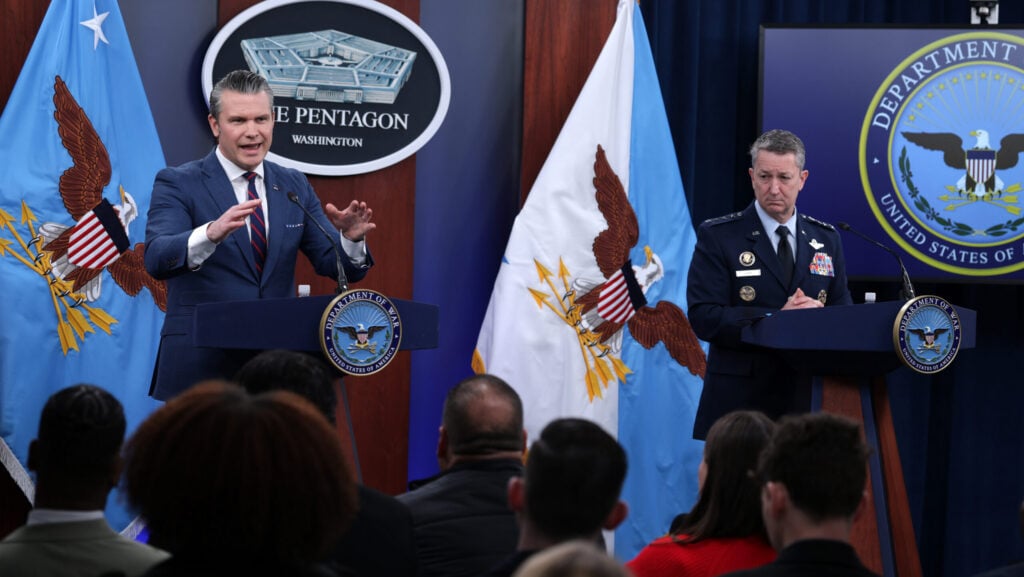
WASHINGTON — More than 48 hours after the US and Israel launched large-scale combat operations against Iran, senior Pentagon leaders held a media briefing where they stated America’s broad goals, but largely sidestepped details about how to get there.
“Our military objectives are clear,” Chairman of the Joint Chiefs of Staff Gen. Dan Caine told reporters. “Our mission is to protect and defend ourselves, and together with our regional partners, prevent Iran from the ability to project power outside of its borders and be ready for follow on actions as appropriate.”
Defense Secretary Pete Hegseth added that the ultimate goal was to prevent Iran from building a nuclear bomb, stating: “Iran was building powerful missiles and drones to create a conventional shield for their nuclear blackmail ambitions. Let me say that again, a conventional shield for their nuclear blackmail ambitions — our bases, our people, our allies — all in their crosshairs.”
US President Donald Trump posted a couple of videos about the weekend US-Israel operation and individually spoken to some reporters, but besides some posts on social media, Pentagon leaders largely remained silent over the weekend. Hegseth and Caine broke that silence today during a briefing on Operation Epic Fury with a group of hand-selected reporters.
While the briefing lasted just over 40 minutes, the duo veered away from directly answering a number of basic questions, including on how long US troops may be in the direct line of fire for this operation.
Although Trump told the New York Times on Sunday that operations could last four to five weeks, Hegseth called that a “gotcha type question.” That timetable, Hegseth added, could “move up, it could move back. We’re going to execute at his command the objectives we’ve set out to achieve.”
Further adding to the confusion on timeline, Trump subsequently told an audience later today: “We’re already substantially ahead of our time projections, but whatever the time is, it’s okay. Whatever it takes, we will always and we have from right from the beginning. We projected four to five weeks, but we have capability to go far longer than that. We’ll do it.”
Caine also deflected answering a question on how many US military members are in theater directly supporting Operation Epic Fury.
“I don’t want to talk specifics because that would tip the enemy off,” Caine said. “We have more tactical aviation flowing into theater just based on the time it took to get it out there. I think we’re just about where we want to be in terms of total combat capacity and total combat power.”
As for US troops inside Iran, Hegseth said there are not currently boots on the ground but said that could change. “We’re not going to go into the exercise of what we will or will not do.”
Initial Hours
While Caine did provide a broad rundown of how the initial hours of Operation Epic Fury unfolded, he veered away from the level of specificity he provided in the wake of Operation Midnight Hammer in June 2025.
After weeks of building up the US force presence in the region to include the USS Gerald R. Ford (CVN-78) and Abraham Lincoln carrier strike group, as well as additional fighter jets and support aircraft, Trump gave the go-ahead at 3:38 p.m. Eastern Standard Time on Friday.
“The president directed, and I quote, ‘Operation Epic Fury is approved. No aborts. Good luck.’” Caine added.
“The first movers were US CYBERCOM and US SPACECOM layering non-kinetic effects, disrupting and degrading and blinding Iran’s ability to see, communicate and respond,” the four-star general later added.
Then at 1:15 am EST on Saturday “the skies surged to life” when more than 100 aircraft launched from land and sea for a “single synchronized wave.” Caine said.
“This was a daylight strike based on their trigger event conducted by the Israeli Defense Forces, enabled by the US intelligence community, the first shooters at sea were Tomahawks unleashed by the United States Navy closed in on Iranian naval forces and began to conduct strikes across the southern flank,” he added.
On the ground, US forces fired a barrage of weapons and, in total, the Pentagon estimates that more than 1,000 targets have been hit.
“We are now roughly 57 hours into the operation in the initial phase. CENTCOM’s focus was systematic targeting of Iranians, command and control infrastructure, naval forces, ballistic missile sites and intelligence infrastructure designed to daze and confuse them,” Caine added. “Coordinated space and cyber operations effectively disrupted communications and sensor networks across the area of responsibility, leaving the adversary without the ability to see, coordinate or respond effectively.”
So far, the Pentagon has announced the deaths of four US service members participating in the latest operations, and said that three US F-15E Strike Eagles went down over Kuwait due to a friendly fire incident.
“I am grateful for the safety of the crews, and we know that this was not from hostile enemy fire,” Caine said.