
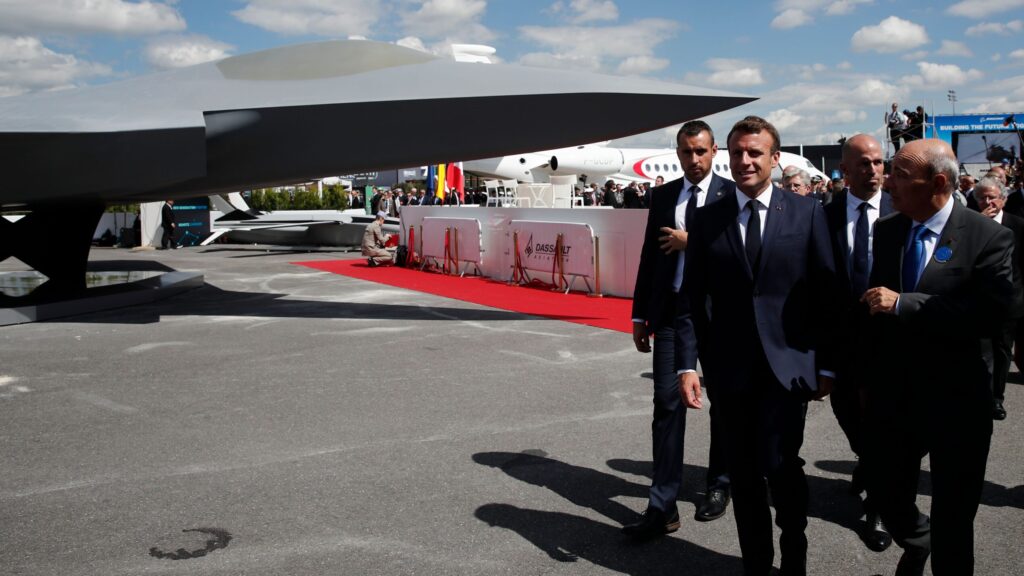
PARIS — France still believes in the faltering Future Combat Air System (FCAS) project with Germany, the CEO of jet-maker Dassault Aviation said today, but the company is willing to proceed with another industrial team if sharp disagreements with Airbus cannot be resolved.
“We will find other partners if we need to,” Eric Trappier told reporters. “But it’s not up to me to choose their nationality; it’s up to the French authorities to approach other countries to see if they’d like to collaborate on developing a future combat system.”
Trappier bluntly said that “if Airbus maintains its position of not wanting to work with Dassault, then the project is dead.”
Trappier went on to push back against comments from German Chancellor Friedrich Merz, who said last month that Berlin needed different capabilities than Paris in a sixth-generation fighter system, the strongest indications yet Germany is turning the page on FCAS.
“France does not support the idea of two aircraft,” Trappier said today. “I have heard from the highest levels of my [French] authorities that ‘no, no, no, no, the operational requirements are identical,’ or at least there is agreement at the operational levels.”
RELATED: FCAS? GCAP? Tempest? Explaining Europe’s sixth-generation fighter efforts
French President Emmanuel Macron said something similar during a trip to India where France is negotiating a contract for New Delhi to acquire scores of fourth-generation fighter jets. Europeans, Macron said, “should have a common model” and adding that the “normal” friction between industrial partners should not “decide the strategy of nations.”

Europe’s military advantage depends on sovereign command of the ground truth
As NATO and European governments accelerate investment in space-based intelligence, decision advantage will depend on how quickly sovereign and commercial capabilities can be fused into a trusted operational picture.
“Is it the best use of our money to develop several planes? We must have a European standard,” Macron said.
Trappier said today that when it comes to the governments’ disagreements, he didn’t know who was right. But the friction between his company and partner Airbus was on full display.
Trappier said Dassault has “no problem with Germany, indeed we have other partnerships with the Germans,” but he said it was Airbus that was not respecting the initial FCAS contract. That contract, Trappier contended, included not only the development of the next-generation fighter jet known as the Next Generation Fighter (NGF) but also drone wingmen and a “combat cloud” communications network.
Dassault, he said, was put in charge of the fighter jet, while Airbus was responsible for the rest.
“Dassault believes that in order to be efficient there must be a real leader who decides that this sub-contractor is proficient, or not. Who decides on the forms of the aircraft, who takes the responsibility of then putting it in the air,” he said.
He said he understood that Airbus might not like that arrangement but he could not agree to a “co-co-co” leadership approach. Trappier noted that Dassault would be a sub-contractor of Airbus for developing and building the drone wingmen “and that doesn’t worry us at all.”
Airbus declined to comment for this report, but in the past the company has been less public about problems in the program.
In June, after Trappier publicly pushed for more control over the program, Jean-Brice Dumont, head of air power at Airbus Defence and Space, acknowledged “tensions,” but said Airbus remained “committed” to FCAS. It was already too late, he said, for Airbus to jump over to a rival European sixth-generation fighter jet program called the Global Combat Air Program (GCAP) run by the British, Italian and Japanese.
Should FCAS fully fracture, an industry source previously told Breaking Defense that long-term industry planning could involve the development of two fighter airframes – one developed by France and the other by Germany with the third current FCAS partner, Spain.
Paul Taylor, senior visiting fellow in defense and security at the Belgian-based European Policy Centre think tank, told Breaking Defense last month, “My sense is that it’s been clear for a year or two that FCAS is dead, it just won’t lie down, because it’s a political project.”
Whatever FCAS’s future, Dassault’s annual financial figures show it is doing just fine. Today the company announced its value has risen nearly 27 percent since the start of the year.