WASHINGTON — The day after Spain announced it was closing off its airspace to US planes involved in the Iran war, senior US officials seemingly called into question a fundamental pillar of the NATO alliance: collective defense.
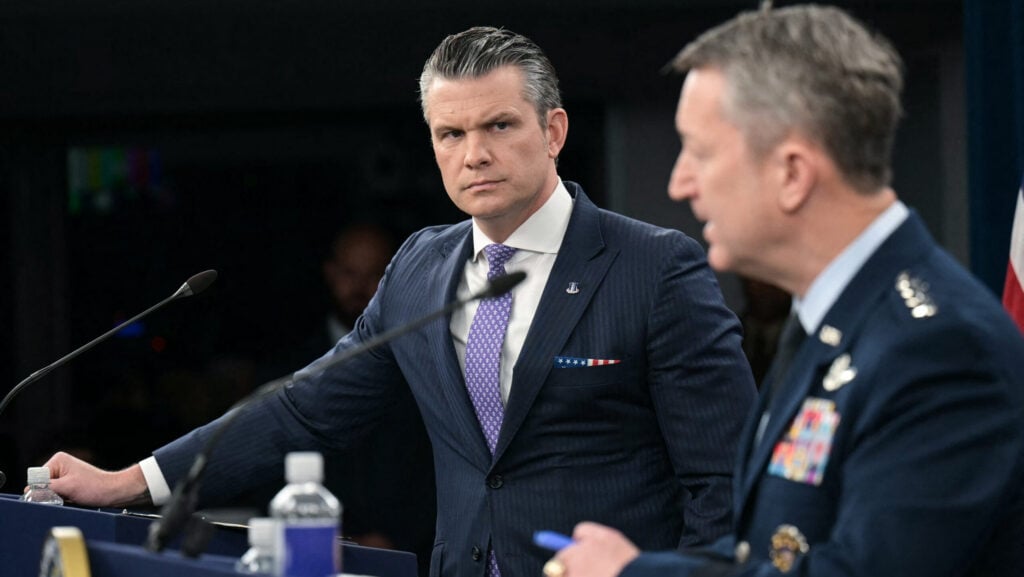
“A lot has been laid bare, a lot has been shown to the world about what our allies would be willing to do for the United States of America,” Defense Secretary Pete Hegseth told reporters inside the Pentagon today. “When we undertake an effort of this scope on behalf of the free world, these are missiles that don’t even range the United States of America, they range allies and others and yet, when we ask for additional assistance or simple access… we get questions or roadblocks or hesitation.”
Hegseth’s comments came just shortly after his boss, President Donald Trump, used social media to take aim at allies and partners — and especially the United Kingdom — not sending military assistance to the region to help with protecting vessels inside the Strait of Hormouz. Despite pressure from Washington, British Prime Minister Keir Starmer has resisted calls to join the war in Iran, opting to approve defensive operations only, although he has authorized the US to use its bases for Iranian strikes.
“I have a suggestion for you: Number 1, buy from the U.S., we have plenty, and Number 2, build up some delayed courage, go to the Strait, and just TAKE IT,” Trump wrote on Truth Social this morning.
“You’ll have to start learning how to fight for yourself, the U.S.A. won’t be there to help you anymore, just like you weren’t there for us,” he added. “Iran has been, essentially, decimated. The hard part is done. Go get your own oil!”
The comments also follow a statement made by Secretary of State Marco Rubio to Al Jazeera — which were then shared by the State Department on social media with an “alert” emoji — that indicated more trouble for Article 5, which has only ever been invoked once, when the US called on its allies in the wake of the 9/11 attacks.
“If NATO is just about us defending Europe if they’re attacked, but then denying us basing rights when we need them, that’s not a very good arrangement. That’s a hard one to stay engaged in and say this is good for the United States,” Rubio said in his Monday interview. “So all that’s going to have to be reexamined. All of it’s going to have to be reexamined.”
Trump’s comments questioning the strength of NATO’s Article 5, the key collective defense clause, date back to the first Trump administration. More recently, he has raised it on multiple occasions including around the proposed Greenland acquisition. But the US-Israeli war in Iran has seemingly increased tensions between Europe and its ally in Washington.
The Strait of Hormuz also remains a logjam for vessels carrying fuel and other cargo, and for the most part, NATO partners have declined to send help to help those vessels transit the waterway. However, the UK has now agreed to let the US use its bases to launch strikes on Iranian sites targeting the strait.
Rubio and Hegseth’s comments seem particularly directed at Spain, where the government was already barring the US from using jointly operated military bases for the conflict but took another step on Monday by announcing that its airspace was now off limits to US aircraft involved in those operations.
“This was made perfectly clear to the American military and forces from the very beginning,” Spain’s defense minister Margarita Robles said. “Therefore, neither the bases are authorised, nor, of course, is the use of Spanish airspace authorised for any actions related to the war in Iran.”
Additionally, it was reported this week that a US military aircraft bound for the Middle East was denied approval to land in Sicily. However, posting on X, Italy’s defense minister Guido Crosetto pushed back on claims that the US was barred from using local airbases, with the government saying instead the issue was the flight did not request approval to use the base in time — a bureaucratic, rather than policy issue.
This all comes against the backdrop of the ongoing question of when the US will decide its objectives have been completed in Iran, and just what those objectives are.
Chairman of the Joint Chief of Staff Gen. Dan Caine today said those operations continue to “degrade and destroy” Iran’s ability to “project power” outside its borders. At the same time there is a steady build up of US ground troops in the region to include thousands of soldiers from the US Army’s 82nd Airborne Division and about about 2,500 Marines, according to reports.
There are also increasing reports of hits on sensitive US targets in the region including on an Air Force E-3 Sentry AWACS command and control aircraft at the Prince Sultan Air Base, Saudi Arabia.
Tim Martin in Belfast contributed to this report.